
Refrigerated Prep Table Repair in Dripping Springs, TX
A prep table where the top pans sit above 41 degrees, a sandwich unit that ices the coil every night, a drawer base that will not hold through a dinner rush, or a table that just cost you an inspection finding. TakiDA services refrigerated prep tables, sandwich units and chef bases for restaurants, taprooms, event venues and catering kitchens across Dripping Springs and the surrounding Hill Country. EPA Section 608 Universal certified and insured. Commercial diagnostic $149, applied toward the repair.
Call (737) 388-3867 | Request a visit
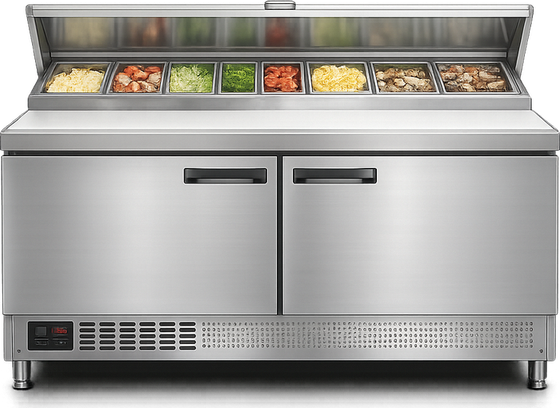
Prep Table Symptoms We Sort Out
The top pans are warm while the base is cold
Common causes. This is the signature prep table failure. An evaporator fan that has quit, pans seated wrong so the air channel is blocked, a missing rail gasket, or a low refrigerant charge showing itself first at the warmest point in the box.
What we do. We measure product temperature at the pan rather than reading the dial, confirm each evaporator fan is turning, check the rail seals and pan fit, and only then take refrigeration readings. Most of these calls end in airflow, not refrigerant, and that distinction is the difference between a moderate repair and an expensive one.
The coil ices up and the unit stops cooling
Common causes. A failed defrost timer or termination thermostat, a low charge, a drain line frozen shut, or lids and doors left open in a humid kitchen all day.
What we do. We verify the defrost cycle actually runs and terminates, measure heater current where fitted, and clear the drain. A table that ices every night has a defrost fault or a humidity problem, and clearing ice without finding which one just resets the clock.
The unit runs constantly and never cycles off
Common causes. A condenser packed with kitchen grease and dust, a unit installed next to a fryer or oven with no clearance, torn door and drawer gaskets, a low charge, or a failing compressor.
What we do. We measure air temperature at the condenser intake, clean the condenser properly, check every gasket, and then read pressures. A prep table beside a cook line pulls hot greasy air all shift, and that is the most common reason one works itself to death.
It will not hold temperature during a rush
Common causes. Warm product loaded straight into the pans, lids off through service, a marginal charge, a weak condenser fan, or a unit undersized for your volume.
What we do. We watch the recovery rate after a door cycle and compare it against what the unit should do. If it recovers properly, we will tell you honestly that the problem is loading practice, and if it does not, we find out why. Either way you get a measurement.
Water pooling in the base or on the floor
Common causes. A blocked or improperly pitched condensate drain, a cracked drain pan, a frozen drain line, or condensation from a failed gasket.
What we do. We clear and re-pitch the drain, replace the pan or gasket, and address whatever iced the line. Water under a prep table is an inspection finding and a slip hazard in the tightest part of the kitchen.
The drawers or doors will not seal
Common causes. Torn or hardened gaskets, bent drawer slides, a sagging door, or a hinge that has lost its spring so the door rests open a fraction.
What we do. We replace gaskets, slides and hinges and set the closures so each one seats. Gaskets are the highest-return repair on any commercial refrigeration, because every hour of leaking seal is runtime you pay for and temperature you cannot hold.
The compressor is loud, hot or will not start
Common causes. A failed start capacitor or relay, worn mounts, liquid floodback from a defrost fault, or an internal winding failure.
What we do. We test the starting components and read winding resistance before condemning anything, and we measure running current against the nameplate. The compressor is the most expensive part in the unit and we do not name it as the fault on a hunch. On a sealed-system suspicion we kill the compressor and watch the low side: climbing pressure says restriction, a pull into vacuum says the charge is gone.
The thermometer and the controller disagree
Common causes. A failed or badly positioned probe, a controller set up wrong on a previous service call, or a loose sensor connection.
What we do. We check each probe against a measured temperature and reposition any that were left hanging in the airstream instead of reading the box. A display that looks fine while a thermometer disagrees is a probe problem, and that is how a table passes its own self-check and fails an inspection.
Prep Tables We Work On
Sandwich and salad prep tables, pizza prep tables with raised rails, mega-top units, refrigerated drawer bases and chef bases, undercounter work tops, and both self-contained and remote condensing designs. We service True, Turbo Air, Traulsen, Continental, Beverage-Air, Hoshizaki, Avantco and Atosa equipment for restaurants, bars and taprooms, event venues, bakeries and catering kitchens.
What a Prep Table Repair Costs
The commercial diagnostic is $149 and it is credited toward the repair when you approve it. Gaskets, evaporator and condenser fans, defrost components, probes, drain repairs and a proper condenser cleaning are the moderate end, and they resolve most of these calls. Leak repair with evacuation and recharge or a compressor replacement is the expensive end, and on an older table we will give you the repair number against a replacement. You get a written estimate with parts, labor and tax before any work starts, and it stays good for 30 days. Labor carries a 3 month warranty and installed parts carry one year against manufacturer defects. All sealed-system work is performed under EPA Section 608 certification.
Where We Work in Dripping Springs
We cover Dripping Springs and the businesses around it, from the restaurants and taprooms along Mercer Street to the wineries, distilleries and event venues out along Ranch Road 12 and Highway 290 West, plus the retail along the 290 corridor. Nearby Driftwood, Henly and Wimberley are inside our normal route, and Bee Cave, Lakeway and Austin are a short run from here.
Frequently Asked Questions
Our prep table keeps failing inspection. Does it need replacing?
Often no. The most common causes are a dead evaporator fan, a missing rail gasket, pans loaded wrong, or a filthy condenser, and all four are affordable fixes. We measure at the product line and tell you which it is before anyone talks about a new table.
Does it matter that the table sits next to the fryer?
It matters a lot. The condenser pulls in hot, grease-laden air, loses capacity, and the compressor runs far longer than it should. Where the layout cannot change we will at least tell you how often that condenser realistically needs cleaning.
How often should the condenser be cleaned?
In a working kitchen, quarterly is realistic, and monthly if it sits on a cook line. It is the cheapest thing you can do to keep a prep table alive.
How fast can you come out?
Commercial calls take priority and same-day is usually possible. A table with product at risk gets treated as urgent, and we will tell you on the phone whether you should move inventory before we arrive.
Book Prep Table Service in Dripping Springs
Tell us the brand, the table type, the temperature you are reading at the pans, and how fast it drifts, and we will come prepared for the sealed system as well as the simple causes.
Refrigerated Prep Table Repair in Dripping Springs, TX
-

What Brings Us Out to a Prep Table
- Pans warm by the middle of a shift
- Base cold while the rail is not
- Frost sheet forming on the coil
- Compressor never shutting off
- Water collecting in the bottom of the base
- Lid not closing down on the gasket
- Readout not matching a thermometer
-
Prep Tables We Cover
- Sandwich and salad prep tables
- Pizza prep tables
- Mega top units
- Undercounter refrigerated bases
- Gasket, hinge and lid work
- True, Turbo Air, Beverage-Air
- Delfield, Continental, Traulsen

Prep Table Brands We Service in Dripping Springs
If your brand is not listed, contact us — we likely service it.
Why Homeowners & Businesses Choose TakiDA
-
 Quality WorkWe deliver professional appliance repair with attention to detail, proper diagnostics, and long-lasting results you can rely on.
-
 OEM / High-Quality PartsWe use OEM or high-quality replacement parts to ensure correct operation, reliability, and extended appliance lifespan.
-
 Same-Day / Next-Day ServiceFast response with same-day or next-day service to reduce downtime and get your appliances back in working order quickly.
-
 Clear PricingUpfront estimates with transparent pricing. No hidden fees, no surprises — you know the cost before work begins.
-
 EPA Certified & InsuredEPA Section 608 Universal certified and fully insured for residential and commercial repair, giving you peace of mind and protection.
-
 Warranty on Labor & PartsAll repairs are backed by a warranty on labor and installed parts for added confidence and long-term reliability.
