
Refrigerated Prep Table Repair in Leander, TX
A prep table that drifts above 41°F during service is a health-code problem that nobody notices until an inspector does. We repair refrigerated prep tables, sandwich and salad units, sushi cases and pizza prep tables for restaurants and delis across Leander and the surrounding area. The $149 commercial diagnostic goes toward the repair, and you get a firm price before any part is replaced.
Common Prep Table Problems in Leander Kitchens
A prep table is judged against one number: the FDA Food Code requires cold-held product at 41°F or below, and an inspector who finds the ambient rail above that writes it up whatever the food itself reads. The manufacturers design to 33 to 41°F in the rail and the cabinet, and most of the faults below are about why that window has slipped.
The rail will not hold 41°F
Common causes. A rail that has drifted from the high thirties into the mid forties is the single most common prep table call, and the cause is usually a condenser or evaporator coil that has loaded up with grease and dust. Kitchens are dirty environments and these units sit low, where everything settles. Beyond coils it is airflow in the rail, a failing fan, a drifted sensor, a door gasket on the cabinet below, or a charge problem.
What we do. We measure at the warmest pan position during service rather than at the display, clean and inspect the coils, confirm fan operation, and take pressures if the cooling side is genuinely short. A table that recovers to specification after a coil clean did not need a part, and we will tell you that rather than selling one.
The rail is cold at one end and warm at the other
Common causes. Rails are cooled by an air blanket moving across the pans, and anything that disturbs it produces a warm end. The manufacturers are explicit about this: empty pan spaces, pans that do not sit down evenly, and drafts from air conditioning, heat or ventilation blowing across the rail all break the blanket. Over-shelves and heat lamps above the line do the same from the other direction.
What we do. We check the rail is fully populated, the pans seat properly, and nothing is blowing across the line. Repositioning a vent or an over-shelf fixes a rail that no amount of refrigeration work will.
Product in the pans is warm but the cabinet below is fine
Common causes. This is usually loading rather than the machine. Rails are not designed to cool warm product — the manufacturers say so plainly and ask that everything arrive at 41°F or below. Pans filled above the fill line block the air path, and lids left off through a rush let the blanket escape. On a table that is otherwise healthy, one tub of freshly made product straight from the stove will put the whole rail out for an hour.
What we do. We measure the cabinet and the rail separately and look at how the line is being loaded. Where the fault is loading we say so and show the fill line, because that costs nothing and prevents the next call.
Water pooling in the pans or under the unit
Common causes. Prep tables drain condensate from the evaporator to a pan or a floor drain, and after a few years that line is packed with food particulate. A blocked drain backs water into the rail wells. A drain pan that has lost its pitch holds water instead of evaporating it.
What we do. We clear and flush the drain line, confirm it runs, and correct the pitch of the pan where it has moved. This is a four-to-five year maintenance item on a busy table rather than a failure.
The compressor runs constantly
Common causes. Continuous running on a prep table usually means heat is getting in faster than the unit can remove it: dirty condenser, blocked airflow at the louvres, worn door or drawer gaskets, or a kitchen running hot around it. Prep tables are frequently built into a line with equipment on both sides, which leaves them breathing warm air all shift.
What we do. We clean the condenser, check the clearances and the gaskets, and measure what the unit is actually achieving. Where the installation is starving the condenser of air, we will say that plainly, because it is the real cause and it will keep returning.
The unit uses R-290 and the last technician would not touch it
Common causes. Newer prep tables from several manufacturers use R-290, a hydrocarbon refrigerant, instead of the older R-134a. It is efficient and environmentally far better, and it is flammable, so it requires different service procedures and the right certification. Some technicians will not work on it.
What we do. We identify the refrigerant from the data plate before opening anything and work to the correct procedure. The technician is EPA Section 608 Universal certified, and we will tell you up front if a unit needs handling we are not equipped for rather than finding out halfway through.
Drawers or doors that will not seal
Common causes. Drawer gaskets on prep tables take constant abuse and harden or tear, and drawer slides go out of alignment so the drawer no longer pulls square. Either way the cabinet below runs warm and the compressor runs long, which shows up on the rail as well.
What we do. We check the gaskets along their whole length and the slide and latch alignment. Gaskets are inexpensive, and a set of them often resolves a table that looked like it had a refrigeration fault.
Documenting temperatures for an inspection
Common causes. The problem with a drifting prep table is that it drifts during service and recovers overnight, so the morning check looks fine and the inspector’s mid-afternoon reading does not. A unit measured only when the kitchen is quiet is not being measured where it matters.
What we do. We log the rail at its warmest position under working conditions and leave you the readings. If the table is genuinely at its limit for the volume you are now doing, we will say that rather than repeating repairs on a unit that is simply undersized for the line.
Prep Tables We Service in Leander
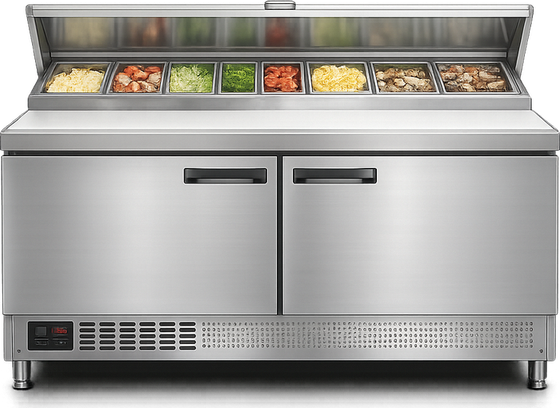
We work on sandwich and salad prep tables, pizza prep tables, sushi cases, raised-rail and flat-top units, and the refrigerated drawers and cabinets beneath them, on R-134a and on the newer R-290 hydrocarbon systems. That includes sealed-system work: the technician is EPA Section 608 Universal certified, which is required to handle refrigerant legally.
Brands we service in Leander: True, Turbo Air, Beverage-Air, Continental, Traulsen, Delfield, Hoshizaki, Silver King, Migali, Atosa, Arctic Air and Avantco.
What Prep Table Repair Costs in Leander
Diagnostics are $149 for a commercial call, and that amount is credited toward the repair when you approve it. After the diagnosis you get a written estimate covering parts and labor, and nothing is replaced before you approve it. The final figure depends on what failed — a fan motor, a gasket set, a sensor, a drain, a control or the sealed system — and on whether the visit turns out to be a coil clean and a drain flush rather than a repair at all.
Completed repairs carry a 3-month labor warranty from TakiDA LLC and a 1-year parts warranty against manufacturer defects.
Neighborhoods We Cover in Leander
We cover Leander as a whole and reach most commercial kitchens in the city within about twenty minutes, including the delis, taquerias and sandwich shops along US-183 and around Old Town. Nearby Cedar Park, Georgetown, Liberty Hill and Round Rock are also in our service area.
Common Questions About Prep Table Repair in Leander
The inspector wrote us up but our food temped fine.
That happens, and it is correct under the code. The ambient temperature in the cold rail has to be at or below 41°F in its own right, so a rail sitting at 45°F is a violation even when the product in it reads lower.
Our rail is fine in the morning and warm by three o’clock.
That is the classic pattern, and it usually means a coil that cannot keep up once the kitchen warms and the line gets busy. We measure under service conditions rather than first thing, because that is where the fault lives.
Do you work on R-290 units?
Yes. Newer tables use R-290 hydrocarbon refrigerant, which needs different handling from R-134a. The technician is EPA Section 608 Universal certified and we identify the refrigerant from the data plate before opening anything.
What does a commercial call cost?
The commercial diagnostic is $149, credited toward the repair when you approve the work. You get a written estimate before anything is replaced.
Book Prep Table Service in Leander
Tell us the make and model, what the rail is actually reading and when — morning, mid-service, or overnight — and whether the cabinet below is holding. That pattern narrows it more than anything else you can tell us.
Reliable Refrigerated Prep Table Repair in Leander, TX
-

Prep Table Faults We Handle
- Pans above 41 degrees Fahrenheit
- Rail warm but the base cold
- Ice building on the evaporator
- Unit running without stopping
- Water pooling inside the base
- Lid or gasket not sealing
- Thermostat reading wrong
-
Prep Tables We Service
- Sandwich and salad prep tables
- Pizza prep tables
- Mega top units
- Undercounter refrigerated bases
- Gasket, hinge and lid work
- True, Turbo Air, Beverage-Air
- Delfield, Continental, Traulsen

Prep Table Brands We Repair
If your brand is not listed, contact us — we likely service it.
Why Homeowners & Businesses Choose TakiDA
-
 Quality WorkWe deliver professional appliance repair with attention to detail, proper diagnostics, and long-lasting results you can rely on.
-
 OEM / High-Quality PartsWe use OEM or high-quality replacement parts to ensure correct operation, reliability, and extended appliance lifespan.
-
 Same-Day / Next-Day ServiceFast response with same-day or next-day service to reduce downtime and get your appliances back in working order quickly.
-
 Clear PricingUpfront estimates with transparent pricing. No hidden fees, no surprises — you know the cost before work begins.
-
 EPA Certified & InsuredEPA Section 608 Universal certified and fully insured for residential and commercial repair, giving you peace of mind and protection.
-
 Warranty on Labor & PartsAll repairs are backed by a warranty on labor and installed parts for added confidence and long-term reliability.
