
Commercial Dishwasher Repair in Dripping Springs, TX
A dish machine that will not reach sanitizing temperature, one that leaves film on every glass, a door machine that will not drain, or a conveyor that stalls mid-rack during service. TakiDA services commercial dishwashers for restaurants, taprooms, event venues, bakeries and catering kitchens across Dripping Springs and the surrounding Hill Country, where hard water drives most of these failures. Insured and certified. Commercial diagnostic $149, applied toward the repair.
Call (737) 388-3867 | Request a visit
Dish Machine Symptoms We Sort Out
The final rinse will not reach sanitizing temperature
Common causes. A scaled or failed booster heater element, a thermostat out of calibration, incoming water below the machine's requirement, a low-flow rinse from blocked nozzles, or a pressure regulator drifting out of range.
What we do. We measure the actual rinse temperature at the manifold and the gauge reading, test the booster elements for resistance, check rinse flow pressure, and descale what the hard water has coated. A machine that fails a thermal label is an inspection problem, and we fix the cause rather than nudging a thermostat.
Glasses come out filmy, spotted or cloudy
Common causes. Hard water scale, no rinse aid or an empty dispenser, a blocked rinse arm, wash water too cool, or detergent concentration off.
What we do. We clear and descale the arms and nozzles, verify the rinse aid and detergent dispensers actually draw, and measure wash and rinse temperatures. In this area filmy glassware is usually water chemistry, and we will tell you plainly whether treatment is the real answer.
The machine will not drain
Common causes. A blocked scrap basket or sump, a drain valve solenoid that will not open, a failed drain pump, a drain line packed with grease, or a standpipe height that is wrong for the machine.
What we do. We clear the sump and drain line, test the valve or pump for voltage and for flow, and check the standpipe and air gap. Dirty standing water in a dish pit is both a sanitation finding and a slip hazard.
It will not fill or fills too slowly
Common causes. A clogged inlet valve screen, a failed fill solenoid, a float or level probe stuck, a closed supply valve, or low incoming pressure.
What we do. We measure supply pressure, clean the inlet screen, test the solenoid, and clear the level sensor. The screen is a quick check that solves this more often than anything else.
The wash pump is loud or moves no water
Common causes. Debris in the impeller, a worn pump seal leaking into the motor, a failed bearing, or a motor drawing over its rating.
What we do. We clear the impeller, measure motor current against the nameplate, and inspect the seal. A leaking pump seal will kill the motor if it is left, so catching it early saves the expensive part.
A conveyor machine stalls or jams
Common causes. A worn drive chain or pawl bar, a jammed rack, a failed drive motor or clutch, or a limit switch that stops the cycle for a fault that has already cleared.
What we do. We inspect the drive mechanism and limit switches and replace the worn linkage. A conveyor that stalls under load but runs empty is usually mechanical wear, and that is what we check first.
The chemical dispensers do not draw
Common causes. A cracked or hardened squeeze tube, an empty chemical container, an air leak in the pickup line, or a dispenser pump that has quit.
What we do. We replace the tubing, check the pickup for air, and test the pumps. A machine running without sanitizer looks completely normal while failing its one job, so we verify draw rather than assuming.
Leaks from the door or the tank
Common causes. Worn door gaskets, a door out of alignment, a cracked tank weld on an older machine, a loose pump or fitting, or a curtain missing so water escapes on a conveyor.
What we do. We replace gaskets and curtains, align the door, and tighten or replace the fittings. On a cracked tank we will tell you honestly that the machine is at the end of its life rather than selling a patch.
Dish Machines We Work On
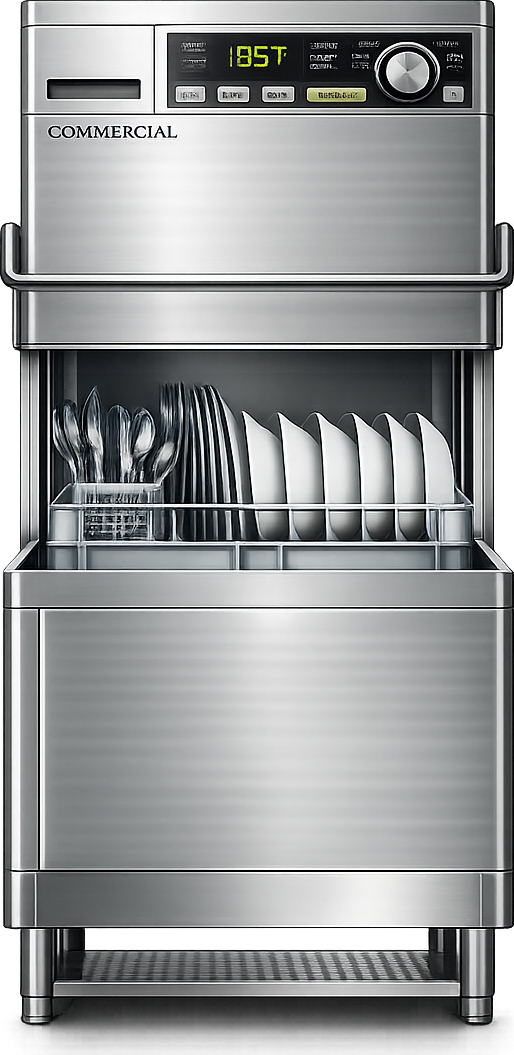
Under-counter dishwashers, door and hood-type machines, single and multi-tank conveyors, glass washers and bar washers, high-temp machines with booster heaters, and low-temp chemical sanitizing machines. We service Hobart, Jackson, CMA, Champion, Ecolab, Moyer Diebel and Insinger equipment for restaurants, bars and taprooms, event venues, bakeries and catering kitchens.
What a Commercial Dishwasher Repair Costs
The commercial diagnostic is $149 and it is credited toward the repair when you approve it. Descaling, gaskets, curtains, dispenser tubing, rinse arms, valves and thermostats are the moderate end and are what most machines out here need. Booster heaters, wash pumps, drive assemblies and control boards are the expensive end, and on an older machine we will give you the repair number against a replacement. You get a written estimate with parts, labor and tax before any work starts, and it stays good for 30 days. Labor carries a 3 month warranty and installed parts carry one year against manufacturer defects.
Where We Work in Dripping Springs
We cover Dripping Springs and the businesses around it, from the restaurants and taprooms along Mercer Street to the wineries, distilleries and event venues out along Ranch Road 12 and Highway 290 West, plus the retail along the 290 corridor. Nearby Driftwood, Henly and Wimberley are inside our normal route, and Bee Cave, Lakeway and Austin are a short run from here.
Frequently Asked Questions
Our thermal labels are not turning. Is the machine unsafe to use?
It means the rinse is not reaching sanitizing temperature, which is a health code issue. We measure the real rinse temperature and find out whether it is the booster, the thermostat, the incoming water or the rinse flow. Do not keep running it on the assumption the labels are wrong.
Why is our glassware always filmy?
Almost always hard water plus rinse aid that is not drawing. Both are fixable, and both are cheaper than the new glassware people buy trying to solve it.
Can you service the machine outside service hours?
Tell us your window. A dish machine down means hand washing through a rush, so we would rather get to you before or after service than during it.
How fast can you come out?
Commercial calls take priority and same-day is usually possible. A machine failing sanitation gets treated as urgent.
Book Dish Machine Service in Dripping Springs
Tell us the brand, whether it is high-temp or low-temp, and what it is doing, and we will arrive ready to descale, repair or diagnose on the first visit.
Commercial Dishwasher Repair in Dripping Springs, TX
-

What Brings Us Out to a Warewasher
- Final rinse coming up short of temperature
- Racks coming out with food still on them
- Tub not filling, or not emptying
- Booster not recovering between racks
- Wash arms turning slowly or not at all
- Sanitizer not being drawn through
- Water running out at the door
-
Warewashers We Cover
- Undercounter dishwashers
- Door type and hood machines
- Conveyor and flight machines
- Glasswashers
- High temp and low temp units
- Hobart, Jackson, CMA, Champion
- Meiko, Moyer Diebel, Insinger

Warewashing Brands We Service in Dripping Springs
If your brand is not listed, contact us — we likely service it.
Why Homeowners & Businesses Choose TakiDA
-
 Quality WorkWe deliver professional appliance repair with attention to detail, proper diagnostics, and long-lasting results you can rely on.
-
 OEM / High-Quality PartsWe use OEM or high-quality replacement parts to ensure correct operation, reliability, and extended appliance lifespan.
-
 Same-Day / Next-Day ServiceFast response with same-day or next-day service to reduce downtime and get your appliances back in working order quickly.
-
 Clear PricingUpfront estimates with transparent pricing. No hidden fees, no surprises — you know the cost before work begins.
-
 EPA Certified & InsuredEPA Section 608 Universal certified and fully insured for residential and commercial repair, giving you peace of mind and protection.
-
 Warranty on Labor & PartsAll repairs are backed by a warranty on labor and installed parts for added confidence and long-term reliability.
