
Commercial Steam Table Repair in West Lake Hills, TX
A steam table that will not reach 140 degrees, a well that boils dry in an hour, an element buried under scale, or a holding cabinet letting food drift into the danger zone. TakiDA services steam tables, bain maries and hot holding equipment for restaurants, cafes, caterers, country clubs and event venues across West Lake Hills and the surrounding 78746 area. Insured and certified. Commercial diagnostic $149, applied toward the repair.
Call (737) 388-3867 | Request a visit
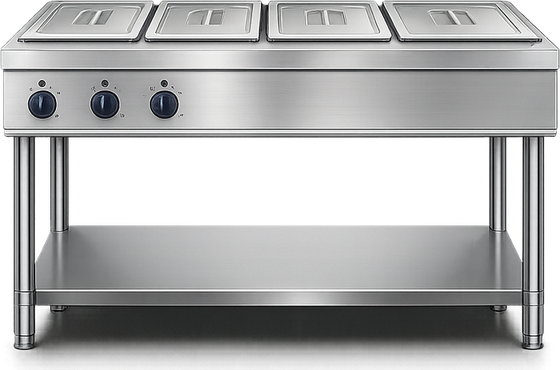
Steam Table Symptoms We Sort Out
The wells never climb to holding temperature
Common causes. A heating element open circuit, an element wrapped in scale so the heat never reaches the water, a thermostat out of calibration, a high-limit that has tripped, or on gas units a tired thermopile or a dirty pilot.
What we do. We read actual water and food temperature with an infrared thermometer, test each element for resistance and current draw, and check the thermostat against its own setpoint. A club line that sat cold all week and is asked to come up to temperature an hour before service will expose a weak element faster than daily use ever does, which is why this call tends to land on a banquet morning.
One well holds and the one beside it does not
Common causes. A single failed element on a multi-well unit, an individual thermostat gone, a burnt terminal on one circuit, or one well sitting dry while its neighbours still hold water.
What we do. Each well gets tested on its own element and its own control. Multi-well tables wire every well independently, so a single cold well is almost always one component rather than a dead table, and we price it that way instead of quoting the whole unit.
The wells boil off faster than anyone can refill them
Common causes. A thermostat running well above its setting, a water level that was never brought up properly at the start of service, a drain valve weeping, or a well already cracked by earlier dry firing.
What we do. We measure real water temperature against the dial, replace the thermostat or drain valve, and check the well for cracks. On equipment used in bursts for events rather than all day, dry firing is the usual killer: someone switches the line on full, walks away, and the water is gone before the food arrives.
White crust building up across the wells
Common causes. Hard water, which is simply the local condition. Scale sits between the element and the water as insulation, so the unit heats slower, the element runs hotter and its life gets shorter.
What we do. We descale wells and elements properly and give you a realistic interval for the water you actually have. This is maintenance rather than repair, and on equipment that spends most of its life idle between events it is the one job that decides whether the table lasts five years or fifteen.
It knocks the breaker out as soon as it heats
Common causes. An element failed to ground, moisture sitting in a terminal box, a damaged cord or plug, or a wire chafed through where the cabinet flexes on its casters.
What we do. We measure insulation resistance on each element to find the one leaking to ground, inspect the terminal box and the cord, and replace whatever measures bad. An element grounding out is a shock hazard around wet hands and stainless, so we do not reset a breaker and call it fixed.
A gas steam table pilot will not stay lit
Common causes. A weak thermopile, a dirty pilot orifice, hood draft blowing the flame off the sensor, or a safety valve that will not hold.
What we do. We measure the thermopile output hot, clean and set the pilot, and confirm the gas pressure. Where the exhaust is pulling the flame off the sensor, a new thermopile would have changed nothing.
The dials and lights have gone dead
Common causes. A failed infinite switch, a burnt indicator lamp, a loose connection inside a hot humid control box, or a cord end damaged from the unit being dragged into position.
What we do. We trace voltage from the cord forward and replace the switch, lamp or connector that measures bad. These are cheap parts, and a table that only has a control fault is firmly worth repairing. Portable units that get rolled out for events and pushed back against a wall take most of this damage at the cord end.
The holding cabinet is drying the food out
Common causes. A thermostat drifting high, an empty humidity pan on a moist-heat cabinet, a dead fan on a forced-air unit, or door gaskets that stopped sealing.
What we do. We measure cabinet temperature against the setting, check the fan and the humidity system, and replace gaskets. A cabinet running hot ruins expensive product as surely as a cold one makes it unsafe, and for a club plating for a hundred covers that difference shows on every plate.
Hot Holding Equipment We Work On
Electric and gas steam tables, drop-in wells and full serving lines, bain maries, soup wells and rethermalizers, hot food wells in buffet counters, heated holding and proofing cabinets, and heat lamps and strip warmers. We service Vollrath, Hatco, Wells, Duke, APW Wyott, Nemco, Alto-Shaam and Atosa equipment for restaurants, cafes, caterers, country clubs and event venues.
What a Steam Table Repair Costs
The commercial diagnostic is $149 and it comes off the repair once you approve it. Descaling, thermostats, infinite switches, indicator lamps, drain valves, cords and gaskets sit at the moderate end and settle most of these calls. Heating elements, gas valves and a full serving-line rebuild are the higher end. On a badly scaled or cracked unit we say plainly when replacement is the better money, rather than quoting a repair that fails again next season.
Where We Work in West Lake Hills
We cover West Lake Hills and the 78746 area around it, including the businesses along Bee Caves Road and the Loop 360 corridor, plus Westlake Highlands and Rollingwood. Lakeway and Bee Cave are inside our normal route, and Austin is a short run from here.
Frequently Asked Questions
The dial says 150 and the food probes at 128. Which do we trust?
The food probe, every time. Well temperature and food temperature are two different numbers, and the gap widens with scale on the element, a shallow water level or pans that do not seat properly. We measure both and close the gap rather than adjusting the dial until it reads better.
How often does a table like ours need descaling?
More often than most people expect. On local water a unit in regular service wants it monthly, and even an event-only table wants it on a schedule rather than when someone notices the crust. Descaling costs a fraction of the elements it protects.
We have an event this weekend. Can you get here before it?
Tell us the date when you call. Hot holding equipment going down ahead of an event moves to the front of the list, and we would much rather look at it the day before than at eight in the morning on the day.
Is a scaled-up steam table worth repairing?
Usually yes, because elements and thermostats are affordable. A well cracked by dry firing is the exception, and we will say so plainly rather than selling a repair that leaks again next month.
Book Steam Table Service in West Lake Hills
Tell us the brand, whether it is gas or electric, how many wells, and the temperature you are actually reading in the food, and we will arrive with the parts most likely to get you back into service.
Commercial Steam Table Repair in West Lake Hills, TX
-

What Brings Us Out to a Steam Table
- Pans dropping below safe holding temperature
- One well lagging behind the rest
- Element dead on a single well
- Dial not holding where it is set
- Wells running dry during service
- Overflowing instead of filling
- Scale coating the bottom of the wells
-
Hot Holding Equipment We Cover
- Electric steam tables
- Gas steam tables
- Drop-in hot wells
- Holding and proofing cabinets
- Soup and food warmers
- Vollrath, APW Wyott, Hatco, Wells
- Duke, Star, Alto-Shaam, Nemco

Hot Holding Brands We Service in West Lake Hills
If your brand is not listed, contact us — we likely service it.
Why Homeowners & Businesses Choose TakiDA
-
 Quality WorkWe deliver professional appliance repair with attention to detail, proper diagnostics, and long-lasting results you can rely on.
-
 OEM / High-Quality PartsWe use OEM or high-quality replacement parts to ensure correct operation, reliability, and extended appliance lifespan.
-
 Same-Day / Next-Day ServiceFast response with same-day or next-day service to reduce downtime and get your appliances back in working order quickly.
-
 Clear PricingUpfront estimates with transparent pricing. No hidden fees, no surprises — you know the cost before work begins.
-
 EPA Certified & InsuredEPA Section 608 Universal certified and fully insured for residential and commercial repair, giving you peace of mind and protection.
-
 Warranty on Labor & PartsAll repairs are backed by a warranty on labor and installed parts for added confidence and long-term reliability.
