
Commercial Steam Table Repair in Leander, TX
A steam table that will not hold 135°F puts your whole line at risk, and an inspector does not care why. We service hot food tables and steam wells for restaurants, cafeterias, caterers, schools and church kitchens in Leander — electric and gas, open well and sealed well. The $149 commercial diagnostic is credited toward the repair, and you get a firm price before anything is replaced.
Common Steam Table Problems in Leander Kitchens
Food in the well is reading below 135°F
This is the call we get most often, usually the morning after an inspection. Before anything is condemned, two things have to be separated: the table is not holding, or the table was never asked to do the right job. Hot food tables are holding equipment. Manufacturer instructions are explicit that they are not designed to cook raw food or to reheat prepared food, and product has to go in already hot — most manuals specify a minimum of 160°F going into the pan. A well loaded with 110°F product will chase 135°F for hours and never get there, and that is not a fault. If product goes in hot and the well still drops, we measure the element, the control for that well and the high limit separately, because any one of the three gives the same symptom.
One well is cold and the rest are fine
That narrows it quickly, because each well on a hot food table is its own circuit: its own element, its own control, and on many units its own high limit. We measure resistance across the element and voltage at the element terminals with the control on high. An element that reads open is finished. An element that reads correct resistance but sees no voltage sends us back up the chain — the infinite switch, the thermostat bulb clamped to the well, or a high limit that has tripped. The high limit is a normally closed switch wired in series with the element, so when it opens the well simply goes cold with nothing else to show for it.
Elements keep burning out
An element that fails once is a part. An element that fails twice in a year is a cause nobody has found yet. The two we see are voltage and dry firing. Manufacturer troubleshooting charts list improper voltage first: a 208V element supplied at 240V runs well over its rated wattage and will not last. The other is running a wet well dry. On wet-well tables the element has to stay covered — the factory figure is water to roughly 3/8 inch above the bottom of the well, checked and topped up with hot water about every two hours of service. Staff draining a well at the end of a shift without switching it off is the single most common way elements and wells get destroyed.
Water on the floor under the table
Two different failures, and they are easy to tell apart once the well is empty. A leak that only shows when the well is full and stops when it is drained is usually the drain valve or its seat; manufacturers list an obstruction in the drain valve as the first thing to check. A leak that seeps constantly is normally the well itself. Central Texas water is hard, and scale builds inside a sealed well until it pits through and leaves pinholes — the factory charts name limescale as the cause of well leaks directly. There is a third origin that is self-inflicted: pouring cold water into a well that has been heated dry can crack it, and every manual we have read carries that warning.
The table trips the breaker or the GFCI
A breaker trip and a GFCI trip are different problems and want different tests. A breaker trip is current, so we check element wattage against the rating plate and against what the circuit actually supplies — manufacturers specify a dedicated circuit for a reason. A GFCI trip is leakage to ground, and on a steam table the usual cause is moisture the element sheath absorbed while the unit stood idle or was washed down. The factory fix is to run the unit dry on maximum, off the GFCI circuit, for thirty to sixty minutes to drive the moisture out. If it still trips after that, the element is leaking internally and gets replaced.
Food crusts on top or the pan stays cold in the middle
This is usually an operating mismatch rather than a fault, and it is worth checking before you call anyone. Open wells are designed to run dry; sealed wells are not, and the manuals say plainly that sealed-well tables should not be used for dry holding. Dry heat comes through the bottom of the pan only, so it dries the surface and leaves depth in the pan cold, which is why dry operation is specified with lids and with deeper six-inch pans. Wet operation surrounds the pan with steam and holds far more evenly. If a kitchen switched from wet to dry to save the morning fill, the symptom shows up within a day.
The table takes an hour to come up to temperature
Factory preheat times are longer than most crews expect: open wells fifteen to twenty minutes dry, sealed wells thirty to forty-five minutes with water, and several manuals specify filling with hot water — one calls for 185°F tap water — precisely to shorten that. So the first question is what the real preheat time is being measured against. When a well that used to be ready in twenty minutes now needs an hour, that is scale. Calcium on the element and on the well bottom is an insulator, and it costs you heat transfer long before it ever causes a leak. Descaling a well is routine work and far cheaper than an element.
Gas hot food table: burners drop out or heat unevenly
Gas tables fail differently. A burner that lights and then drops out after a few minutes is a thermocouple or a pilot that has drifted out of the flame, not a control problem. Uneven heat across a gas table is usually burner ports partly blocked with grease and spillover, or a manifold pressure that was never set for the gas the kitchen actually has. We check manifold pressure against the rating plate and look at the flame pattern at each burner before anything is replaced, and any work on the gas train finishes with a leak check.
Steam Table Types and Brands We Repair in Leander
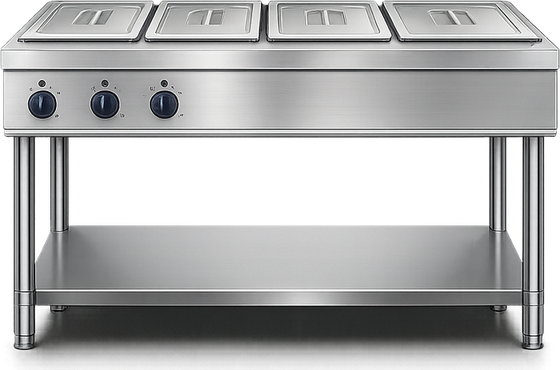
We service electric and gas hot food tables, open-well and sealed-well units, drop-in hot wells built into a counter, mobile and portable serving lines, and bain marie wells. That covers tables with infinite switches and tables with thermostatic controls, from a single well up to a six-well line.
Brands we repair in Leander: Vollrath, APW Wyott, Wells, Duke, Delfield, Hatco, Star, Eagle Group, Advance Tabco, Randell, Nemco, Atosa, Avantco, ServIt and Vulcan.
What Commercial Steam Table Repair Costs in Leander
The commercial diagnostic is $149, credited toward the repair when you approve it. After the diagnosis you get a written estimate covering parts and labor, and nothing is replaced before you approve it. What the job finally costs depends on whether it is a control, an element, a well or a gas component, and on how accessible the well is once the table is sitting in a line.
We work around service hours where we can. If you are in the middle of service, one well can usually be isolated and shut down while the rest of the table keeps running until we get back to it.
Neighborhoods We Cover in Leander
Most of our commercial calls in Leander run along the US-183 and Hero Way corridor, around the Leander Station area and the retail off Ronald Reagan. We also cover school and church kitchens out toward Crystal Falls and Bryson. Leander is twenty minutes from the shop, so a morning call is normally a same-day call.
Common Questions About Steam Table Repair in Leander
Can I put cold food in the well and let it come up to temperature?
No, and every manufacturer says so in print. A hot food table is holding equipment, not cooking equipment. Food goes in already hot — most manuals specify at least 160°F — and the table keeps it there. Bringing cold product up in the well leaves it sitting in the danger zone for hours.
Should my wells run wet or dry?
It depends on the table. Open wells are built to run dry and need a spillage pan if you want to run them wet. Sealed wells are built to run wet and should not be held dry. If you are not sure which you have, the drain tells you: a well with its own drain valve is almost always a wet well.
How often does a steam table need descaling?
On Leander water, a wet well used daily usually wants descaling a few times a year. You notice it as longer preheat before you notice it as anything else. Left long enough, scale pits through a sealed well and the well itself has to be replaced.
Do you work on gas hot food tables as well as electric?
Yes. Gas tables, electric tables, drop-in wells and portable units. Gas work covers the pilot, thermocouple, burner and manifold pressure, and it finishes with a leak check.
How fast can you get to a kitchen in Leander?
Usually same-day or next morning. Leander is our home town, so we are not driving in from across the metro. Call (737) 388-3867 and tell us how many wells are down — that decides whether it is an emergency or something we schedule around your service.
Book Steam Table Repair in Leander
Tell us whether the table is gas or electric, how many wells are down, and what the food is actually reading. That is normally enough for us to arrive with the right parts on the van.
Reliable Commercial Steam Table Repair in Leander, TX
-

Steam Table Faults We Handle
- Food holding below 135 degrees Fahrenheit
- One well cold, the rest hot
- Element not heating
- Thermostat will not hold a setting
- Water not filling or overfilling
- Scale build up in the wells
- Control knob or switch failed
-
Hot Holding Equipment We Service
- Electric steam tables
- Gas steam tables
- Drop-in hot wells
- Holding and proofing cabinets
- Soup and food warmers
- Vollrath, APW Wyott, Hatco, Wells
- Duke, Star, Alto-Shaam, Nemco

Steam Table Brands We Repair
If your brand is not listed, contact us — we likely service it.
Why Homeowners & Businesses Choose TakiDA
-
 Quality WorkWe deliver professional appliance repair with attention to detail, proper diagnostics, and long-lasting results you can rely on.
-
 OEM / High-Quality PartsWe use OEM or high-quality replacement parts to ensure correct operation, reliability, and extended appliance lifespan.
-
 Same-Day / Next-Day ServiceFast response with same-day or next-day service to reduce downtime and get your appliances back in working order quickly.
-
 Clear PricingUpfront estimates with transparent pricing. No hidden fees, no surprises — you know the cost before work begins.
-
 EPA Certified & InsuredEPA Section 608 Universal certified and fully insured for residential and commercial repair, giving you peace of mind and protection.
-
 Warranty on Labor & PartsAll repairs are backed by a warranty on labor and installed parts for added confidence and long-term reliability.
