
Refrigerated Prep Table Repair in Lakeway, TX
Every other refrigerated unit in a kitchen has a door you close. A prep table does not: the rail is open to the room for the whole of service, and the only thing holding those pans cold is a thin blanket of cold air moving across them. In a Lakeway kitchen with a patio line running in July, that is the hardest job in the building. The base will usually hold fine while the pans at the rail drift into the danger zone, which is both a food safety problem and the one an inspector will find. We repair sandwich and salad prep tables, pizza prep tables and mega tops, and we diagnose the rail as a separate problem from the base, because it usually is one.
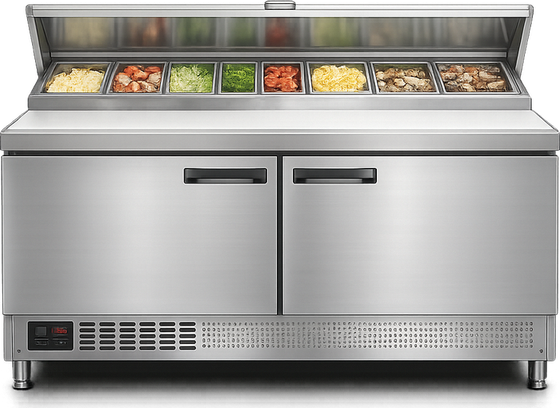
Common prep table problems we fix in Lakeway
Pans at the rail running warm while the base is fine
This is the signature prep table fault and the reason prep tables need their own diagnosis. The base is a closed box and holds easily. The rail depends on airflow across the pan wells, and anything that interrupts that airflow leaves the pans warm. The usual causes are a blocked return air path, pans sitting too high or the wrong depth for the well, product packed above the fill line, or a fan that has slowed. We check the air path at the rail before touching the refrigeration system, because the system is usually fine.
Unit running constantly and never cycling off
A prep table that never cycles off is losing cold as fast as it makes it. In a busy Lakeway kitchen the two causes are almost always a dirty condenser and a lid that spends service open. Condensers on prep tables sit low and close to the floor, where they collect dust, grease and whatever gets swept toward them, and in a kitchen running hard they load up quickly. We clean the coil and check the fan, then measure before concluding anything about the sealed system.
Ice building up on the evaporator
Ice on the coil means the defrost cycle is not keeping up or humid air is getting in faster than the unit can handle. On a prep table, the second cause dominates: an open rail in a humid kitchen loads the coil continuously. A defrost control or termination sensor that has failed turns that into a solid block. We thaw it, verify the defrost cycle runs, and address the air path, because clearing the ice alone buys a day.
Lid, cover or gasket no longer sealing
The lid on a prep table is what holds temperature overnight and during slow periods. A warped lid, a broken hinge or a hardened gasket means the unit runs all night for nothing and starts service already behind. These are cheap parts with an immediate effect on the unit ability to hold through a busy service.
Water pooling in the base or on the floor
Condensate from the evaporator has to reach a drain. A blocked drain line, a drain pan cracked or out of position, or a failed condensate evaporator pan means water in the bottom of the cabinet and eventually on the floor beneath a prep line. That is a slip hazard where people are working fast with knives, so we treat it as more than a nuisance.
Controller reading a temperature the unit is not holding
Digital controllers on prep tables measure at one point, usually in the base. A display reading 36 tells you nothing about the pan at the end of the rail. We measure actual product temperature in several pans and compare, because the gap between the display and the pans is the number that matters for food safety and the one an inspector will take.
Compressor short cycling or tripping
Short cycling points at a safety control, an overloaded condenser, or a start component. A prep table compressor that trips thermally and restarts has usually been fighting a dirty coil for weeks. We check the airside first, measure the draw, and only then look at the compressor and start components, because a compressor replacement on a unit with a blocked coil fails again.
Unit coming back from a shutdown and not holding
Seasonal and event kitchens around Lakeway shut prep tables down between busy periods. A unit that comes back on after weeks often has a dried gasket, a drain line that has gone bad, or a start capacitor that has aged. Discovering that an hour before a service is the worst way to find out, and it is the most avoidable one.
Why the rail is its own problem
When a prep table complaint comes in, the single most useful question is whether the base is holding. If the base is cold and the pans are warm, the refrigeration is working and the problem is airflow at the rail, which is usually cheap to fix. If both are warm, we are looking at the condenser, the charge or the compressor. Operators often assume a warm pan means a failing unit and start pricing a replacement, when the actual fault is a blocked return, the wrong pan depth, or product loaded above the fill line. We check the simple causes first, and we tell you which category you are in before any parts are discussed.
Summer, open lids and patio service
Prep tables are rated to hold product at ambient conditions that a Lakeway kitchen in July exceeds, especially on a line that faces an open patio. Heat and humidity both work against the rail: heat raises the load, humidity ices the coil. A unit that performed well in April can struggle in July without anything having broken. We will tell you honestly when that is what we find, because the money is then better spent on condenser cleaning, lid discipline and pan management than on parts that will not change the outcome.
Food safety and what an inspector checks
A health inspector will put a thermometer into the pans at the rail, not read your controller. Product above 41 degrees at the rail is a finding regardless of what the display says. This is why we measure in the pans on every prep table call and why we will tell you if the unit is marginal rather than failed. Knowing you are sitting at 43 on a busy Saturday is information you can act on; finding out during an inspection is not.
Prep table questions from Lakeway operators
The base is cold but the pans are warm. Is the unit dying?
Usually not. That pattern means the refrigeration is working and the airflow across the rail is not. Blocked returns, wrong pan depth, or product above the fill line are the common causes, and all are inexpensive to put right.
Our prep table struggles only in summer
That is normal behavior pushed past its limit, and the fix is usually a clean condenser, better lid discipline and keeping backup product in the base rather than the rail. We will tell you if the unit is genuinely faulty instead of just loaded.
How often should the condenser be cleaned?
More often than most kitchens do it. Prep table condensers sit low and collect everything. In a busy kitchen, quarterly is a reasonable starting point and some need it more. We will tell you based on what yours looks like.
Can you check whether we would pass an inspection?
We measure actual product temperature in the pans, which is what an inspector does. If you are marginal we will tell you exactly where you sit and what it would take to get solid margin.
What does prep table repair cost in Lakeway?
The commercial diagnostic is $149 and it is credited toward the repair when you approve it. Airflow corrections, gaskets and lids are inexpensive; condenser fans, controls and sealed system work cost more. You get a written estimate with parts, labor and tax before work begins.
Book Prep Table Service in Lakeway
Tell us the brand, the table type, and whether the base is holding while the pans are warm or both are warm. We serve restaurants, bars, clubs and event kitchens in Lakeway, Bee Cave, Lago Vista, Leander, Lakeway and the surrounding Hill Country, with same-day service when the schedule allows.
Refrigerated Prep Table Repair in Lakeway, TX
-

What we fix
- Pans at the rail running warm
- Base holds but the top does not
- Unit running constantly and never cycling off
- Ice building on the evaporator
- Lid or cover no longer sealing
- Water pooling in the base or on the floor
- Controller reading a temperature the unit is not holding
-
Lakeway specifics
- Open rails facing a hot patio line in summer
- Condensers loading up fast in a busy kitchen
- Weekend volume with the lid open continuously
- Seasonal kitchens idle for weeks between events
- Health inspection pan temperature requirements
- Single prep line with no backup during service

Prep Table Brands We Service in Lakeway
If your brand is not listed, contact us — we likely service it.
Why Homeowners & Businesses Choose TakiDA
-
 Quality WorkWe deliver professional appliance repair with attention to detail, proper diagnostics, and long-lasting results you can rely on.
-
 OEM / High-Quality PartsWe use OEM or high-quality replacement parts to ensure correct operation, reliability, and extended appliance lifespan.
-
 Same-Day / Next-Day ServiceFast response with same-day or next-day service to reduce downtime and get your appliances back in working order quickly.
-
 Clear PricingUpfront estimates with transparent pricing. No hidden fees, no surprises — you know the cost before work begins.
-
 EPA Certified & InsuredEPA Section 608 Universal certified and fully insured for residential and commercial repair, giving you peace of mind and protection.
-
 Warranty on Labor & PartsAll repairs are backed by a warranty on labor and installed parts for added confidence and long-term reliability.
