
Refrigerated Prep Table Repair in Cedar Park, TX
A rail that will not hold 41°F, a cabinet that recovers slowly after the rush, ice on the back wall, or pans freezing to the rail. We service refrigerated prep tables for sandwich shops, pizzerias, taquerias and delis in Cedar Park. The $149 commercial diagnostic is credited toward the repair.
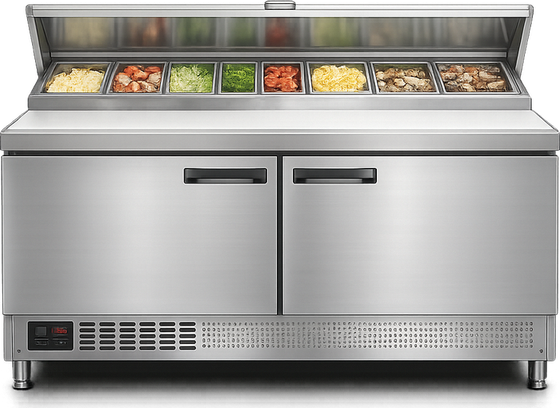
Common Prep Table Problems in Cedar Park Kitchens
The rail holds but the cabinet below does not
On most prep tables one system cools both, with air routed to the rail and to the cabinet, so a split like this is about distribution rather than refrigeration. The usual findings are a blocked air path in the cabinet — product stacked against the vents or over the load line — a cabinet evaporator fan that has stopped, or a door that no longer seals and is loading the cabinet with warm air. The rail keeps up because it has the shorter path. We check the airflow before anyone opens a sealed system.
Condensation running down the outside of the cabinet
A prep table standing in a Cedar Park kitchen in August is working against humidity as much as heat. Sweating on the outside is normally a door gasket that is letting cold out and warm wet air in, a door left standing open through service, or an anti-sweat heater circuit that has failed. It is worth fixing rather than wiping, because the same leak that makes the outside wet is costing the cabinet temperature.
Ice building up on the back wall inside the cabinet
Ice on an evaporator means moisture is getting in faster than defrost can clear it, or defrost is not clearing it at all. Gaskets and door closers come first, then the defrost arrangement — most prep tables rely on off-cycle defrost, so anything that keeps the compressor running continuously also stops defrost happening. Once a coil ices over, airflow drops and the cabinet stops holding, so the temperature complaint and the ice are the same fault.
Pans freeze to the rail
Too cold is a fault as much as too warm. Product freezing at the rail usually means the rail is being fed more cold air than it needs — a controller set low to chase a daytime problem, a damper or diverter out of position, or a probe reading warm and never letting the system cycle off. Setting the controller lower to fix a warm rail at noon is what causes frozen product at eight in the morning, and that is a trap we see often.
It trips the breaker on hot afternoons
Current rises with head pressure, and head pressure rises with a dirty condenser and a hot kitchen. A unit that runs all winter and trips in July is usually telling you the condenser needs cleaning rather than that the compressor is failing. We measure running current against the data plate and check the condenser and the condenser fan first, because replacing a compressor on a blocked condenser just buys the same failure again.
The controller shows a probe fault
Digital controllers on prep tables monitor one or more probes, and when a probe reads open or shorted the controller reports it and usually falls back to a default run pattern. That fallback is why a unit with a probe fault can look like it is working while the temperature wanders. Probes are inexpensive and the fault is specific, so this is one of the quicker repairs on the list — but it should not be left running on a default cycle with food in it.
The cabinet recovers slowly after the lunch rush
Recovery is the honest test of a prep table, because anything can hold temperature overnight. A unit that takes hours to come back after service has lost capacity somewhere: condenser, charge, airflow or a door that spent two hours open. We would rather be there during or just after a rush than first thing in the morning, because that is when the fault is visible.
A smell from the cabinet, and water in the bottom
Prep tables make condensate and it drains to a pan, usually one evaporated by the compressor's heat. A blocked drain line leaves water standing in the cabinet floor, and that smells within days. Clearing the line and the pan is routine. If the pan is overflowing rather than blocked, the unit is running far more than it should, which brings the conversation back to capacity.
Prep Tables We Service in Cedar Park
Sandwich and salad prep tables, pizza prep tables with raised rails, mega-top units, and under-counter refrigerated bases with prep rails. Door and drawer configurations, R-134a and R-290 refrigerant.
Sealed system work included — the technician holds EPA Section 608 Universal certification.
Brands we service in Cedar Park: True, Turbo Air, Beverage-Air, Continental, Delfield, Traulsen, Atosa and Avantco.
What Prep Table Repair Costs in Cedar Park
The commercial diagnostic is $149, credited toward the repair when you approve it. After the diagnosis you get a written estimate covering parts and labor, and nothing is replaced before you approve it. Gaskets, fans, probes, controllers, drains and door hardware are modest parts, and they account for most of what actually fails. Compressors and sealed system work are not, and we will give you the number before you commit.
If the table is holding product above 41°F right now, say so when you call — that changes how we schedule it.
Neighborhoods We Cover in Cedar Park
Prep tables are the piece of equipment an inspector checks first, and ours in Cedar Park sit in sandwich shops and pizzerias along Bell Boulevard, the taquerias and delis off Lakeline, and the serving kitchens near Brushy Creek. A hot kitchen and a busy rail is the hardest combination for this equipment, which is why most of our calls here come in summer. We run down from Leander.
Common Questions About Prep Table Repair in Cedar Park
What temperature does the rail actually have to hold?
Cold holding is 41°F or below, and that is what gets measured — in the food, not in the air. Keep a thermometer in a pan rather than trusting the display, because the display reads the cabinet and the inspector reads the product.
Why is the rail warm but the cabinet fine?
Usually because the rail is being asked to do something it was not built for — cooling warm product down rather than holding cold product cold. Rails are holding equipment. Product goes in already at temperature, and pans are filled from the cabinet rather than from the bench.
Does a lid or a cover really make a difference?
A large one. An open rail in a hot kitchen with air moving over it loses temperature quickly, and manufacturers say not to let drafts blow across the rail. Night covers and lids during quiet periods do more than most repairs.
My table uses R-290. Is that a problem?
Not at all, but it is different work. R-290 is flammable and the service procedure, the parts and the tooling differ from R-134a. We check the data plate before we open anything.
How fast can you get to Cedar Park?
Usually same-day when a table is out of temperature. Call (737) 388-3867 and tell us what the rail and the cabinet are each reading — those two numbers together point us at the fault before we arrive.
Book Prep Table Service in Cedar Park
Tell us the make and what the rail and the cabinet are each reading. Those two numbers together usually point at the fault before we arrive.
Refrigerated Prep Table Repair in Cedar Park, TX
-

What Brings Us Out to a Prep Table
- Pans warm by the middle of a shift
- Base cold while the rail is not
- Frost sheet forming on the coil
- Compressor never shutting off
- Water collecting in the bottom of the base
- Lid not closing down on the gasket
- Readout not matching a thermometer
-
Prep Tables We Cover
- Sandwich and salad prep tables
- Pizza prep tables
- Mega top units
- Undercounter refrigerated bases
- Gasket, hinge and lid work
- True, Turbo Air, Beverage-Air
- Delfield, Continental, Traulsen

Prep Table Brands We Service in Cedar Park
If your brand is not listed, contact us — we likely service it.
Why Homeowners & Businesses Choose TakiDA
-
 Quality WorkWe deliver professional appliance repair with attention to detail, proper diagnostics, and long-lasting results you can rely on.
-
 OEM / High-Quality PartsWe use OEM or high-quality replacement parts to ensure correct operation, reliability, and extended appliance lifespan.
-
 Same-Day / Next-Day ServiceFast response with same-day or next-day service to reduce downtime and get your appliances back in working order quickly.
-
 Clear PricingUpfront estimates with transparent pricing. No hidden fees, no surprises — you know the cost before work begins.
-
 EPA Certified & InsuredEPA Section 608 Universal certified and fully insured for residential and commercial repair, giving you peace of mind and protection.
-
 Warranty on Labor & PartsAll repairs are backed by a warranty on labor and installed parts for added confidence and long-term reliability.
