
Commercial Refrigeration and Walk-In Repair in Cedar Park, TX
A walk-in drifting above 41°F, a reach-in short cycling, ice at the freezer door or water on the floor. We service commercial refrigeration for restaurants, bars, convenience stores, schools and church kitchens in Cedar Park. The $149 commercial diagnostic is credited toward the repair, and sealed system work is covered — the technician is EPA Section 608 certified.
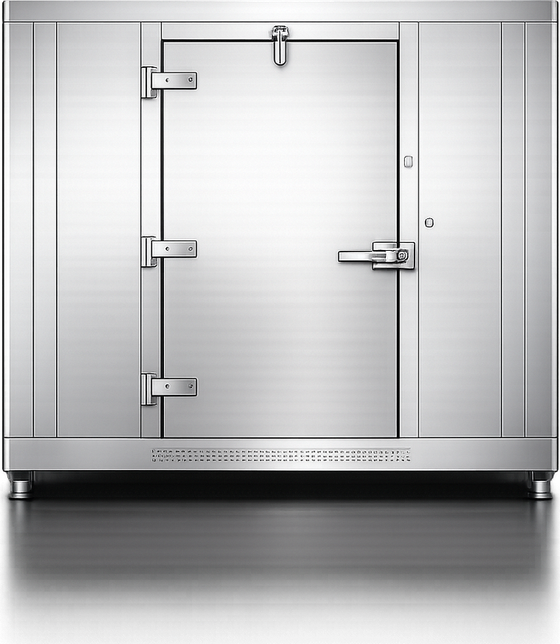
Common Commercial Refrigeration Problems in Cedar Park Kitchens
It holds overnight but drifts during service
A box that reads correctly at seven in the morning and fails at one in the afternoon is not usually a failing system — it is a system with no reserve left. Door openings, hot product going in, and a kitchen at full tilt all load it at once, and anything that has quietly reduced capacity shows up only then. The first two things we check are the condenser coil and the refrigerant charge, because a dirty coil and a slightly low charge both cost capacity without ever showing on an overnight reading.
Product at the front of the shelf is warm, the back is fine
That is airflow, not cooling. Evaporators move air in a defined pattern, and loading above the load line or stacking cases against the coil blocks it. The symptom is a temperature difference across one shelf, which looks alarming and is usually free to fix. If the airflow is clear and the gradient is still there, we look at the evaporator fans — one failed fan in a bank of three produces exactly this.
Ice on the floor near the door
Warm humid Cedar Park air getting into a freezer condenses and freezes wherever it lands, and that is almost always at the door. The causes are a gasket that no longer seals, a door that does not self-close, or a missing strip curtain. On freezers there are also heaters in the frame and sometimes in the floor whose only job is to stop exactly this, and a failed heater circuit gives the same picture. It is worth fixing promptly — ice at a doorway is a fall risk before it is a refrigeration problem.
The unit cycles on and off every few minutes
Short cycling wears a compressor faster than almost anything else. The usual causes are a low charge, a dirty or blocked condenser pushing head pressure up until a control opens, or a pressure control that has drifted out of adjustment. They are told apart with gauges and a thermometer rather than by listening, and the measurements take minutes. A compressor allowed to short cycle for months is a replacement rather than a repair.
The cooler side holds, the freezer side does not
On dual-temperature reach-ins and on sites with two systems sharing a rack, this narrows the problem usefully. It means the common parts — supply, controller, condensing unit where shared — are working, and the fault is in the freezer circuit: its evaporator, its defrost, its valve or its fans. Freezer evaporators also depend on defrost working properly, so a freezer that slowly loses ground over days is a defrost question before it is a refrigerant question.
Condensate dripping onto product
Every refrigerated box makes water, and all of it is supposed to leave through a drain. When it drips instead, the drain line is blocked, the drain pan is cracked, or on a freezer the drain line heater has failed and the line has frozen solid. That last one is common and is the reason a freezer drain blocks in winter and clears by itself in spring. We clear the line, confirm the heater, and check the slope rather than just mopping up.
The remote condenser is louder than it used to be
Rooftop and remote condensers are out of sight and get ignored until something changes. Rising noise is nearly always fan bearings or a fan blade out of balance with dirt. Both are cheap now and expensive later, because a fan that stops takes the head pressure up and the system down in the middle of service. In Cedar Park a rooftop coil also collects a season of cedar pollen and dust, which is worth a wash long before it is worth a service call.
A smell in the box that cleaning does not fix
If the shelves are clean and it still smells, the usual source is the drain pan or the evaporator itself. Pans sit warm and wet, and coils hold a biofilm between the fins where nobody looks. Coil cleaning is routine maintenance that also buys back capacity, so it tends to fix the smell and the temperature drift at the same time.
Equipment We Service in Cedar Park
Walk-in coolers and freezers, reach-in and under-counter refrigeration, glass-door merchandisers, back-bar and keg coolers, blast chillers, and remote and self-contained condensing units.
Sealed system work included: the technician holds EPA Section 608 Universal certification, which is a legal requirement for handling refrigerant.
Brands we service in Cedar Park: True, Turbo Air, Beverage-Air, Traulsen, Continental, Delfield, Heatcraft, Bohn, Copeland, Atosa and Avantco.
What Commercial Refrigeration Repair Costs in Cedar Park
The commercial diagnostic is $149, credited toward the repair when you approve it. After the diagnosis you get a written estimate covering parts and labor, and nothing is replaced before you approve it. A fan motor, a gasket, a defrost control or a drain heater is modest. Compressors and sealed system work are not, and on an older condensing unit we will put the repair next to the replacement so you can decide with real numbers.
If you are losing product right now, say so when you call — that changes how we schedule it.
Neighborhoods We Cover in Cedar Park
Our commercial refrigeration calls in Cedar Park are mostly restaurants and bars along Bell Boulevard and Whitestone, convenience stores and taquerias off Lakeline, and the kitchens serving the schools and churches around Brushy Creek. Being based in Leander means a box that fails at ten in the morning normally gets looked at before the dinner service rather than tomorrow.
Common Questions About Commercial Refrigeration Repair in Cedar Park
How often should the condenser coil be cleaned?
Quarterly for most kitchens, and more often for a rooftop unit in Cedar Park where pollen and dust load it fast. It is the single cheapest thing you can do for capacity, run time and compressor life.
My box is at 45°F. How long do I have?
Not long — the cold holding threshold is 41°F, and time above it counts. Move product to another box if you have one and call. We will tell you honestly on the phone whether we can get there in time to matter.
Do you do sealed system work or only electrical?
Both. The technician is EPA Section 608 Universal certified, which is required by law to open a sealed system and handle refrigerant.
Can you come outside service hours?
Where we can, yes, and we would rather plan it that way for anything that is not an emergency. Tell us your service windows when you call.
How fast can you get to Cedar Park?
Usually same-day for a box that is down. Call (737) 388-3867 and tell us what the box is reading and whether product is at risk — that decides the order we run the day in.
Book Commercial Refrigeration Service in Cedar Park
Tell us what the box is reading, what it should be reading, and whether product is at risk. That decides how fast we come and what goes on the van.
Commercial Refrigeration Repair in Cedar Park, TX
-

What Brings Us Out to Cedar Park Kitchens
- Product warming overnight
- Ice sheet over the evaporator coil
- Condenser fan spinning, box still warm
- Compressor starting and stopping
- Puddle at the walk-in threshold
- Door swinging open on its own
- Controller showing a sensor fault
-
Refrigeration We Cover
- Walk-in coolers and freezers
- Reach-in refrigerators and freezers
- Refrigerated display cases
- Remote and self-contained racks
- Defrost and controller work
- True, Turbo Air, Traulsen, Beverage-Air
- Delfield, Continental, Master-Bilt, Norlake

Commercial Refrigeration Brands We Service in Cedar Park
If your brand is not listed, contact us — we likely service it.
Why Homeowners & Businesses Choose TakiDA
-
 Quality WorkWe deliver professional appliance repair with attention to detail, proper diagnostics, and long-lasting results you can rely on.
-
 OEM / High-Quality PartsWe use OEM or high-quality replacement parts to ensure correct operation, reliability, and extended appliance lifespan.
-
 Same-Day / Next-Day ServiceFast response with same-day or next-day service to reduce downtime and get your appliances back in working order quickly.
-
 Clear PricingUpfront estimates with transparent pricing. No hidden fees, no surprises — you know the cost before work begins.
-
 EPA Certified & InsuredEPA Section 608 Universal certified and fully insured for residential and commercial repair, giving you peace of mind and protection.
-
 Warranty on Labor & PartsAll repairs are backed by a warranty on labor and installed parts for added confidence and long-term reliability.
