
Oven and Range Repair in Cedar Park, TX
Uneven baking, an oven running hot or cold, a blank display, a self-clean cycle that will not start, or a smell of gas on ignition. We repair ovens and ranges across Cedar Park — gas, electric and dual-fuel, freestanding and built-in. The $99 diagnostic comes off the repair, and you get a firm price before anything is replaced.
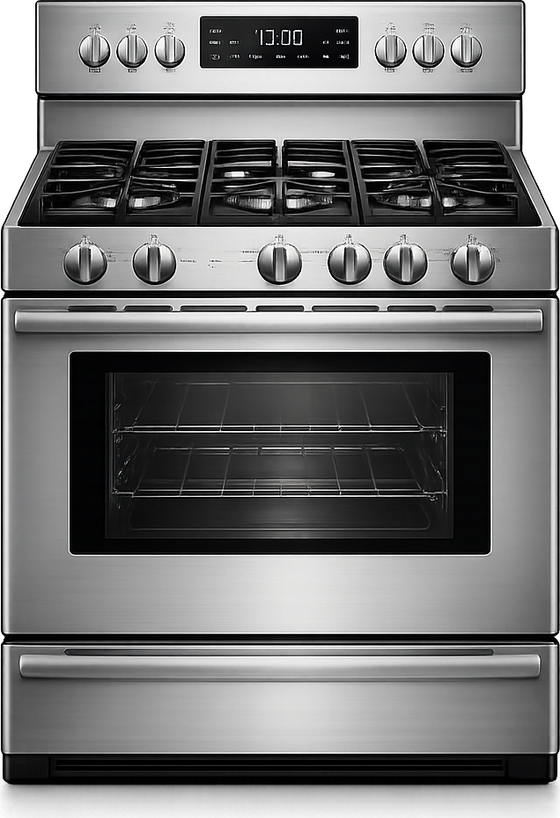
Common Oven and Range Problems in Cedar Park Homes
Food browns on one side of the tray and not the other
Before anyone opens the oven, two ordinary things cause most of this: a pan too large for the cavity, which blocks the airflow around it, and a rack in the wrong position. Once those are ruled out, uneven browning is usually an element with a failed section or a convection fan that has slowed. We measure the elements rather than look at them — a bake element can glow across most of its length and still be open at one end, and that is invisible from the doorway.
Everything burns on the bottom
That pattern points at the bake element running when it should not, or at the oven running hotter than the display says. Both are measurable in a few minutes. The oven's temperature sensor is a resistance thermometer, and it has a specified value — around 1080 ohms at room temperature on most of the ovens we see. Below about 900 or above about 1200 and the sensor comes out for a separate check: if the reading is the same at the connector and at the sensor itself, the sensor is at fault, and if it is not, the wiring is. The control board measures resistance, not heat, so a sensor reading low makes a perfectly good oven overshoot.
Convection makes no difference even though the fan runs
On most convection ovens the fan is only half the system. There is a separate element wrapped around it, and when that element fails open, the fan keeps spinning and simply circulates air the bake element is heating. Food then cooks as if convection were switched off, which is exactly what people describe. The element is an ordinary part and the test is an ordinary resistance check.
The display is blank, or the clock keeps resetting
An electric range runs the oven on 240 volts and the control on 120, and a blank or resetting display usually means one of the two supplies is intermittent. A loose connection at the terminal block behind the range is the most common cause we find, and it is worth taking seriously — a loose high-current connection generates heat. After that it is the board. We check the supply first because replacing a control board on a bad connection just destroys the new board.
It beeps and shuts itself down after a long bake
Ovens protect themselves. A cooling fan that has stopped, a blocked vent path or a failing board lets the electronics behind the control panel get too hot, and the control shuts the oven down rather than cook itself. Manufacturers also set hard overheat limits in the firmware — in the region of 615 to 630°F in bake and over 900°F in clean on the platforms we see — and the first thing to suspect when an oven exceeds them is a relay that has welded closed rather than a sensor.
Self-clean will not start, or stops partway
Self-clean will not begin until the control can confirm the door is locked, so a cycle that refuses to start is nearly always the latch motor or its switch rather than anything to do with heat. A cycle that starts and quits partway is usually the oven hitting its clean-mode limit and backing off, which points back at the sensor or the door seal. Worth knowing before you start one: self-clean is the hardest thing an oven ever does, and it is when tired parts fail.
You smell gas when the oven lights
Stop using it and call someone. The usual cause is delayed ignition: the igniter has weakened with age, it no longer gets hot enough to open the gas valve quickly, and gas collects for a second or two before it lights. The result is a whump and a smell. Hot surface igniters are tested by the current they draw against the manufacturer's figure, not by whether they glow — a glowing igniter that draws too little current will still cause this. Any gas work we do finishes with a leak check.
The door will not sit flush and heat escapes
Oven doors are held shut by hinges under spring tension, and those springs relax over years, particularly on ovens that get used hard. A door standing proud at the top loses heat, upsets the cavity temperature and eventually makes the oven look like it has a calibration problem when it does not. Hinges and door gaskets are replaceable parts, and getting the door square again often fixes baking complaints that nobody connected to the door.
Ovens and Ranges We Repair in Cedar Park
Freestanding and slide-in ranges, built-in wall ovens single and double, gas, electric and dual-fuel, and convection models. Range cooktops are covered on the same visit.
Brands we repair in Cedar Park: Whirlpool, GE, Samsung, LG, Frigidaire, Maytag, KitchenAid, Bosch, Amana, Kenmore, Electrolux and Hotpoint.
What Oven and Range Repair Costs in Cedar Park
The residential diagnostic is $99 and comes off the repair when you approve it. You get a written price covering parts and labor before anything is replaced. Elements, sensors, igniters, latches and hinges are modest parts. Control boards on built-in wall ovens are the exception, and on an older unit we will put the board price next to what a replacement oven costs before you decide.
Gas work finishes with a leak check on anything we opened.
Neighborhoods We Cover in Cedar Park
Most of the single-storey homes around Buttercup Creek, Carriage Hills and Cedar Park Ranchettes run freestanding ranges, where elements, igniters and sensors are the everyday work. The larger kitchens in Twin Creeks, Ranch at Brushy Creek and the newer builds off Whitestone Boulevard bring built-in wall ovens and dual-fuel ranges, which take longer to get out of the cabinetry and more often come down to a board. We cover the whole city and allow for the difference rather than discovering it on the day.
Common Questions About Oven and Range Repair in Cedar Park
My oven bakes twenty degrees low. Can it be adjusted?
Most ovens have a calibration offset in the settings, and if the sensor is good that is the right fix. The trap is using it to paper over a failing sensor, which drifts further every month. We check the sensor against its specified resistance first and only then calibrate.
Is replacing a control board worth it?
On a freestanding range, often yes. On a built-in wall oven, often no — boards for those can be a large share of a replacement oven, and supply is patchy on older models. We tell you the part price up front rather than after the cabinetry is open.
Do you work on gas, electric and dual-fuel?
All three, plus single and double wall ovens. Gas work ends with a leak check on anything we opened.
Should I use the self-clean cycle?
Sparingly. It is the hottest thing the oven ever does and it is when door latches, sensors and boards tend to let go. On an older oven, cleaning by hand is kinder to it.
How quickly can you get to Cedar Park?
Usually the same day. Call (737) 388-3867 with the brand, whether it is gas or electric, and any F code on the display — the code usually decides what we bring.
Book Oven or Range Repair in Cedar Park
Tell us the brand, whether it is gas or electric, and any F code on the display. That is normally enough for us to arrive with the right parts on the van.
Oven and Range Repair in Cedar Park, TX
-

Oven and Range Symptoms We Sort Out
- Oven never reaches the set temperature
- Food browning on one side only
- Takes forever to preheat
- Temperature drifting during a bake
- Door sagging or not sealing
- Oven dead after a self clean cycle
- Error code on the panel
-
Ovens and Ranges We Work On
- Gas ranges
- Electric ranges
- Double wall ovens
- Slide-in and freestanding ranges
- Convection ovens
- Whirlpool, GE, Samsung, LG, KitchenAid
- Frigidaire, Maytag, Bosch, Electrolux

Oven and Range Brands We Service in Cedar Park
If your brand is not listed, contact us — we likely service it.
We repair all major residential appliance brands across Central Texas, including Whirlpool, GE, Samsung, LG, Maytag, Frigidaire, KitchenAid, Amana, Bosch, Electrolux, Hotpoint, Kenmore, Haier, Fisher & Paykel, Sub-Zero, Wolf, Viking, Thermador, JennAir, Dacor, U-Line, Marvel, Miele, and GE Monogram.
Why Homeowners & Businesses Choose TakiDA
-
 Quality WorkWe deliver professional appliance repair with attention to detail, proper diagnostics, and long-lasting results you can rely on.
-
 OEM / High-Quality PartsWe use OEM or high-quality replacement parts to ensure correct operation, reliability, and extended appliance lifespan.
-
 Same-Day / Next-Day ServiceFast response with same-day or next-day service to reduce downtime and get your appliances back in working order quickly.
-
 Clear PricingUpfront estimates with transparent pricing. No hidden fees, no surprises — you know the cost before work begins.
-
 EPA Certified & InsuredEPA Section 608 Universal certified and fully insured for residential and commercial repair, giving you peace of mind and protection.
-
 Warranty on Labor & PartsAll repairs are backed by a warranty on labor and installed parts for added confidence and long-term reliability.
