
Oven and Range Repair in Leander, TX
An oven that will not heat, or that bakes at the wrong temperature, is the appliance you notice fastest. We repair gas, electric and dual-fuel ovens, ranges and wall ovens across Leander — Crystal Falls, Travisso, Bryson and the older streets around Old Town — usually same-day or next-day. The $99 diagnostic goes toward the repair, and you get a firm price before any part is replaced.
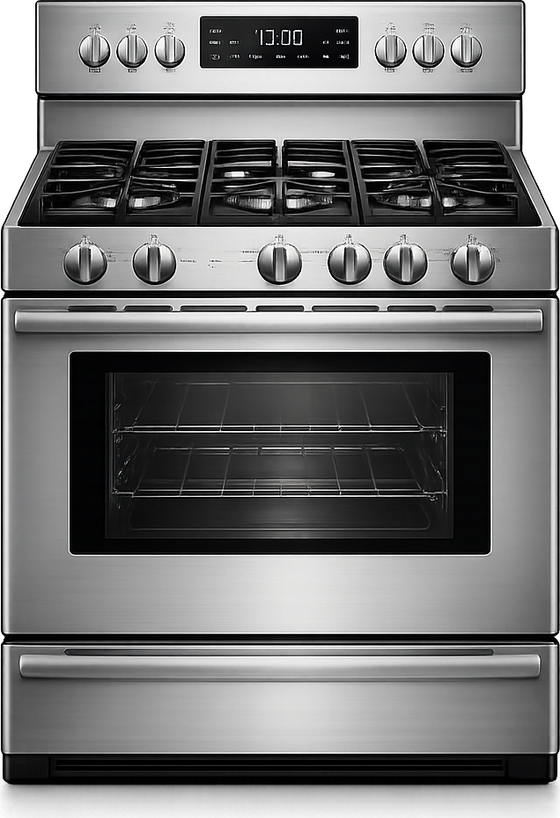
Common Oven and Range Problems in Leander Homes
The diagnosis below follows the manufacturers’ own service documentation for Whirlpool, Maytag, KitchenAid, GE, Samsung, LG and Frigidaire — their fault codes, sensor values and element tests — rather than general advice.
The oven will not heat at all
Common causes. On an electric oven the bake element, the relay that powers it, or the control itself has failed. A burned-out element usually shows a blister or a break, but not always, which is why it gets measured rather than looked at. The manufacturers build a test for exactly this: the control watches for current through the bake circuit and sets its own fault when it does not see any. On a gas range the same symptom is almost always a weak igniter that glows but never draws enough current to open the gas valve.
What we do. We measure the element and the supply at the element terminals, and on gas we measure the igniter’s current draw rather than judging it by how brightly it glows — a glowing igniter that has drifted out of specification is the single most common gas oven misdiagnosis.
The oven heats, but the temperature is wrong
Common causes. Temperature in a modern oven is read by an RTD sensor, and the control board measures the resistance of that circuit rather than the temperature itself. A sensor that has drifted, or a corroded connection adding resistance in the harness, makes the oven run cold or hot while the display says otherwise. The factory figure is specific: around 1,080 ohms at room temperature, and the Frigidaire procedure treats anything below about 900 or above about 1,200 as out of range.
What we do. We measure the sensor at the control plug and then at the sensor itself. If both read the same and the value is wrong, the sensor is the fault; if the sensor reads correctly but the plug does not, the harness is the fault. That one extra measurement is the difference between replacing a sensor and chasing a board.
The oven takes far too long to preheat
Common causes. Slow preheat on an electric oven usually means one of the two elements is not firing — many ovens preheat on both bake and broil, so a dead broil element doubles the preheat time while baking still works. A door that no longer seals, a drifted sensor, or a hidden bake element failing intermittently will do the same.
What we do. We watch which elements actually energise during preheat, measure both, and check the door seal and hinges. A door that will not close square loses heat continuously, and no amount of calibration fixes that.
An F code on the display
Common causes. Oven codes are unusually consistent across brands. An open temperature sensor and a shorted temperature sensor are reported as two separate faults; a door lock circuit fault is its own code; and an over-temperature fault is the serious one. The manufacturers give the thresholds: GE sets its over-temperature fault above roughly 615 to 630°F during bake and above roughly 915 to 930°F during clean, and Frigidaire uses 665°F with the door unlocked. The first thing to check on an over-temperature fault is a welded bake or broil relay, because that means the element keeps heating whatever the control commands.
What we do. We read the code, look it up for the exact model, then measure. On an over-temperature code we check the relay contacts before anything else, and we will tell you not to use the oven until it is resolved. A welded relay is a runaway heat condition, not an inconvenience.
The door will not unlock after a self-clean cycle
Common causes. Self-clean runs the cavity hot enough that the lock will not release until the oven cools, so the first question is whether enough time has passed. Beyond that, the lock motor, the lock switches or the wiring between them has failed — on motorised locks a pinched harness between the control and the lock switches is a known cause.
What we do. We confirm the cavity has actually cooled, then test the lock motor and both switches rather than forcing anything. A door forced open on a locked latch damages the latch and sometimes the door itself.
Bake works but broil does not, or the other way round
Common causes. Each element has its own relay on the control board, so losing one function and keeping the other usually means that element or that relay. On a dual-fuel or convection oven the convection element and fan add a third circuit that fails independently.
What we do. We measure each element and check for voltage at its terminals with the function selected. That separates a failed element from a failed relay in a couple of minutes, and they are very different parts at very different prices.
A surface burner on the range will not light or will not heat
Common causes. On a gas range, continuous clicking with no flame is normally a wet or dirty igniter, a burner cap out of position, or a clogged port. On an electric coil or radiant range, a single dead burner is the element, its receptacle, or the infinite switch behind the knob.
What we do. We clean and reseat the burner parts first, then test the spark module or the switch. Burned receptacles on coil ranges are common and easy to miss, so they get looked at before the element is condemned.
The door glass is loose, foggy or the door will not sit square
Common causes. Oven doors sag when the hinges wear, and a sagging door stops sealing, which shows up as slow preheat and uneven baking long before anyone notices the gap. Condensation between the glass panes points at a failed door seal or a glass panel that has shifted in its frame.
What we do. We check the hinges, the gasket and the door alignment, and we replace hinges in pairs where they have worn, since a single new hinge against a worn one puts the door out of square again.
Oven and Range Types and Brands We Repair in Leander
We work on freestanding and slide-in ranges, single and double wall ovens, gas, electric and dual-fuel, with and without convection, plus the self-clean and steam-clean systems built into them.
Brands we repair in Leander: Whirlpool, Maytag, GE, GE Profile, Samsung, LG, Frigidaire, KitchenAid, Amana, Bosch, Electrolux, Hotpoint, Kenmore, Fisher & Paykel, Wolf, Viking, Thermador, JennAir, Dacor and Miele.
What Oven and Range Repair Costs in Leander
Diagnostics are $99 for a residential call, and that amount is credited toward the repair when you approve it. After the diagnosis you get a written estimate covering parts and labor, and nothing is replaced before you approve it. The final figure depends on which part failed — a temperature sensor, a bake or broil element, an igniter, a door lock, a hinge set or a control board — and how far a built-in unit has to come out of the cabinetry to reach it.
Completed repairs carry a 3-month labor warranty from TakiDA LLC and a 1-year parts warranty against manufacturer defects.
Neighborhoods We Cover in Leander
We cover Leander as a whole, including Crystal Falls, Travisso, Bryson and Old Town, and we reach most addresses in the city within about twenty minutes. The newer builds out toward Crystal Falls and Travisso run a lot of built-in wall ovens and slide-in ranges, while Old Town kitchens are mostly freestanding gas, and the two come apart very differently. Nearby Cedar Park, Georgetown, Liberty Hill and Round Rock are also in our service area.
Common Questions About Oven and Range Repair in Leander
My oven bakes unevenly. Can it be calibrated?
Most ovens allow a calibration offset, but calibration only helps when the oven is genuinely holding a steady temperature at the wrong number. If the sensor has drifted or an element is out, calibration hides the symptom for a week and the problem comes back. We measure first and calibrate only when the measurements say it is the right answer.
Is a control board replacement worth it?
Sometimes, and often it is not actually the board. Over-temperature and sensor codes get blamed on boards constantly when the fault is a sensor, a harness or a welded relay. We confirm with measurements before quoting a board, because it is usually the most expensive part in the appliance.
Do you work on gas ranges, dual-fuel and wall ovens?
Yes, all three. Wall ovens and built-in units need more care getting in and out of the cabinetry, which is reflected in the labor, but they are regular work for us.
How fast can you get to Leander?
Leander is our home city, so same-day is usually possible if you call in the morning, and next-day otherwise.
Book Oven and Range Repair in Leander
Tell us the brand, whether it is gas, electric or dual-fuel, and what it is doing — no heat, wrong temperature, an F code, or a door that will not unlock. That is normally enough for us to arrive with the right parts on the van.
Reliable Oven and Range Repair in Leander, TX
-

Common Oven and Range Problems We Fix
- Oven will not heat
- Baking unevenly or burning food
- Temperature far off the setting
- Oven will not hold a setting
- Door will not close or seal
- Self clean leaves the oven dead
- Error code on the display
-
Ovens and Ranges We Repair
- Gas ranges
- Electric ranges
- Double wall ovens
- Slide-in and freestanding ranges
- Convection ovens
- Whirlpool, GE, Samsung, LG, KitchenAid
- Frigidaire, Maytag, Bosch, Electrolux

Oven and Range Brands We Repair
If your brand is not listed, contact us — we likely service it.
We repair all major residential appliance brands across Central Texas, including Whirlpool, GE, Samsung, LG, Maytag, Frigidaire, KitchenAid, Amana, Bosch, Electrolux, Hotpoint, Kenmore, Haier, Fisher & Paykel, Sub-Zero, Wolf, Viking, Thermador, JennAir, Dacor, U-Line, Marvel, Miele, and GE Monogram.
Why Homeowners & Businesses Choose TakiDA
-
 Quality WorkWe deliver professional appliance repair with attention to detail, proper diagnostics, and long-lasting results you can rely on.
-
 OEM / High-Quality PartsWe use OEM or high-quality replacement parts to ensure correct operation, reliability, and extended appliance lifespan.
-
 Same-Day / Next-Day ServiceFast response with same-day or next-day service to reduce downtime and get your appliances back in working order quickly.
-
 Clear PricingUpfront estimates with transparent pricing. No hidden fees, no surprises — you know the cost before work begins.
-
 EPA Certified & InsuredEPA Section 608 Universal certified and fully insured for residential and commercial repair, giving you peace of mind and protection.
-
 Warranty on Labor & PartsAll repairs are backed by a warranty on labor and installed parts for added confidence and long-term reliability.
