
Cooktop and Vent Hood Repair in Cedar Park, TX
A burner that will not light, an element stuck on high, touch controls that ignore you, or a hood that makes noise and pulls nothing. We repair cooktops and residential vent hoods across Cedar Park — gas, electric and induction. The $99 diagnostic comes off the repair, and you get a firm price before anything is replaced.
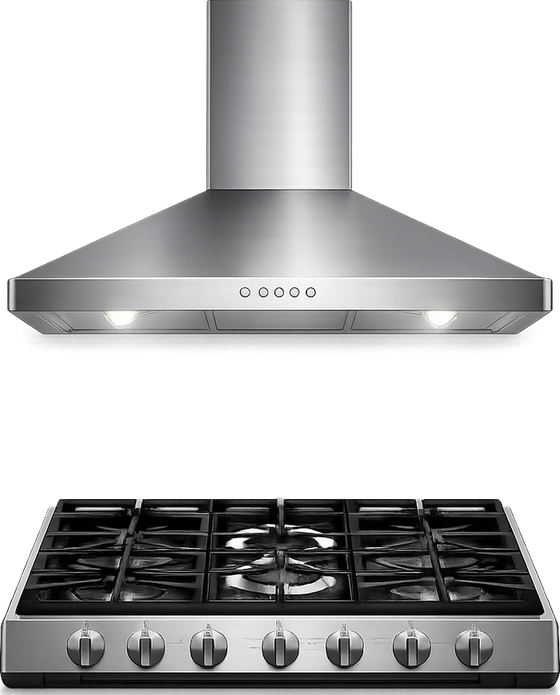
Common Cooktop and Vent Hood Problems in Cedar Park Homes
A gas burner lights with a yellow, lazy flame
A healthy gas flame is blue and tight. Yellow, soft and slow to respond means the burner is short of air or running on the wrong gas setting. The three causes, in the order we check them, are a port blocked by spillover, an air shutter knocked closed during cleaning, and an orifice sized for a different fuel — a cooktop converted to propane years ago and moved since is a common find. Yellow flames also deposit soot on pans, so if the undersides of your pots have gone black, that is the same fault telling you twice.
An electric element only works on high
Radiant elements do not vary their heat; they switch on and off, and the ratio is what you feel as a setting. When an element is on or nothing, the switching has failed closed — usually the infinite switch behind the knob or, on a touch-control cooktop, the relay on the control board. Manufacturers build a relay test into the service mode for exactly this, so it is a defined check rather than a parts swap. A welded relay is also what leaves an element glowing after everything is switched off, which is worth treating as urgent rather than annoying.
Touch controls ignore you, or the wrong zone responds
Capacitive controls read a change in capacitance through the glass, so anything that changes it will confuse them: a film of grease, a wet cloth left on the panel, or moisture that has worked under the glass at the edge. Clean and dry first, every time. If it persists, the control membrane or the board is the fault, and most platforms will tell you which — the control stores the last several fault codes and will replay them in service mode.
The cooktop shuts a zone off mid-cook
On induction this is usually the appliance protecting itself rather than failing. The power electronics sit under the glass and are cooled by a fan, and if the airflow is restricted the control drops the zone or shuts down. Manufacturers say to check ventilation and the installation clearance before condemning a part, and in Cedar Park the usual finding is a cooktop installed over a drawer cabinet with no path for air. The sensors themselves have a specified resistance — around a thousand ohms at room temperature on the platforms we see most — so a genuine sensor fault is measurable rather than inferred.
The hot surface light stays on for ages
Often not a fault at all. The indicator is driven by a sensor reading the glass, and most manufacturers hold it on until the surface drops below about 150°F. A heavy cast pan can keep glass above that for a long time after cooking. It becomes a fault when the light is on with the cooktop stone cold, which points at the sensor or its wiring rather than at anything that cooks.
The hood is loud, or rattles at the top speed
Hood noise is almost always the blower wheel rather than the motor. Grease builds unevenly on the wheel, it goes out of balance, and the vibration runs through the housing and the ducting. A wheel left like that chews its bearings, so the noise is an early warning worth acting on. The other common rattle is a backdraft damper flapping in the duct, which costs nothing to fix and sounds alarming.
Hood lights flicker or will not come on
On older hoods this is the lamp socket: heat and grease degrade the contacts, and the bulb looks fine while the socket is the problem. On newer hoods with LED strips there is a driver module between the switch and the lights, and a failing driver gives exactly the flicker people describe. Both are small parts. The switch itself is the third suspect and the easiest to confirm.
Grease drips from the hood onto the cooktop
Filters only work installed the right way round and seated so grease drains where it is meant to. A filter put back the wrong way after a wash, a bent baffle or a missing end cap sends grease down the face of the hood instead. If the filters are clean and correctly fitted and it still drips, the grease is coming back down the duct, which means the duct run or the termination needs attention rather than the hood.
Cooktops and Hoods We Repair in Cedar Park
Gas, electric radiant and induction cooktops, downdraft units, and the full range of residential vent hoods — under-cabinet, wall chimney, island and insert liners, ducted and recirculating.
Brands we repair in Cedar Park: Whirlpool, GE, Samsung, LG, Frigidaire, Maytag, KitchenAid, Bosch, Amana, Kenmore, Broan and NuTone.
What Cooktop and Hood Repair Costs in Cedar Park
The residential diagnostic is $99 and comes off the repair when you approve it. You get a written price covering parts and labor before anything is replaced. Switches, igniters, sockets, hood motors and blower wheels are modest. Induction power boards and glass tops are not, and on a cracked glass top we will usually tell you straight away that replacing the cooktop is the better buy.
Gas work finishes with a leak check on anything we opened.
Neighborhoods We Cover in Cedar Park
Kitchens in Cedar Park split by era, and so do the faults. The 1990s builds around Buttercup Creek and Carriage Hills mostly run gas or coil cooktops with simple under-cabinet hoods, where switches, igniters and lamp sockets are the usual work. The newer kitchens in Twin Creeks, Ranch at Brushy Creek and the Town Center builds bring glass and induction tops with touch controls and chimney hoods, where ventilation clearance and control boards come into it. We cover both, and the diagnostic is the same either way.
Common Questions About Cooktop and Hood Repair in Cedar Park
My glass cooktop is cracked. Can it be repaired?
No — a cracked glass top is replaced, not repaired, and on most models the glass with its frame costs enough that a new cooktop is the better value. We will give you the part price so you can compare rather than taking the job by default. In the meantime a cracked top should not be used: moisture reaching the wiring underneath is a real risk.
Why do my induction zones keep cutting out?
Most often ventilation rather than electronics. Induction cooktops cool their power boards with a fan, and a tight installation or a blocked path makes the control protect itself. We check the clearance and the airflow before anyone orders a board.
Can you fix the hood as well as the cooktop?
Yes — motors, blower wheels, switches, lights, dampers and controls. Residential hoods only; commercial kitchen exhaust is a different trade and we will say so.
My burner clicks even after it lights. Is that bad?
It means the spark module is still being told the flame is not there, usually because the igniter is dirty or wet, or the burner cap is seated crooked. It is a small job and worth doing — a module that sparks continuously wears out.
How quickly can you get to Cedar Park?
Usually the same day. Call (737) 388-3867 with the brand and whether the cooktop is gas, electric or induction — those three carry completely different parts.
Book Cooktop or Hood Repair in Cedar Park
Tell us the brand, whether the cooktop is gas, electric or induction, and what it is doing. That is normally enough for us to arrive with the right parts on the van.
Cooktop and Vent Hood Repair in Cedar Park, TX
-

Cooktop and Hood Symptoms We Sort Out
- Igniter clicking with no flame
- Flame yellow or lifting off the burner
- One element dead, the rest fine
- Glass top controls not responding
- Hood barely moving any air
- Hood fan rattling or humming
- Smell of gas at the cooktop
-
Cooktops and Hoods We Work On
- Gas and propane cooktops
- Electric coil and radiant cooktops
- Induction cooktops
- Downdraft systems
- Wall-mounted and island hoods
- Whirlpool, GE, Samsung, LG, KitchenAid
- Frigidaire, Maytag, Bosch, Electrolux

Cooktop and Hood Brands We Service in Cedar Park
If your brand is not listed, contact us — we likely service it.
We repair all major residential appliance brands across Central Texas, including Whirlpool, GE, Samsung, LG, Maytag, Frigidaire, KitchenAid, Amana, Bosch, Electrolux, Hotpoint, Kenmore, Haier, Fisher & Paykel, Sub-Zero, Wolf, Viking, Thermador, JennAir, Dacor, U-Line, Marvel, Miele, and GE Monogram.
Why Homeowners & Businesses Choose TakiDA
-
 Quality WorkWe deliver professional appliance repair with attention to detail, proper diagnostics, and long-lasting results you can rely on.
-
 OEM / High-Quality PartsWe use OEM or high-quality replacement parts to ensure correct operation, reliability, and extended appliance lifespan.
-
 Same-Day / Next-Day ServiceFast response with same-day or next-day service to reduce downtime and get your appliances back in working order quickly.
-
 Clear PricingUpfront estimates with transparent pricing. No hidden fees, no surprises — you know the cost before work begins.
-
 EPA Certified & InsuredEPA Section 608 Universal certified and fully insured for residential and commercial repair, giving you peace of mind and protection.
-
 Warranty on Labor & PartsAll repairs are backed by a warranty on labor and installed parts for added confidence and long-term reliability.
