
Oven and Range Repair in Austin, TX
Ovens fail quietly. Nothing breaks, the food just starts coming out wrong, and by the time anyone calls, the oven has been running thirty or forty degrees off for months. We work on ranges and wall ovens all over Austin, from thirty year old units in bungalow kitchens to pro style ranges dropped into recent remodels, and the first thing we do is measure what the oven is actually doing rather than what the display claims.
Common Oven and Range Problems in Austin Homes
An oven baking well under the set temperature
Nearly every modern oven measures cavity temperature with a resistance sensor, and that sensor drifts as it ages. When it starts reading higher than the real temperature, the control shuts the heat off early and everything bakes slow and pale. A single thermometer reading is not enough to prove it, because ovens are supposed to swing either side of the set point. The sensor gets measured cold, and the cavity gets watched through a full cycle before anything is replaced.
An oven that is completely dead after a self clean cycle
Self clean drives the cavity to roughly eight hundred and eighty degrees and everything behind the back panel lives through it. The usual casualty is the thermal fuse, an inexpensive part that opens and never resets, and sometimes the control board goes with it. If the oven worked an hour before the clean cycle and nothing responds afterward, that is the first place to look. It is also the reason we suggest never running self clean the week before a holiday.
A gas oven that lights, runs for a while, then quits
A gas oven safety valve does not open because the igniter glows. It opens because the igniter draws enough current through the circuit to pull it in. As a carbide igniter ages it still glows bright orange while drawing less and less, so the oven lights when cold and refuses once it is hot. That is why current is measured while the oven tries to light, instead of judging the igniter by how it looks.
A convection fan that grinds or stops turning
The convection motor sits in the hottest moving air in the appliance and its bearing dries out over the years. First it announces itself with a grind or a whine on convection settings, then it stops. What makes this one sneaky is that the oven usually throws no error code at all. It just starts baking unevenly, and people chase recipes and racks for months before someone listens to the fan.
The broiler works but the bake element does nothing
Two possibilities and they cost very different amounts. Either the bake element has burned open, which can often be seen as a break or a blister, or the relay that switches the bake circuit on the control board has failed. Resistance across the element settles it in a minute. Replacing a board because an element failed, or an element because a relay failed, is exactly the kind of guess we would rather not make on your money.
A touch panel that is unresponsive or stuck in lock
Control lock, Sabbath mode and a failed membrane look identical from the front. The free checks come first. After that, membranes usually crack from heat near the vent, and the pattern of which keys still respond points at which trace has opened. That tells us whether the panel alone will fix it or whether the board behind it is also involved.
A door that will not seal or hangs crooked
Hinge springs stretch over years of use and a heavy door slowly drops out of square. Heat then escapes at the top of the door, the control panel above it cooks, and the cavity never holds a steady temperature. Replacing a temperature sensor on an oven with a leaking door accomplishes nothing, so the door and the gasket get checked before anyone talks about calibration.
A range in a remodeled kitchen that cooks hot on one side
Large cavity ranges are sensitive to how they are installed. A unit that is not level, that is pushed too tight into cabinetry, or that has a blocked vent path under the backguard will bake unevenly no matter how healthy the elements are. We check installation and airflow alongside the electrical side, because a perfectly good range in a bad opening behaves like a broken one.
Ovens and Ranges We Repair in Austin
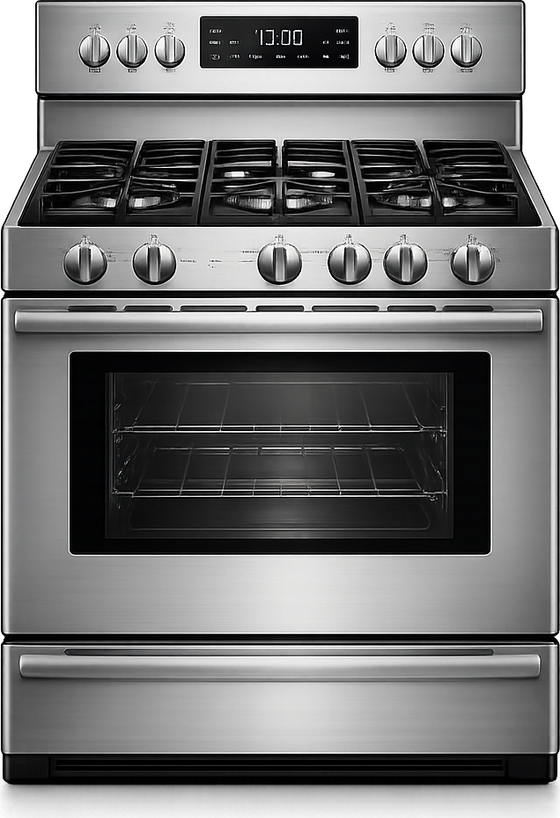
Freestanding gas and electric ranges, slide in and pro style ranges, dual fuel units, and single and double wall ovens including convection and true convection models. Common brands include Whirlpool, Maytag, GE, KitchenAid, Samsung, LG, Frigidaire, Bosch, Electrolux, Thermador and Wolf.
Wall ovens get pulled from their cabinet when the work requires it and set back in properly, which on a double oven is a two person job we plan for rather than discover.
What Oven and Range Repair Costs in Austin
The diagnostic is ninety nine dollars on a residential call and it is credited toward the repair once you approve the work. A thermal fuse, an igniter, a bake element, a sensor or a hinge set are all modest repairs. A control board or a glass door assembly on a pro style range is a different number, and you will see it in writing before we order anything.
On an older range we will also tell you honestly when the repair is approaching the cost of a replacement, and what we would do in your position.
Neighborhoods We Cover in Austin
Downtown and Rainey Street, East Austin, Hyde Park, North Loop, Mueller, Crestview, Brentwood, Allandale, Windsor Park, Bouldin Creek, Travis Heights, South Congress, Zilker, Barton Hills, the Domain and North Austin, East Riverside, and the northwest neighborhoods along 620.
Common Questions About Oven and Range Repair in Austin
Is it safe to run the self clean cycle?
On a healthy oven, yes, but it is the hardest thing you will ever ask the appliance to do. If the oven is older, or already showing temperature trouble, a manual clean is kinder. And whatever you do, do not run it the week you are planning to cook for guests.
My oven reads thirty degrees off. Can it just be calibrated?
Most ovens allow an offset of a limited number of degrees, and that is the right answer when the sensor itself is still accurate. When the sensor has drifted, calibration just moves the error around. Measuring the sensor is what tells us which of the two we are dealing with.
The igniter glows. Does that not mean it is fine?
No, and this is the single most common wrong conclusion on gas ovens. The valve responds to current, not to light. A weak igniter glows beautifully and still fails to open the valve, especially once the oven is warm. It has to be measured.
Can a built in wall oven be repaired, or is it a replacement?
Almost always repaired. Wall ovens are expensive to replace and often leave a cabinet opening that no current model fits, so repair is usually the better economics by a wide margin. Parts availability is the main thing we check before recommending it.
How long does a part usually take?
Common parts for mainstream brands are often same day or next day. Pro style and European brands can run longer. We tell you the expected wait when you approve the estimate, not after.
Book Oven or Range Repair in Austin
Tell us the brand, whether it is gas or electric, and what the oven does rather than what the display says, and we can usually narrow it down before we arrive. Call (737) 388-3867 or book online. The ninety nine dollar diagnostic is credited toward the repair.
Oven and Range Repair in Austin, TX
-

Oven and Range Problems We Get Called For
- Oven baking forty degrees under the set temperature
- Completely dead oven right after a self clean cycle
- Gas oven that lights, runs a while, then quits
- Convection fan noisy or not turning at all
- Broiler working while the bake element stays cold
- Touch panel unresponsive or stuck in lock
- Door that will not seal or hangs crooked
-
Ovens and Ranges We Service
- Freestanding gas and electric ranges
- Slide in and pro style ranges
- Single and double wall ovens
- Convection and true convection ovens
- Dual fuel ranges
- Door, hinge and gasket work

Oven and Range Brands We Service in Austin
If your brand is not listed, contact us — we likely service it.
We repair all major residential appliance brands across Central Texas, including Whirlpool, GE, Samsung, LG, Maytag, Frigidaire, KitchenAid, Amana, Bosch, Electrolux, Hotpoint, Kenmore, Haier, Fisher & Paykel, Sub-Zero, Wolf, Viking, Thermador, JennAir, Dacor, U-Line, Marvel, Miele, and GE Monogram.
Why Homeowners & Businesses Choose TakiDA
-
 Quality WorkWe deliver professional appliance repair with attention to detail, proper diagnostics, and long-lasting results you can rely on.
-
 OEM / High-Quality PartsWe use OEM or high-quality replacement parts to ensure correct operation, reliability, and extended appliance lifespan.
-
 Same-Day / Next-Day ServiceFast response with same-day or next-day service to reduce downtime and get your appliances back in working order quickly.
-
 Clear PricingUpfront estimates with transparent pricing. No hidden fees, no surprises — you know the cost before work begins.
-
 EPA Certified & InsuredEPA Section 608 Universal certified and fully insured for residential and commercial repair, giving you peace of mind and protection.
-
 Warranty on Labor & PartsAll repairs are backed by a warranty on labor and installed parts for added confidence and long-term reliability.
