
Cooktop and Vent Hood Repair in Austin, TX
Austin kitchens run the whole range. A high rise condo with an induction cooktop and a hood that recirculates through charcoal filters, a 1950s bungalow with gas and an original soffit duct, an island downdraft in a mid century remodel, or a pro style range under a hood that moves more air than the house can replace. The fix usually depends on which of those you have.
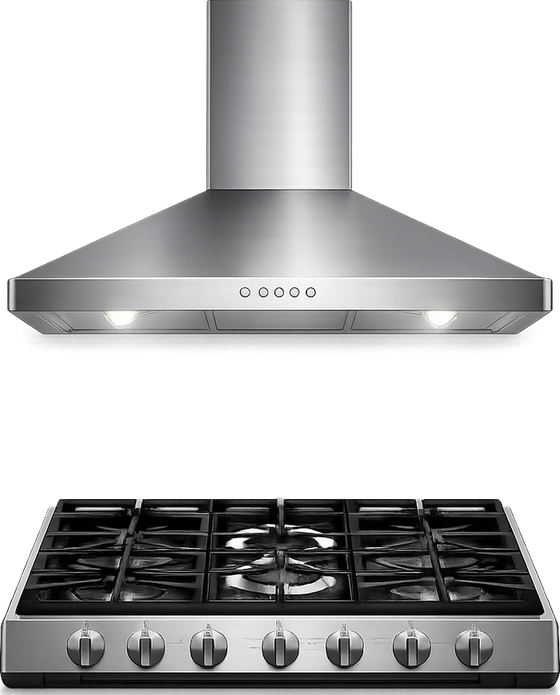
Common Cooktop and Vent Hood Problems in Austin Homes
An induction burner that cuts out partway through cooking
Induction zones shut themselves down for two reasons. Either the pan is no longer being detected, because the base has warped off the glass or it is smaller than the zone expects, or the electronics underneath are overheating. The generator board sits in a cooling air path, and in a tight cabinet that intake gets blocked by a drawer, a liner, or dust. A failed glass thermistor does the same thing and has to be separated from the airflow problem by measurement, not by guessing.
A gas burner that keeps clicking after it lights
The spark module keeps firing because something tells it the burner has not lit. Most of the time that something is moisture: a boil over under the burner cap, a cap sitting crooked on its base, or a switch that got wet during cleaning. If every burner clicks together, suspicion moves to the module itself. The burner keeps working while this happens, which is why people live with it, but a module firing continuously does eventually fail.
One zone dead on an island downdraft cooktop
Downdraft units hide the blower, the damper and most of the wiring below the counter. The harness that feeds the vent assembly flexes every time the vent rises and drops, so that is where conductors break first. Getting to it means pulling the unit up out of the island carefully, with the gas or power isolated, rather than working blind through a cabinet door.
A hood fan that runs but pulls nothing
In a condo the hood is often ductless, and it recirculates through charcoal filters that are completely saturated after a year or two of real cooking. In a house with a ducted hood the same symptom comes from a backdraft damper that no longer swings open, a duct crushed inside a soffit, or a roof cap screened over by a previous owner. The blower is usually fine in all three cases, so the first measurement is airflow, not motor current.
Hood lights work but the blower stays silent
Lighting and blower are separate circuits inside the hood, so working lights tell you only that the hood has power. A blower that hums without turning points at the motor capacitor or a seized bearing. Complete silence points at the speed control or the switch assembly. Those are different parts at different prices, and the test that separates them takes a couple of minutes.
Touch controls on a glass cooktop ignoring you
The control board sits directly under the glass in a hot, occasionally damp place. Before anything is replaced, the free checks come first: control lock engaged, residue or a wet cloth across the sensors, a tripped leg of the supply. After that it comes down to a loose ribbon connector or a board that has taken heat damage, and the board is identified by model rather than by appearance.
A radiant burner stuck on high no matter where the knob is
Electric radiant cooktops do not vary power smoothly. An infinite switch cycles the element on and off, and the knob only changes how long it stays on. When the contacts inside that switch weld shut, the element never gets the off half of the cycle and sits at full power. Turn the circuit off at the breaker and leave it off until it is repaired. This one is worth treating as urgent.
A new pro style hood that underperforms or pulls on the water heater
A high capacity hood in a tightly remodeled Austin house can move more air than the house can replace. With no makeup air path the hood never reaches its rating, and in the worst case it pulls on an atmospheric water heater or furnace flue. That is an airflow and pressure problem, not a broken blower, and it gets diagnosed as one before anybody suggests replacing the hood.
Cooktops and Hoods We Repair in Austin
We service gas, coil and radiant glass cooktops, induction cooktops, downdraft and island units, and ducted as well as recirculating vent hoods in under cabinet, wall chimney and island configurations. Common brands include Whirlpool, KitchenAid, GE, Bosch, Samsung, LG, Frigidaire, Thermador, Wolf and Zephyr.
Cooktop and hood often get looked at together, because the complaint that brings us out is usually about the whole cooking area rather than one appliance.
What Cooktop and Hood Repair Costs in Austin
The diagnostic is ninety nine dollars on a residential call and it is credited toward the repair when you approve it. After that the price follows the part. A spark module, an infinite switch, a hood capacitor or a set of charcoal filters are inexpensive. An induction generator board or a glass top for a built in cooktop is not. You see the number in writing before anything is replaced.
Duct and makeup air work is quoted on its own. It is a different kind of job from a part swap, and pretending otherwise leads to a hood that is repaired on paper and still does not pull.
Neighborhoods We Cover in Austin
Downtown and Rainey Street, East Austin, Hyde Park, North Loop, Mueller, Crestview, Brentwood, Allandale, Windsor Park, Bouldin Creek, Travis Heights, South Congress, Zilker, Barton Hills, the Domain and North Austin, East Riverside, and the northwest neighborhoods along 620.
Common Questions About Cooktop and Hood Repair in Austin
Why does my induction cooktop switch a burner off by itself?
Either it stopped seeing the pan or the electronics underneath got too hot. Try the same burner with a flat, heavy, magnetic pan and with the cabinet below clear. If it still drops out, the cooling path or a temperature sensor is the problem, and that is worth checking before the board takes damage.
Is a ductless hood in a condo worth fixing?
Usually yes, and often the fix is filters rather than parts. A recirculating hood depends entirely on charcoal that has a service life, and a saturated filter makes a working blower feel broken. If the blower itself has failed, replacing the motor assembly is still normally cheaper than a new hood plus cabinet work.
My burner clicks even after it lights. Is that dangerous?
It is not an emergency, but it should not be ignored. The spark module is running continuously, which shortens its life, and the usual cause is moisture or a misaligned burner cap that is also affecting how the burner performs. Dry everything thoroughly, reseat the cap, and if it keeps clicking, it is time to look at the module and the switches.
Can you work on a downdraft cooktop built into an island?
Yes. Those take longer because the unit has to come up out of the counter to reach the blower, damper and harness, and that is factored into the estimate rather than discovered halfway through. Stone counters and tight island cabinets get handled carefully.
Can the cooktop and the hood be done in one visit?
If both need attention, we diagnose both on the same call and you get one estimate covering them. Parts availability decides whether everything finishes that day, and you will know which it is before we leave.
Book Cooktop or Hood Repair in Austin
Tell us the brand, whether it is gas, electric or induction, and whether the hood is ducted or recirculating, and we can narrow it down before we arrive. Call (737) 388-3867 or book online. The ninety nine dollar diagnostic is credited toward the repair.
Cooktop and Vent Hood Repair in Austin, TX
-

Cooktop and Hood Problems We Get Called For
- Induction burner that cuts out partway through cooking
- Gas burner that keeps clicking long after it lights
- One burner dead on an island downdraft cooktop
- Hood fan running but barely pulling anything
- Hood lights working while the blower stays silent
- Touch controls on a glass cooktop ignoring you
- Burner stuck on high regardless of the knob
-
Cooktops and Hoods We Service
- Gas, coil and radiant glass cooktops
- Induction cooktops
- Downdraft and island cooktops
- Ducted and recirculating vent hoods
- Under cabinet, wall chimney and island hoods
- Blower, damper and duct airflow checks

Cooktop and Hood Brands We Service in Austin
If your brand is not listed, contact us — we likely service it.
We repair all major residential appliance brands across Central Texas, including Whirlpool, GE, Samsung, LG, Maytag, Frigidaire, KitchenAid, Amana, Bosch, Electrolux, Hotpoint, Kenmore, Haier, Fisher & Paykel, Sub-Zero, Wolf, Viking, Thermador, JennAir, Dacor, U-Line, Marvel, Miele, and GE Monogram.
Why Homeowners & Businesses Choose TakiDA
-
 Quality WorkWe deliver professional appliance repair with attention to detail, proper diagnostics, and long-lasting results you can rely on.
-
 OEM / High-Quality PartsWe use OEM or high-quality replacement parts to ensure correct operation, reliability, and extended appliance lifespan.
-
 Same-Day / Next-Day ServiceFast response with same-day or next-day service to reduce downtime and get your appliances back in working order quickly.
-
 Clear PricingUpfront estimates with transparent pricing. No hidden fees, no surprises — you know the cost before work begins.
-
 EPA Certified & InsuredEPA Section 608 Universal certified and fully insured for residential and commercial repair, giving you peace of mind and protection.
-
 Warranty on Labor & PartsAll repairs are backed by a warranty on labor and installed parts for added confidence and long-term reliability.
