
Ice Maker Repair in Liberty Hill, TX
An ice maker is the first appliance to complain about the water it is given. In Liberty Hill that often means a private well, and the sediment and mineral load that goes with it, plus a second ice maker out on a covered patio or in a shop where the summer heat does the rest. The mechanical parts rarely fail first. The water side does.
Common Ice Maker Problems in Liberty Hill Homes
No ice at all while the freezer is still cold
A cold freezer rules out the sealed system and moves the search to the ice maker itself and its water supply. The usual list is the inlet valve, a line frozen at the point where it enters the door or the freezer wall, the ice maker module or motor, and the shut off arm or optical sensor telling the machine the bin is full when it is not. Those are four very different parts, which is why the water line gets tested before anything is replaced.
Cubes coming out small, hollow or cloudy
Thin or hollow cubes mean the mold is not filling completely, and on a well that is almost always restriction: a loaded filter, a silted inlet screen, or weak pressure from the pressure tank. Cloudy ice is mineral carried into the cube rather than a fault. Measuring the fill volume per cycle tells us which one we are dealing with in a couple of minutes.
Ice that tastes or smells wrong
Ice absorbs whatever is around it. The causes split into three: water chemistry, which on a well can mean sulfur or iron, an old filter that has stopped filtering and started contributing, and simply ice that has been sitting in the bin for weeks absorbing freezer odors. Dumping the bin and running fresh cycles after a filter change settles most of it.
A bin full of ice frozen into one block
Bridged ice means the cubes are going in wet or the bin is warming slightly between cycles. A slow leak at the inlet valve dribbles water into the mold between fills, the cubes fuse, and the auger or the dispenser then jams on the mass. People break it up with a screwdriver, which is how molds and augers get damaged.
Water leaking down the back of the freezer
Usually the fill tube has frozen partly closed and water is now overshooting the mold, or the inlet valve is weeping. Both end as a sheet of ice at the back of the freezer and a puddle on the floor. The fill tube can be cleared, but the reason it froze, which is usually a slow leak or a defrost issue, has to be addressed too or it comes straight back.
An outdoor or patio unit that gives up in summer
Outdoor rated ice makers exist because a standard indoor unit cannot reject heat into a hundred degree afternoon under a patio roof. If the unit out there is not outdoor rated, it will keep failing every July no matter what we replace, and the honest answer is a different unit. If it is rated and still failing, the condenser and its airflow come first.
A dispenser jamming or crushing when it should cube
In door dispensers have a solenoid and a crusher assembly, and the two share a path. A jam from bridged ice, a broken crusher blade, or a solenoid that no longer shifts will all produce the wrong ice or no ice at all while the maker itself is working perfectly. That distinction matters because the parts live in completely different places.
An ice maker that stopped after a power flicker
Rural power dips often and ice maker modules are simple but not immune. A unit that produced ice before a storm and nothing after it frequently needs a proper power down and a reset rather than a module. If it does not come back, then the module or the control is a real candidate instead of a guess.
Ice Makers We Repair in Liberty Hill
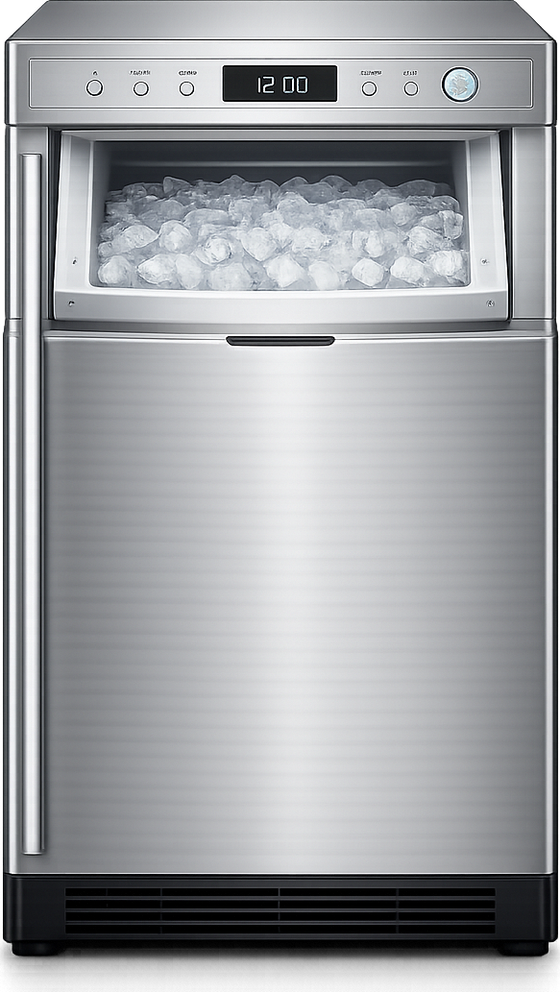
Refrigerator ice makers in the door and in the freezer, under counter residential units, outdoor rated and patio models, nugget and clear ice machines, and standalone makers in shops and home bars. Common brands include Whirlpool, Samsung, LG, GE, KitchenAid, Frigidaire, Scotsman, U Line, Marvel and Hoshizaki.
On a well we check pressure and filtration as part of the diagnosis, because an ice maker is the appliance most sensitive to what is coming out of the ground.
What Ice Maker Repair Costs in Liberty Hill
The diagnostic is ninety nine dollars for a residential call and it is credited toward the repair once you approve the work. Inlet valves, fill tubes, modules, augers, sensors and filters are all moderate repairs. A full ice maker assembly on a built in unit costs more, and on an inexpensive countertop machine we will tell you honestly when a repair is not worth doing.
If the restriction is upstream of the appliance, in the filter housing, the line or the pressure tank, you will hear that rather than paying for a valve.
Neighborhoods We Cover in Liberty Hill
Santa Rita Ranch, Orchard Ridge, Rancho Sienna, Butler Farms, Bar W Ranch, Stonewall Ranch, Clearwater Ranch, Liberty Parke, downtown Liberty Hill, and acreage properties along 29, 183 and Ronald Reagan Boulevard.
Common Questions About Ice Maker Repair in Liberty Hill
How long should an ice maker take to fill the bin?
Most refrigerator ice makers produce roughly two to three pounds a day once up to temperature, so a full bin from empty takes a day or two rather than an afternoon. A unit that has not produced anything in twenty four hours has a real fault.
Does well water need a filter before the refrigerator?
It helps a great deal. The refrigerator filter is designed for taste and particulates on treated water, not for sediment from a well. Filtration ahead of the appliance keeps the inlet valve, the fill tube and the mold working as intended and makes the fridge filter last its stated life.
Why is my ice cloudy when the water tastes fine?
Cloudiness is dissolved mineral and trapped air, not dirt. It is cosmetic and very common on hard water. Clear ice machines freeze slowly from one direction specifically to avoid it, and that is a different machine rather than a setting.
Can an indoor ice maker be used outside under a patio?
It will work in spring and fail in summer. Outdoor rated units use different condensers and seals for exactly that reason. If one is already out there and failing every July, that is the explanation.
Is an ice maker worth repairing or should the fridge be replaced?
Repairing the ice maker is almost always the right call. It is a subsystem inside an otherwise healthy appliance, and replacing a whole refrigerator over an ice maker rarely makes financial sense.
Book Ice Maker Repair in Liberty Hill
Tell us the brand, whether the freezer is still cold, whether you are on a well, and what the ice looks like when it does come out, and we can usually narrow it down before we arrive. Call (737) 388-3867 or book online. The ninety nine dollar diagnostic is credited toward the repair.
Ice Maker Repair in Liberty Hill, TX
-

Ice Maker Problems We Get Called For
- No ice at all with the freezer still cold
- Cubes coming out small, hollow or cloudy
- Ice tasting or smelling off
- Bin full of ice frozen into one block
- Water leaking down the back of the freezer
- Outdoor or patio unit that quits in summer
- Dispenser jamming or crushing when it should cube
-
Ice Makers We Service
- Refrigerator ice makers, in door and in freezer
- Under counter residential ice makers
- Outdoor rated and patio units
- Nugget and clear ice machines
- Standalone ice makers in shops and bars
- Water line, valve and filtration diagnostics

Ice Maker Brands We Service in Liberty Hill
If your brand is not listed, contact us — we likely service it.
We repair all major residential appliance brands across Central Texas, including Whirlpool, GE, Samsung, LG, Maytag, Frigidaire, KitchenAid, Amana, Bosch, Electrolux, Hotpoint, Kenmore, Haier, Fisher & Paykel, Sub-Zero, Wolf, Viking, Thermador, JennAir, Dacor, U-Line, Marvel, Miele, and GE Monogram.
Why Homeowners & Businesses Choose TakiDA
-
 Quality WorkWe deliver professional appliance repair with attention to detail, proper diagnostics, and long-lasting results you can rely on.
-
 OEM / High-Quality PartsWe use OEM or high-quality replacement parts to ensure correct operation, reliability, and extended appliance lifespan.
-
 Same-Day / Next-Day ServiceFast response with same-day or next-day service to reduce downtime and get your appliances back in working order quickly.
-
 Clear PricingUpfront estimates with transparent pricing. No hidden fees, no surprises — you know the cost before work begins.
-
 EPA Certified & InsuredEPA Section 608 Universal certified and fully insured for residential and commercial repair, giving you peace of mind and protection.
-
 Warranty on Labor & PartsAll repairs are backed by a warranty on labor and installed parts for added confidence and long-term reliability.
