
Ice Maker Repair in Leander, TX
The ice maker has stopped, and nobody wants to be buying bagged ice through a Texas summer. We repair refrigerator ice makers and standalone ice machines across Leander — Crystal Falls, Travisso, Bryson and the older streets around Old Town — usually same-day or next-day. The $99 diagnostic goes toward the repair, and you get a firm price before any part is replaced.
Common Ice Maker Problems in Leander Homes
The diagnosis below follows the manufacturers’ own ice maker service documentation for Whirlpool, Maytag, GE, Samsung, LG and Frigidaire — their service modes, cycle timings and resistance checks — rather than general advice.
The ice maker makes no ice at all
Common causes. An ice maker will not start a cycle until the mold itself is cold enough: GE documents 16°F as the point where the cycle begins, and LG’s service data expects 0 to 5°F in the freezer with a harvest roughly every 70 to 80 minutes. A freezer sitting at 10°F therefore stops ice production with nothing at all wrong in the ice maker. After temperature, the usual faults are a frozen fill tube, a supply line that is kinked or shut off, a water valve that no longer opens, a filter long past its service life, a feeler arm or bin switch left in the off position, or the module itself.
What we do. We measure the real freezer temperature with our own thermometer rather than reading the display, because that single number rules out half the list. Then we follow the factory sequence: start a harvest, check for heat at the mold, catch the fill water in a measuring container, and compare it against the volume the manual specifies. Whirlpool’s own chart gives the readings for the parts in that circuit — around 300 ohms at the water valve coil, around 72 ohms at the mold heater, several thousand at the motor — so a dead part is proven with a meter, not assumed.
The cubes come out small, hollow or only half formed
Common causes. Cube size is set by how much water reaches the mold, so small cubes almost always mean a restricted fill rather than a cooling fault. A filter at the end of its life, low house pressure, a partly frozen fill tube or a valve that opens only part way all shorten the fill. LG specifies a fill of roughly 3.5 to 4 ounces per cycle, and anything meaningfully under that shows up immediately as a thin or hollow cube.
What we do. We measure the actual fill volume during a harvest and the water pressure at the supply, then decide between filter, line, valve and fill-tube heater. Some platforms have a fill adjustment at the module, but adjusting it to hide a restricted supply only buys a few weeks, so we fix the restriction first.
The ice freezes into one solid block in the bin
Common causes. Cubes clump when they partly melt and refreeze, which means the freezer is drifting warm or losing air, or when water keeps dripping into the bin between cycles. A water valve that does not close fully is the classic version of the second case: the manufacturers note that ice found in the fill tube points at a valve that is weeping rather than at the ice maker.
What we do. We check the freezer temperature and the door seal first, then look for ice in the fill tube and test whether the valve holds when it should be closed. If the freezer is cycling warm, the clumping is a symptom and the defrost or airflow fault underneath it is the actual repair.
Water leaks into the freezer or onto the floor
Common causes. A leak around an ice maker comes from one of three places: the fill tube missing the cup so water runs down the back wall, a supply line or valve connection that seeps, or an overfill caused by a valve that stays open too long. A fill tube that is seated badly will also freeze over and then push the next fill outside the mold.
What we do. We run a cycle and watch where the water actually goes before taking anything apart, because the trail at the end of a cycle names the part. Then we check the seating of the fill tube and fill cup, the valve’s shut-off, and the line fittings.
The ice tastes or smells bad
Common causes. Ice absorbs odours, so the usual source is a filter long overdue, a bin of old ice that has sat through several defrost cycles, or food odours in a cabinet whose air is not moving properly. A supply line that has not been flushed since installation can carry a plastic taste of its own.
What we do. We check filter age and flush the line, empty and wash the bin, and verify that airflow and defrost are working — a cabinet that is slowly frosting over concentrates odours and carries them into the ice.
The dispenser jams and ice will not come through
Common causes. Most dispenser jams are mechanical: cubes fused together in the chute, a chute flap that no longer closes so warm air melts and refreezes the ice at the opening, or a broken auger coupling. A dispenser motor or door switch fault is less common but does happen.
What we do. We clear the chute and check that the flap seals, then test the auger drive and the switch. If ice keeps refreezing at the chute, the flap or its gasket is the repair — clearing the blockage without that puts the same call back in a week.
The ice maker cycles but the ice never drops
Common causes. A failed harvest means the mold heater is not freeing the cubes, the ejector is jammed, or the control is ending the cycle early. In the factory service mode the heater is held on for at least twenty seconds before the ejector sweeps, so a heater that is open or a thermostat that will not close stops the harvest cold. On GE controls the thermistor is watched through the cycle, and the board itself will flag an insufficient fill when the mold does not cool as expected.
What we do. We enter the service mode, run a harvest on command, and feel for heat at the bottom of the mold within the first part of the cycle. No heat means the heater or its thermostat, not the module. If the heater works and the ejector still stalls, we look at the motor and the gear train.
An error code tied to the ice maker
Common causes. Samsung and LG both log ice maker faults separately from the rest of the refrigerator, with their own codes for the ice maker function, its sensor and the ice compartment fan. A code names the circuit that failed a self-test, and the failure can be the part, the wiring to it, or the board reading it. Some ice-related codes clear after a full defrost, which tells you the real fault was frost rather than the ice maker.
What we do. We read the code, look it up for your exact model, and confirm it with a measurement before ordering anything. A code that reports an ice maker sensor out of range can be the sensor, the harness or the board, and those are three different repairs at three different prices.
Ice Maker Types and Brands We Repair in Leander
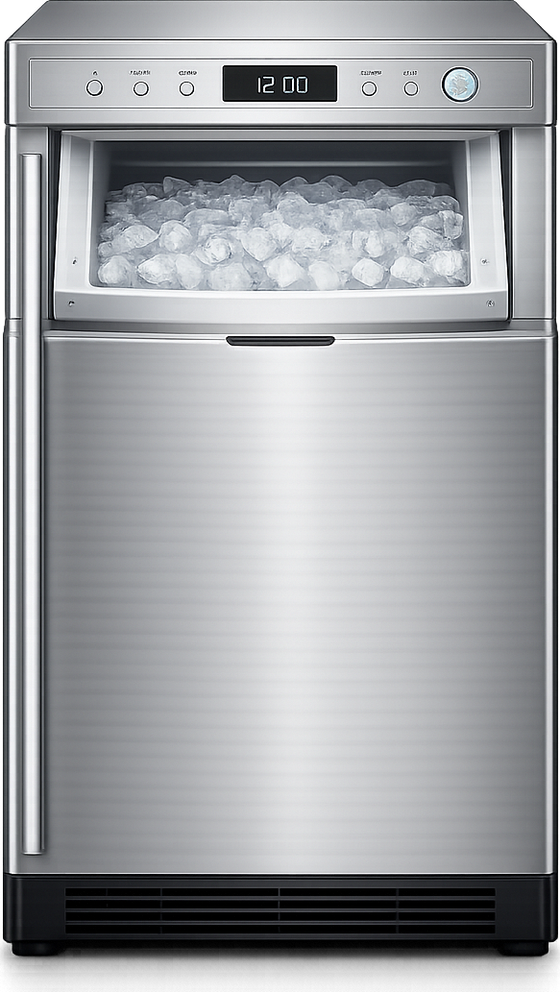
We work on ice makers built into French door, side-by-side and bottom-freezer refrigerators, in-door ice systems, built-in and column units, and standalone undercounter ice machines. That includes sealed-system work on units that make their own cold: the technician is EPA Section 608 certified, which is required to handle refrigerant legally.
Brands we repair in Leander: Whirlpool, GE, GE Monogram, Samsung, LG, Maytag, Frigidaire, KitchenAid, Amana, Bosch, Electrolux, Hotpoint, Kenmore, Haier, Fisher & Paykel, Sub-Zero, Viking, Thermador, JennAir, Dacor, U-Line, Marvel, Scotsman and Manitowoc.
What Ice Maker Repair Costs in Leander
Diagnostics are $99 for a residential call, and that amount is credited toward the repair when you approve it. After the diagnosis you get a written estimate covering parts and labor, and nothing is replaced before you approve it. The final figure depends on which part failed — a water valve, a fill tube heater, a module or the ice maker assembly — and how far the unit has to come apart to reach it.
Completed repairs carry a 3-month labor warranty from TakiDA LLC and a 1-year parts warranty against manufacturer defects.
Neighborhoods We Cover in Leander
We cover Leander as a whole, including Crystal Falls, Travisso, Bryson and Old Town, and we reach most addresses in the city within about twenty minutes. The newer subdivisions out toward Crystal Falls and Travisso are mostly French door refrigerators with in-door ice, while the older streets around Old Town run more side-by-side units — the parts on the van differ accordingly. Nearby Cedar Park, Georgetown, Liberty Hill and Round Rock are also in our service area.
Common Questions About Ice Maker Repair in Leander
Is an ice maker worth repairing, or should I just buy bagged ice?
In most cases it is worth repairing, because the parts that fail are inexpensive: a water valve, a fill tube heater, a thermostat or the module itself. The expensive scenario is a standalone ice machine with a sealed-system fault, and we will tell you plainly when a repair stops making sense on a given unit.
Does Leander water affect ice makers?
Central Texas water is hard, and the mineral content shortens filter life and leaves scale in valves and lines. In practice that means filters here need changing closer to the short end of the manufacturer’s interval, and a valve that has been passing hard water for years is a more likely suspect than it would be elsewhere.
How long should a new ice maker take to start producing?
Give a newly connected or newly repaired unit a full 24 hours before judging it. The freezer has to reach temperature, the mold has to prechill, and the first cycles are often short while air clears from the line.
How fast can you get to Leander?
Leander is our home city, so same-day is usually possible if you call in the morning, and next-day otherwise.
Book Ice Maker Repair in Leander
Tell us the brand, roughly how old the unit is, and what the ice maker is doing — no ice at all, small cubes, a block in the bin, or a leak. That is normally enough for us to arrive with the right parts on the van.
Reliable Ice Maker Repair in Leander, TX
-

Common Ice Maker Problems We Fix
- No ice at all
- Hollow, small or cloudy cubes
- Ice tastes or smells wrong
- Cubes freezing together in the bin
- Water leaking into the freezer
- Ice maker runs but never harvests
- Fill tube freezing shut
-
Ice Makers We Repair
- Refrigerator ice makers
- Built-in undercounter ice makers
- Freestanding ice makers
- Water line and inlet valve work
- Side-by-side and French door units
- Whirlpool, GE, Samsung, LG, KitchenAid
- Frigidaire, Maytag, Bosch, Electrolux

Ice Maker Brands We Repair
If your brand is not listed, contact us — we likely service it.
We repair all major residential appliance brands across Central Texas, including Whirlpool, GE, Samsung, LG, Maytag, Frigidaire, KitchenAid, Amana, Bosch, Electrolux, Hotpoint, Kenmore, Haier, Fisher & Paykel, Sub-Zero, Wolf, Viking, Thermador, JennAir, Dacor, U-Line, Marvel, Miele, and GE Monogram.
Why Homeowners & Businesses Choose TakiDA
-
 Quality WorkWe deliver professional appliance repair with attention to detail, proper diagnostics, and long-lasting results you can rely on.
-
 OEM / High-Quality PartsWe use OEM or high-quality replacement parts to ensure correct operation, reliability, and extended appliance lifespan.
-
 Same-Day / Next-Day ServiceFast response with same-day or next-day service to reduce downtime and get your appliances back in working order quickly.
-
 Clear PricingUpfront estimates with transparent pricing. No hidden fees, no surprises — you know the cost before work begins.
-
 EPA Certified & InsuredEPA Section 608 Universal certified and fully insured for residential and commercial repair, giving you peace of mind and protection.
-
 Warranty on Labor & PartsAll repairs are backed by a warranty on labor and installed parts for added confidence and long-term reliability.
