
Ice Maker Repair in Cedar Park, TX
No ice, small ice, or an ice maker that quietly stopped keeping up. We repair built-in and standalone ice makers across Cedar Park — Buttercup Creek, Ranch at Brushy Creek, Twin Creeks and the rest of town — usually same-day or next-day. The $99 diagnostic comes off the repair, and plenty of these turn out to cost nothing more than that.
Common Ice Maker Problems in Cedar Park Homes
It makes ice, just never enough
Partial production is a different fault from no production, and it is worth knowing which you have before anyone opens the freezer. A household ice maker works to a cycle: the mold fills, the water freezes, and when the mold reaches roughly 15°F a thermostat closes, switches on the mold heater and drives the harvest. Anything that slows that cycle cuts output without stopping it. The usual culprits are a freezer running warmer than 0°F, a short fill, or restricted water. Factory specification for a standard fill is about 1.75 ounces of water per batch, and that is measurable — we catch a fill and check it rather than guessing from cube size.
The first batch of the day is fine, then nothing more
That pattern points at water, not at the ice maker. Solenoid water valves are specified to work between 20 and 120 PSI, and pressure has to be checked under load with other fixtures running, not at rest. Pressure that sags once the house starts using water lets the valve close incompletely or not open at all on the next cycle. The other cause of exactly this pattern is a fill tube that refreezes between batches. Either way, the ice maker is doing its job and the supply is not.
Cubes are cloudy or white through the middle
Cloudy ice is dissolved air and mineral content, and Cedar Park water is hard enough that this is often normal rather than a fault. What is not normal is cubes that are hollow or only half formed. That is a short fill, and the factory troubleshooting is direct about it: low fill gives hollow cubes, and the cause is either low water pressure or a thermostat cutting the cycle early. Those are two different parts and we measure before replacing either.
The shutoff arm or sensor keeps stopping production
Every ice maker has something that says the bin is full — a bail arm on older units, an infrared emitter and receiver on newer ones. Both fail in the same direction: they report full when the bin is empty, and production stops with no error. On arm units it is usually the arm hanging up on a cube or the switch behind it. On optical units it is almost always the lens, clouded by frost or by a splash of something, and it costs nothing to clean. This is the single most common "the ice maker is dead" call that turns out not to be.
A grinding or buzzing from inside the freezer wall
During harvest the motor turns the ejector blades while the mold heater warms the mold just enough to release the ice. If the ice has not let go, the motor stalls against it and you hear it straining. A mold heater that has failed open leaves the ice stuck every cycle and the motor grinding every cycle, and that eventually kills the motor too. Mold heaters have a specified resistance — on the units we see most it sits in the low hundreds of ohms — so this is a meter test, not a judgement call.
Ice stopped right after a water filter change
Common and usually not a repair. A new filter introduces air into the line, and the first two or three batches come out small, hollow or hollow and misshapen; manufacturers tell you to discard them. What is a real fault is a filter that is not seated properly or an aftermarket filter that restricts flow enough to starve the valve. If production has not recovered after a day, the filter is the first thing we pull and the cheapest thing to rule out.
The fill tube freezes solid
This one has a cause most people never guess. On many refrigerators the fill tube has its own small heater, and that heater is switched on by the control board for a set period after each fill — forty minutes on the Whirlpool platform. The logic is deliberate: no fill, no heater. So when the bin sits full for a few days, the heater never runs, condensation in the tube freezes, and the first time you empty the bin the ice maker cannot fill. A fill tube heater has a defined resistance and can be driven directly from the service diagnostics, so we confirm it rather than chip ice out and hope.
New refrigerator and the ice maker has never worked properly
Give a new unit a full day before judging it: the freezer has to reach temperature before the mold thermostat will ever close, and the first batches are meant to be thrown away. After that, if it is still wrong, the usual findings on a new installation are a saddle valve barely opened, a supply line kinked behind the unit, or the refrigerator not level — an out-of-level cabinet produces cubes bigger at one end and jams the mold. All three are installation issues rather than appliance faults, and all three are quick.
Ice Makers We Repair in Cedar Park
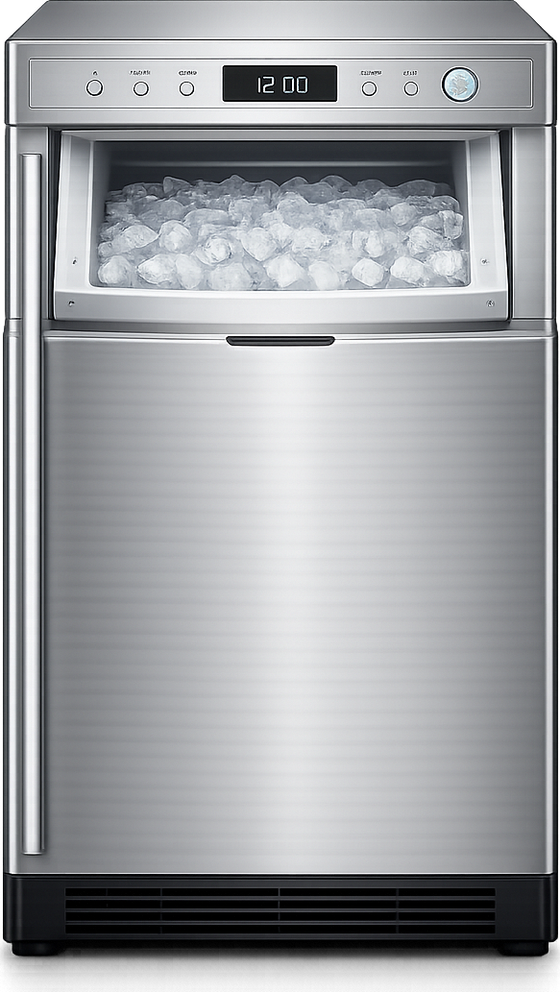
Built-in ice makers in French door, side-by-side, top-freezer and bottom-freezer refrigerators, through-the-door dispensers, and standalone undercounter ice makers. Where the fault is in the sealed system rather than the ice maker, we can do that work too — the technician holds EPA Section 608 Universal certification.
Brands we repair in Cedar Park: Whirlpool, GE, Samsung, LG, Maytag, Frigidaire, KitchenAid, Amana, Bosch, Electrolux, Kenmore and Haier.
What Ice Maker Repair Costs in Cedar Park
The residential diagnostic is $99 and comes off the repair when you approve it. You get a written price covering parts and labor before anything is replaced. Ice maker work splits cleanly: a valve, a thermostat, a fill tube heater or a sensor is a modest job, while a complete ice maker assembly on a high-end unit is not, and we will tell you which one you are looking at before you commit.
Quite often the answer costs nothing at all — a clouded sensor, an arm hung up on a cube, or a filter that needs reseating. We would rather tell you that and charge the diagnostic than sell you a part.
Neighborhoods We Cover in Cedar Park
Ice maker calls come to us from right across Cedar Park — the established streets in Buttercup Creek and Cedar Park Ranchettes, the newer builds in Ranch at Brushy Creek and Walsh Trails, Twin Creeks, Forest Oaks and Anderson Mill West, and everything along Whitestone Boulevard. We run down from Leander, so Cedar Park is a short trip rather than a scheduling problem.
Common Questions About Ice Maker Repair in Cedar Park
How much ice should a household ice maker actually make?
Roughly two to three pounds a day on a standard refrigerator, which is nothing like what people expect after a party. If yours keeps up normally and only falls behind when the house is full, it is probably working to specification rather than failing.
Does Cedar Park water wreck ice makers?
Hard water does not usually kill them, but it does build scale in the valve and the fill path over years, and it is the reason cubes here often look cloudy. Changing the filter on schedule does more for an ice maker than anything else you can do.
Is replacing the whole ice maker ever the right call?
Sometimes. On a sealed modular assembly where the motor and the mold heater have both gone, the assembly price can be close to the sum of the parts and takes a fraction of the labor. We quote both ways and let you choose.
How long should a new ice maker take to start working?
About a day. The freezer has to come down to temperature first, and the mold thermostat will not start a harvest until it does. Throw the first couple of batches away.
How quickly can you get to Cedar Park?
Usually the same day. Call (737) 388-3867 and tell us the brand and whether it is making no ice at all or just not enough — those two go down different paths and we would rather bring the right parts.
Book Ice Maker Repair in Cedar Park
Tell us the brand and whether it makes no ice at all or just not enough. Those two go down different paths, and it decides what we bring.
Ice Maker Repair in Cedar Park, TX
-

Ice Maker Symptoms We Sort Out
- Bin stays empty
- Cubes thin, hollow or stuck together
- Ice tasting of the freezer
- Fill tube freezing over
- Arm or sensor stopping production early
- Water dripping down the back wall
- Production dropping off in summer
-
Ice Makers We Work On
- Refrigerator ice makers
- Undercounter ice makers
- Freestanding units
- Dual ice maker refrigerators
- Water line, filter and valve work
- Whirlpool, GE, Samsung, LG, KitchenAid
- Frigidaire, Maytag, Bosch, Electrolux

Ice Maker Brands We Service in Cedar Park
If your brand is not listed, contact us — we likely service it.
We repair all major residential appliance brands across Central Texas, including Whirlpool, GE, Samsung, LG, Maytag, Frigidaire, KitchenAid, Amana, Bosch, Electrolux, Hotpoint, Kenmore, Haier, Fisher & Paykel, Sub-Zero, Wolf, Viking, Thermador, JennAir, Dacor, U-Line, Marvel, Miele, and GE Monogram.
Why Homeowners & Businesses Choose TakiDA
-
 Quality WorkWe deliver professional appliance repair with attention to detail, proper diagnostics, and long-lasting results you can rely on.
-
 OEM / High-Quality PartsWe use OEM or high-quality replacement parts to ensure correct operation, reliability, and extended appliance lifespan.
-
 Same-Day / Next-Day ServiceFast response with same-day or next-day service to reduce downtime and get your appliances back in working order quickly.
-
 Clear PricingUpfront estimates with transparent pricing. No hidden fees, no surprises — you know the cost before work begins.
-
 EPA Certified & InsuredEPA Section 608 Universal certified and fully insured for residential and commercial repair, giving you peace of mind and protection.
-
 Warranty on Labor & PartsAll repairs are backed by a warranty on labor and installed parts for added confidence and long-term reliability.
