
Refrigerator Repair in Cedar Park, TX
A refrigerator that stops holding temperature puts everything inside it on a clock. We repair residential refrigerators across Cedar Park — Buttercup Creek, Twin Creeks, Ranch at Brushy Creek and the streets around Town Center — usually same-day or next-day. The $99 diagnostic comes off the repair, and you get a firm price before any part is replaced.
Common Refrigerator Problems in Cedar Park Homes
Everything is a few degrees too warm and food spoils early
This is the fault people live with longest, because nothing looks broken. Manufacturers build a fresh food compartment to sit around 37–38°F; four or five degrees above that and milk turns days early while the fridge still feels cold to the hand. The cheap causes come first: a condenser coil packed with dust and pet hair, a condenser fan that has slowed, a door gasket that stopped sealing, or vents inside the cabinet blocked by a full shelf. Only after those are cleared does it make sense to look at the thermistors, which are what the control actually reads temperature from. We put a thermometer in the compartment rather than trusting the display, because a drifting sensor shows the number you want to see.
Food freezing in the fresh food section
Lettuce frozen solid at the back while the setting has not changed is almost always one part. On most refrigerators the fresh food compartment is cooled by freezer air through an electric damper, and when that damper sticks open, freezer air keeps pouring in with nothing to stop it. There is a defined test for it: the control can be put into a service mode that toggles the damper open and closed, and on many models the damper motor winding has a specified resistance. If the damper is good, the next suspect is the fresh food thermistor reporting the compartment colder than it is, so the control never stops cooling. Both are modest parts. What matters is testing which one rather than replacing both.
Water on the kitchen floor in front of the fridge
Three different sources, and the puddle tells you which. Water that appears after a defrost cycle and runs out from under the door is a blocked defrost drain: the trough fills, overflows the front lip and runs down the inside of the cabinet. Water that is there every morning regardless of anything is usually the supply line, the filter head or a fitting behind the unit. Water that appears only when the ice maker fills is the fill tube or the inlet valve. We dry the floor and watch which one happens, because guessing here means pulling the wrong thing apart.
The outside of the cabinet sweats
Condensation on the door flange or down the centre strip between the doors is normal behaviour in a Cedar Park August and a fault the rest of the year. Manufacturers fit a small heater in that strip, the mullion heater, specifically to keep those surfaces above the dew point, and it is switched by the control board. Service procedure is straightforward: the control board can be put in a test mode to energise it, and if there is no voltage at the heater the board is at fault rather than the heater. Manufacturers also list a second cause worth checking first — a high room temperature combined with restricted air movement at the condenser. A fridge crammed into a cabinet with no clearance sweats for that reason alone.
A noise that comes and goes
Intermittent noise is diagnosed by when it happens, not by how it sounds. A rattle or hum only while the compressor runs points at the condenser fan or at something touching the compressor mounts. A scraping or ticking that builds over days and then disappears for a while is an evaporator fan blade catching ice — which means the defrost system is not clearing the coil properly, and that is the real fault. A sharp click every few minutes followed by silence is the compressor trying to start and failing on its relay. Each one goes somewhere different, so we ask when, not what.
It stopped cooling after a power outage
Cedar Park gets its share of summer outages, and the part that usually fails on restart is the compressor start relay. When the relay is cool, current passes through it to the compressor start winding; once the motor is running the relay heats and drops the start winding out of the circuit. On modern units this is a solid-state relay that plugs straight onto the compressor terminals, and it is an inexpensive part. The trap is that a compressor failing to start sounds exactly the same whether the relay is at fault or the motor is seized, so it has to be measured. On inverter-driven models there is no conventional relay at all and the fault lies with the drive board, which is a different conversation and a different price.
Nothing is cold — fridge and freezer both
When both compartments are warm, the question is simply whether the compressor is running and whether the system still holds refrigerant. If the compressor is silent, it is power, control, relay or motor. If it runs continuously and nothing gets cold, it is the sealed system. There is a clean test that separates the two possibilities inside the sealed system: with gauges on, stop the compressor and watch the low side. If pressure climbs back toward equalisation, there is a restriction. If it sits in a vacuum, the system has lost its charge. Sealed system work is legally restricted to EPA Section 608 certified technicians, which we hold.
A smell that keeps coming back
If cleaning the shelves does not fix it, the smell is almost never the food. Defrost water runs down a trough at the back of the freezer and out through a drain tube to a pan under the unit. When that tube partially blocks, the trough stays wet, biofilm grows and the smell returns within days of every cleaning. Clearing the drain properly, rather than pouring hot water at the symptom, is the fix. While it is open we check the drain heater or clip that stops that tube re-freezing, because a drain that blocks once usually blocks again.
Refrigerator Types and Brands We Repair in Cedar Park
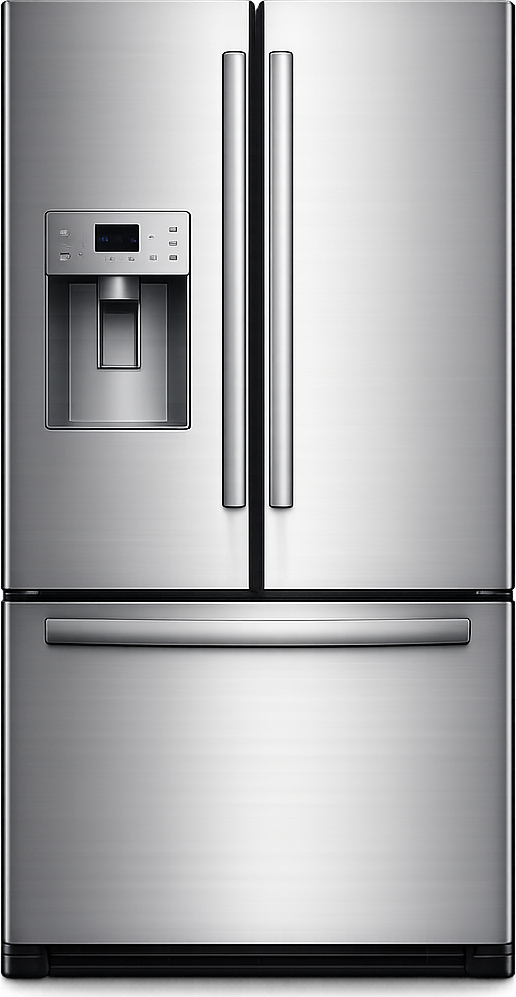
French door, side-by-side, top-freezer and bottom-freezer, counter-depth and built-in, garage and compact units, and wine coolers. Sealed system work included — the technician holds EPA Section 608 Universal certification, which is required by law to handle refrigerant.
Brands we repair in Cedar Park: Whirlpool, GE, Samsung, LG, Maytag, Frigidaire, KitchenAid, Amana, Bosch, Electrolux, Hotpoint, Kenmore, Haier and Insignia.
What Refrigerator Repair Costs in Cedar Park
The residential diagnostic is $99 and comes off the repair when you approve it. You get a written price for parts and labor before anything is replaced, and nothing gets ordered without your say-so. Where the final figure lands depends mostly on one split: a fan, damper, thermistor or relay is a modest job, while sealed system work and inverter boards are not.
If the repair is not worth doing on the age of the unit, we will say that plainly and you will still only have paid the diagnostic.
Neighborhoods We Cover in Cedar Park
We cover Cedar Park end to end — Buttercup Creek and Carriage Hills on the older side of town, Twin Creeks and Ranch at Brushy Creek, Anderson Mill West and Forest Oaks, Cedar Park Town Center, and the newer streets off Ranch at Cypress Creek. Cedar Park is a short run down Bell Boulevard from our base in Leander, so same-day is normal rather than a favour.
Common Questions About Refrigerator Repair in Cedar Park
What temperature should my refrigerator actually be?
Around 37–38°F in the fresh food compartment and 0°F in the freezer. Put a separate thermometer in there for a day before you decide something is wrong — display readings drift, and a few degrees is the difference between food lasting a week and lasting three days.
The repair quote is high. Repair or replace?
Our rule of thumb is the age of the unit against the share of a new one the repair costs. A fan or a damper on a ten-year-old fridge is worth doing. A compressor or a sealed system leak on the same fridge usually is not, and we will tell you so on the spot rather than taking the job.
How long does food stay safe if the fridge quits?
A closed refrigerator holds a safe temperature for roughly four hours, and a full freezer for about 48. Keeping the doors shut matters more than anything else you can do while you wait for us.
Do you handle refrigerant work?
Yes. The technician is EPA Section 608 Universal certified, which is a legal requirement for handling refrigerant, not a marketing line. Anyone quoting you a sealed system repair without it should not be doing the work.
How quickly can you get to Cedar Park?
Usually the same day, often within a few hours. We are based in Leander, so Cedar Park is a short drive rather than a cross-metro trip. Call (737) 388-3867 with the brand and what it is doing.
Book Refrigerator Repair in Cedar Park
Tell us the brand, roughly how old it is, and what it is doing. That is normally enough for us to arrive with the right parts on the van.
Refrigerator Repair in Cedar Park, TX
-

Refrigerator Symptoms We Sort Out
- Fridge warm, freezer still cold
- Frost building on the back wall
- Compressor clicking on and off
- Water pooling under the crisper
- Running loud or never stopping
- Door alarm or display fault
- Food freezing in the fresh food side
-
Refrigerators We Work On
- Side-by-side models
- French door models
- Top and bottom freezer models
- Built-in and counter depth units
- Beverage and dual-purpose fridges
- Whirlpool, GE, Samsung, LG, KitchenAid
- Frigidaire, Maytag, Bosch, Electrolux

Refrigerator Brands We Service in Cedar Park
If your brand is not listed, contact us — we likely service it.
We repair all major residential appliance brands across Central Texas, including Whirlpool, GE, Samsung, LG, Maytag, Frigidaire, KitchenAid, Amana, Bosch, Electrolux, Hotpoint, Kenmore, Haier, Fisher & Paykel, Sub-Zero, Wolf, Viking, Thermador, JennAir, Dacor, U-Line, Marvel, Miele, and GE Monogram.
Why Homeowners & Businesses Choose TakiDA
-
 Quality WorkWe deliver professional appliance repair with attention to detail, proper diagnostics, and long-lasting results you can rely on.
-
 OEM / High-Quality PartsWe use OEM or high-quality replacement parts to ensure correct operation, reliability, and extended appliance lifespan.
-
 Same-Day / Next-Day ServiceFast response with same-day or next-day service to reduce downtime and get your appliances back in working order quickly.
-
 Clear PricingUpfront estimates with transparent pricing. No hidden fees, no surprises — you know the cost before work begins.
-
 EPA Certified & InsuredEPA Section 608 Universal certified and fully insured for residential and commercial repair, giving you peace of mind and protection.
-
 Warranty on Labor & PartsAll repairs are backed by a warranty on labor and installed parts for added confidence and long-term reliability.
