
Cooktop and Vent Hood Repair in Lakeway, TX
Lakeway kitchens tend to be built around a serious cooking surface and a hood sized to match. That combination brings its own problems. Many of these hoods do not have the motor in the hood at all: the blower sits in the attic or on the roof, connected by a long duct, which means a dead fan is often not a dead hood. Homes off the natural gas main run propane, and a cooktop converted without changing the orifices never burns right. And a modern Lakeway house is sealed tight enough that a high CFM hood can pull harder than the house can replace, so the fan runs loud and moves nothing. We repair gas, electric, induction and downdraft cooktops along with the hood system that goes with them, and we treat the two as one job because they usually are.
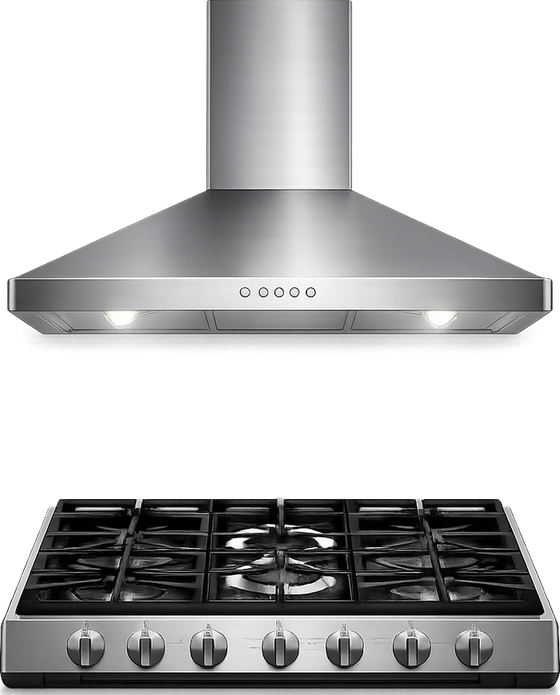
Common cooktop and hood problems we fix in Lakeway
Gas burner clicks but will not light
Continuous clicking with no flame is the spark circuit working and the gas not arriving, or the spark landing in the wrong place. The usual causes are a burner cap sitting crooked, a clogged burner port, a wet or cracked spark electrode, or a failed spark module. On propane units we also check the orifice, because an orifice sized for natural gas will light badly or not at all on propane. We clean and align first, since a surprising number of these calls need no parts.
Burner lights then goes out when you release the knob
That is the flame supervision circuit. Gas cooktops use a thermocouple or a flame sensor to prove a flame is present before the valve stays open. A dirty or misaligned sensor reads no flame and shuts the gas off for safety, which is the system working correctly on bad information. We clean and position the sensor and measure the signal it produces rather than replacing the valve, which is the expensive guess people often start with.
Induction element cuts out or shows an error
Induction cooktops fail in ways that look like the cookware is at fault. An element that runs then drops out is usually overheating, either because the cooling fan underneath is blocked or because the thermistor on the coil is reading high. Error codes on induction units are specific and worth noting before you call. Induction also needs a flat ferrous pan, so an element that never starts on one particular pot is not a fault at all.
Electric element stays on high or will not heat
On a radiant electric cooktop, an element locked on full is almost always a welded infinite switch contact, not a bad element. An element that will not heat at all is the element, the switch or the connection at the terminal block. We check both legs of the supply first, because a lost leg on a 240 volt circuit can take out some elements and not others and sends people chasing the wrong part.
Hood fan will not run at all
With a remote or inline blower, the switch in the hood and the motor in the attic are two separate things joined by a wire run. We confirm the control is sending power before anyone goes into the attic. If power is arriving at the blower and the motor is dead, it is the motor or the capacitor. On hoods with the motor in the hood itself, the usual suspects are the capacitor, the speed control board and the motor bearings.
Fan runs but smoke stays in the kitchen
This is airflow, not the motor. The duct may be blocked, the damper at the roof or wall cap may be stuck or screened over, a filter may be loaded with grease, or the house may simply be too tight to let the hood pull. A high CFM hood in a sealed Lakeway house without makeup air will starve itself, and the symptom is exactly this. We check the duct and the cap, then measure capture at the hood before concluding anything.
Hood runs on one speed only, or lights are out
Single-speed behavior points at the speed control board or a failed switch, and on a variable-speed blower it can be the control module rather than the motor. Dead lights are usually the lamp sockets, the transformer on LED systems, or the control board. These are small parts, and they are worth fixing because a hood with no light over a gas cooktop is a safety issue in its own right.
Downdraft that will not raise or does not pull
Downdraft systems have a lift mechanism as well as a fan, and the lift is usually what fails first: a stretched belt, a jammed track, or a limit switch out of position. If the unit raises but does not pull, the problem is the blower or the duct run, which on a downdraft often goes down through the slab or along a joist bay where it can collect grease and moisture.
The blower is often not in the hood
This is the single most useful thing to know about hoods in Lakeway. Many of the larger hoods here are built around a remote blower mounted on the roof or an inline blower sitting in the attic, connected to the hood by ten or twenty feet of duct. It is a quieter design and a better one, but it changes diagnosis completely. A hood that does nothing can be a dead blower, a broken wire between the hood and the blower, a failed control module, or a roof damper that never opens. We start at the hood controls and work along the run, and we do not pull a hood apart until we know the fault is in it. If your house has a blower on the roof, mention it when you call so we come with the right equipment.
Propane cooktops and ranges
Homes in Lakeway away from the gas main run propane, and a cooktop built for natural gas must have its orifices changed and its regulator set for propane. We regularly find units that were converted in a hurry: orifices left as delivered, or a regulator flipped without changing anything else. The symptoms are yellow lazy flames, soot on pans, burners that will not light, or a cooktop that burns far hotter than it should. We check the conversion as part of the diagnosis on any propane unit rather than treating it as someone else is problem, because it is the cause of the complaint often enough to be worth ruling out first.
Makeup air in a tight house
A hood rated at 900 or 1200 CFM has to get that air from somewhere. In an older leaky house it comes in through gaps. A new Lakeway house is sealed well enough that it cannot, so the fan spins against a closed system, the noise goes up and the smoke stays put. Worse, in a house with a gas water heater or fireplace, a strong hood can pull combustion gases back down a flue. If your hood got noticeably worse after new windows, spray foam or any air sealing work, that is the likely reason and the fix is a makeup air path, not a new motor. We will tell you if that is what we find.
Cooktop and hood questions from Lakeway customers
My hood is loud but barely pulls anything. Is the motor failing?
Usually not. A loud fan that moves little air is a restriction or a house that cannot supply the air. We check the filters, the duct, the roof or wall cap, and whether the house has a makeup air path. A failing motor normally gets quieter and slower, not louder.
Do you service blowers mounted in the attic or on the roof?
Yes. We service remote and inline blowers along with the hood controls, and we trace the wiring between them. Tell us when you call that the blower is remote so we arrive prepared for attic or roof access.
One burner clicks constantly even when it is off
That is moisture or spillage bridging the spark electrode. Dry the area and clean around the electrode; if it keeps clicking the electrode or the spark module needs attention. Do not keep using the cooktop while it clicks continuously.
We switched to propane. Should the cooktop have been changed?
Yes, if it was built for natural gas. The orifices and the regulator both need to be correct for propane. If no one changed them, you will see lazy yellow flames, soot, or burners that will not stay lit. We verify and correct the conversion.
What does cooktop or hood repair cost in Lakeway?
The diagnostic is $99 and it is credited toward the repair when you approve it. A cooktop and hood call often turns out to be two small things rather than one big one, so we diagnose first and then give you a written estimate with parts, labor and tax before any work starts.
Book Cooktop or Hood Repair in Lakeway
Tell us the brand, whether the cooktop is gas, propane, electric or induction, and whether your hood blower sits in the hood, the attic or on the roof. We serve Lakeway, Bee Cave, Lago Vista, Leander, Lakeway and the surrounding Hill Country, with same-day appointments when the schedule allows.
Cooktop and Vent Hood Repair in Lakeway, TX
-

What we fix
- Burner will not light or keeps clicking
- Gas burner lights then goes out
- Induction element cuts out or shows an error
- Electric element stays on high or will not heat
- Hood fan will not run or runs on one speed only
- Hood runs but does not pull smoke
- Hood lights out or control panel dead
-
Lakeway specifics
- Remote and inline blowers mounted in the attic or on the roof
- Propane conversions on ranges and cooktops off the gas main
- Tight houses that need makeup air for a high CFM hood
- Long roof duct runs with elbows and a cap that sticks shut
- Outdoor kitchen and grill hoods exposed to weather
- Downdraft systems venting under a slab floor

Cooktop and Hood Brands We Service in Lakeway
If your brand is not listed, contact us — we likely service it.
We repair all major residential appliance brands across Central Texas, including Whirlpool, GE, Samsung, LG, Maytag, Frigidaire, KitchenAid, Amana, Bosch, Electrolux, Hotpoint, Kenmore, Haier, Fisher & Paykel, Sub-Zero, Wolf, Viking, Thermador, JennAir, Dacor, U-Line, Marvel, Miele, and GE Monogram.
Why Homeowners & Businesses Choose TakiDA
-
 Quality WorkWe deliver professional appliance repair with attention to detail, proper diagnostics, and long-lasting results you can rely on.
-
 OEM / High-Quality PartsWe use OEM or high-quality replacement parts to ensure correct operation, reliability, and extended appliance lifespan.
-
 Same-Day / Next-Day ServiceFast response with same-day or next-day service to reduce downtime and get your appliances back in working order quickly.
-
 Clear PricingUpfront estimates with transparent pricing. No hidden fees, no surprises — you know the cost before work begins.
-
 EPA Certified & InsuredEPA Section 608 Universal certified and fully insured for residential and commercial repair, giving you peace of mind and protection.
-
 Warranty on Labor & PartsAll repairs are backed by a warranty on labor and installed parts for added confidence and long-term reliability.
