
Cooktop and Vent Hood Repair in Leander, TX
A dead burner or a hood that pulls nothing turns the kitchen into a one-pot operation. We repair gas, radiant electric and induction cooktops, and the range hoods above them, across Leander — Crystal Falls, Travisso, Bryson and the older streets around Old Town — usually same-day or next-day. The $99 diagnostic goes toward the repair, and you get a firm price before any part is replaced.
Common Cooktop and Vent Hood Problems in Leander Homes
The diagnosis below follows the manufacturers’ own service data sheets for Whirlpool, Maytag, KitchenAid, GE, Samsung, LG and Frigidaire — their diagnostic modes, stored fault codes and sensor values — rather than general advice.
One burner or element will not heat
Common causes. On a radiant cooktop the element is switched by a relay on the control board, so a single dead zone is usually the element itself, its connection, or that relay. On induction the same symptom usually sits in the generator board for that zone, its coil, or the coil’s temperature sensor. Electric cooktops run on 240 volts across two legs, and a lost leg at the breaker takes out some zones while leaving others working — which looks exactly like a failed element until it is measured.
What we do. We confirm the supply voltage on both legs first, because a dropped leg explains a dead zone without any part being faulty. Then we use the factory diagnostic: Whirlpool-platform controls hold the last ten faults and have a relay test that switches each output on command, and GE induction models enter a service mode that reports codes by zone, which isolates the failed board instead of guessing at it.
An element heats but will not switch off
Common causes. An element that stays on when the control says off is a relay that has welded shut from arcing. It is not a user fault and it is not something a setting will clear. On a touch-control cooktop it can also be a control board reading a stuck key as a constant demand.
What we do. We shut the circuit off at the breaker before anything else, because a zone stuck on is a fire risk and not something to leave running. Then we confirm whether the demand is coming from the touch control or from a welded relay, and quote the board accordingly.
An induction cooktop will not recognise the pan
Common causes. Induction heats only ferrous cookware, so the first question is always the pan: aluminium, copper and some stainless will not couple at all, and a pan smaller than the zone may not trigger detection. Beyond cookware, a pan-detection fault points at the coil or the generator board for that zone.
What we do. We test with known-good cookware before touching the appliance, because that settles it in thirty seconds. If detection still fails, we pull the stored code — the brands report pan detection separately from power faults — and test the coil and its sensor.
The cooktop shows an error code
Common causes. Codes on a cooktop fall into three families: sensor faults, over-temperature faults and board faults. Frigidaire’s induction service data sheet is explicit about the first two — a broken coil temperature sensor is checked against a value of roughly 1,000 ohms at room temperature, and an over-temperature code sends you to the cooktop’s own ventilation and fan before any part is replaced. Whirlpool-platform controls report a sensor out of range and a shorted or open board thermistor as separate codes. “HOT” on the display is not a fault at all: it means the glass is still above about 150°F.
What we do. We read the stored codes, look them up for your exact model, and confirm with a measurement before ordering. An over-temperature code on an induction cooktop very often turns out to be blocked ventilation under the counter rather than a failed board, and that is a far cheaper outcome.
The glass top is cracked or chipped
Common causes. Ceramic glass cracks from impact, from a pot boiling dry, or from a heavy pan set down hard. A crack that reaches an element opening is not cosmetic: moisture gets to live wiring underneath.
What we do. We assess whether the glass is replaceable on your model and what it costs against a new cooktop, and we say plainly when replacement of the appliance is the better money. A cracked top should not be used in the meantime.
A gas burner clicks but will not light
Common causes. Continuous clicking with no flame is almost always a wet or dirty igniter, a burner cap sitting crooked, or a clogged port. If every burner clicks at once, the spark module or a switch stuck closed is the more likely cause. A burner that lights and then drops out points at the flame sensing circuit instead.
What we do. We clean and reseat the cap and igniter first, because that resolves a large share of these calls. If the clicking continues, we test the spark module and the switches, and on models with flame sensing we measure the sensing current rather than judging it by eye.
The vent hood fan will not run, or runs at one speed only
Common causes. A hood that does nothing is usually the speed switch or the control board rather than the motor, since motors rarely fail silently. A hood stuck on one speed points at the switch or at a failed capacitor on multi-speed motors. A motor that hums without turning is a seized bearing or a dead capacitor.
What we do. We check power at the motor, test the switch positions, and measure the capacitor before condemning a motor. A capacitor is a fraction of the cost of a blower assembly, and it is the part that actually fails most often.
The hood runs but pulls no smoke
Common causes. Airflow problems are rarely electrical. Grease-loaded filters, a damper flap that no longer opens, a crushed or over-long duct run, or a hood ducted into the cabinet instead of outside all produce strong noise and no capture. Recirculating hoods with exhausted charcoal filters do the same thing.
What we do. We check the filters, the damper and the duct path, and confirm the hood is actually ducted where the homeowner thinks it is. We also do dryer vent cleaning, so ductwork is familiar territory rather than something we hand off.
Cooktop and Hood Types and Brands We Repair in Leander
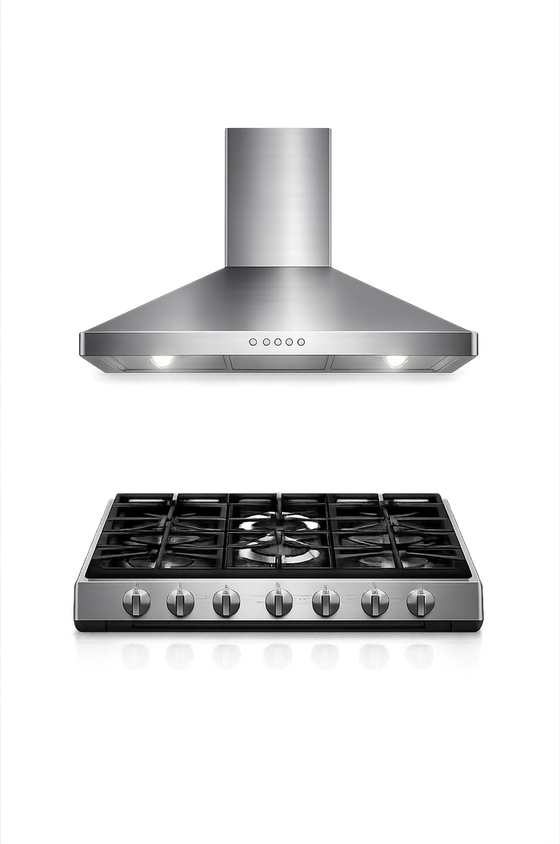
We work on sealed-burner and open-burner gas cooktops, radiant electric and induction cooktops, downdraft units, and the full range of hoods above them — under-cabinet, wall-mount chimney, island and insert blowers, both ducted and recirculating.
Brands we repair in Leander: Whirlpool, GE, GE Profile, Samsung, LG, Maytag, Frigidaire, KitchenAid, Amana, Bosch, Electrolux, Kenmore, Fisher & Paykel, Wolf, Viking, Thermador, JennAir, Dacor, Broan, Zephyr and Vent-A-Hood.
What Cooktop and Vent Hood Repair Costs in Leander
Diagnostics are $99 for a residential call, and that amount is credited toward the repair when you approve it. After the diagnosis you get a written estimate covering parts and labor, and nothing is replaced before you approve it. The final figure depends on which part failed — an element, an igniter, a spark module, a capacitor, a touch control or a generator board — and how far the cooktop has to come out of the counter to reach it.
Completed repairs carry a 3-month labor warranty from TakiDA LLC and a 1-year parts warranty against manufacturer defects.
Neighborhoods We Cover in Leander
We cover Leander as a whole, including Crystal Falls, Travisso, Bryson and Old Town, and we reach most addresses in the city within about twenty minutes. The newer builds out toward Crystal Falls and Travisso tend to run induction or radiant glass tops with chimney hoods, while the older Old Town kitchens are mostly gas with under-cabinet hoods. Nearby Cedar Park, Georgetown, Liberty Hill and Round Rock are also in our service area.
Common Questions About Cooktop and Vent Hood Repair in Leander
Is a cracked glass cooktop worth replacing?
It depends on the model. On some cooktops the glass is a stocked part and the swap is straightforward; on others the glass is bonded to the frame and the part costs most of a new appliance. We price both options and tell you which one is the better money.
My induction cooktop keeps shutting a zone off. Is the board failing?
Not necessarily. Over-temperature protection on induction is triggered by the coil’s own sensor, and the manufacturers send you to the cooktop’s ventilation first. Blocked airflow under the counter is a common cause in newer Leander homes where the cooktop sits above a drawer stack.
Do you work on gas cooktops as well as electric?
Yes, gas, radiant electric and induction. Sealed-burner gas cooktops, igniters, spark modules and valves are regular work for us.
Do you repair vent hoods or only cooktops?
Both, and they usually come as one visit. Motors, capacitors, speed switches, lights, dampers and duct problems are all things we handle, and we do dryer vent cleaning as well, so ductwork is familiar ground.
Book Cooktop and Vent Hood Repair in Leander
Tell us the brand, whether it is gas, radiant or induction, and what it is doing — one dead zone, a code on the display, clicking without flame, or a hood that moves no air. That is normally enough for us to arrive with the right parts on the van.
Reliable Cooktop and Vent Hood Repair in Leander, TX
-

Common Cooktop and Hood Problems We Fix
- Burner will not light or keeps clicking
- Weak or uneven flame
- Electric element not heating
- Touch controls unresponsive
- Hood fan noisy or barely pulling
- Hood light out
- Gas smell near the cooktop
-
Cooktops and Hoods We Repair
- Gas and propane cooktops
- Electric coil and radiant cooktops
- Induction cooktops
- Downdraft systems
- Wall-mounted and island hoods
- Whirlpool, GE, Samsung, LG, KitchenAid
- Frigidaire, Maytag, Bosch, Electrolux

Cooktop and Vent Hood Brands We Repair
If your brand is not listed, contact us — we likely service it.
We repair all major residential appliance brands across Central Texas, including Whirlpool, GE, Samsung, LG, Maytag, Frigidaire, KitchenAid, Amana, Bosch, Electrolux, Hotpoint, Kenmore, Haier, Fisher & Paykel, Sub-Zero, Wolf, Viking, Thermador, JennAir, Dacor, U-Line, Marvel, Miele, and GE Monogram.
Why Homeowners & Businesses Choose TakiDA
-
 Quality WorkWe deliver professional appliance repair with attention to detail, proper diagnostics, and long-lasting results you can rely on.
-
 OEM / High-Quality PartsWe use OEM or high-quality replacement parts to ensure correct operation, reliability, and extended appliance lifespan.
-
 Same-Day / Next-Day ServiceFast response with same-day or next-day service to reduce downtime and get your appliances back in working order quickly.
-
 Clear PricingUpfront estimates with transparent pricing. No hidden fees, no surprises — you know the cost before work begins.
-
 EPA Certified & InsuredEPA Section 608 Universal certified and fully insured for residential and commercial repair, giving you peace of mind and protection.
-
 Warranty on Labor & PartsAll repairs are backed by a warranty on labor and installed parts for added confidence and long-term reliability.
