
Commercial Steam Table Repair in Liberty Hill, TX
Hot holding gets taken for granted until an inspector puts a probe in a pan. A steam table is simple equipment, which is exactly why it runs for years with a scaled element and a thermostat nobody trusts. Around Liberty Hill it is usually holding the barbecue, the catering trays or the school line that the whole day revolves around.
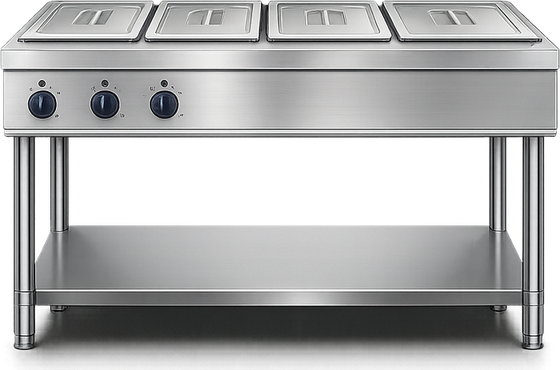
Common Steam Table Problems in Liberty Hill Kitchens
Food holding below one hundred and thirty five degrees
This is the one that fails an inspection. It can be the element, the thermostat, a water level too low to transfer heat, or simply pans loaded cold and asked to come up to temperature in a unit designed only to hold. A steam table holds hot food. It does not reheat it, and treating it as a reheater is behind a surprising number of these calls.
One well cold while the rest of the table holds
On a table with individually controlled wells, a single cold well points at that element, its thermostat, or the wiring to it. On a shared water bath it usually means uneven water level or scale across one section of the element. Which pattern you have narrows the job immediately, so it is worth noting before we arrive.
Water boiling off faster than anyone can refill it
A thermostat that has failed closed drives the water to a hard boil, which burns off the bath, dries the well and eventually destroys the element. Staff keep topping it up and nobody reports it as a fault. If a well is boiling rather than steaming, the control has already failed.
An element scaled over with mineral
Every evaporation cycle leaves minerals behind in the well, and the water here leaves plenty. That crust insulates the element from the water, so it runs hotter to deliver less heat and fails early. Regular descaling of the wells is the cheapest maintenance in the kitchen and almost nobody does it.
A thermostat knob that no longer changes anything
Infinite switches and capillary thermostats on hot holding equipment live in heat and steam and they wear out. The usual signs are a unit that is either off or flat out, or settings in the middle of the dial that behave identically. It is an inexpensive part and the repair restores real control rather than guesswork.
A breaker tripping with every well switched on
A full steam table is a serious electrical load. When it trips only with everything running, the question is whether the circuit was ever right for the equipment, or whether an element has gone partly to ground and is drawing more than it should. That is measured at the element rather than assumed from the breaker behavior.
A catering unit that will not hold at an event
Hot holding away from the building depends entirely on the power available. On a long extension run or a loaded generator, elements receive less voltage and produce far less heat than their rating. The equipment is often fine. We measure voltage under load first on those calls, because no part will fix a supply that cannot deliver.
A holding cabinet running hot and drying product out
Heated holding and proofing cabinets depend on a thermostat, a fan and, on humidified units, a water pan that is actually full. When product is drying out or crusting, the cabinet is usually running hotter than the dial says or circulating dry air. Both are measurable and both are inexpensive to correct.
Hot Holding Equipment We Service in Liberty Hill
Electric and gas steam tables, wet well and dry well units, drop in hot wells and buffet lines, heated holding and proofing cabinets, soup wells and countertop warmers. Common brands include Vollrath, Wells, Hatco, Duke, APW Wyott, Star, Alto Shaam and Cres Cor.
We are insured and can provide a certificate of insurance where a venue or landlord asks for one before work.
What Steam Table Repair Costs in Liberty Hill
The commercial diagnostic is one hundred and forty nine dollars and it is credited toward the repair once you approve the work. Elements, thermostats, infinite switches, contactors, drain valves and gaskets are all inexpensive repairs. Full control assemblies or a replacement well cost more, and the number comes to you before anything is ordered.
If an inspection is coming, tell us when you call. Hot holding is usually the fastest finding to fix and the easiest to fail.
Neighborhoods We Cover in Liberty Hill
Downtown Liberty Hill and the businesses along 29, Santa Rita Ranch, Orchard Ridge, Rancho Sienna, Butler Farms, Bar W Ranch, Stonewall Ranch, the venues and event barns off 183 and Ronald Reagan, and commercial properties toward Bertram and Leander.
Common Questions About Steam Table Repair in Liberty Hill
Can we reheat food in the steam table?
No, and it is the single most common cause of a temperature failure. Hot holding equipment is designed to keep food that is already at temperature there. Bring product up in an oven, a range or a combi, then move it to the table.
How much water should be in the well?
Follow the fill line rather than a habit. Too little and the element runs dry and dies, too much and the pans float and the product never settles at temperature. Low water is behind a large share of burned out elements.
How often should the wells be descaled?
Monthly is realistic for a table that runs every day, and more often again on well water. Mineral crust on the element is the main reason elements fail early here, and the cleaning costs nothing but a little time.
Do you work on gas steam tables as well as electric?
Yes, both. On gas units the thermostat, pilot and burner assembly are the usual suspects rather than elements, but the symptom at the pan is identical.
Is an old steam table worth repairing?
Almost always. These units are mechanically simple and the parts that fail are inexpensive and widely available. The exception is a well that has corroded through, which is a replacement conversation, and we will say so if that is what we find.
Book Steam Table Service in Liberty Hill
Tell us the make, whether it is gas or electric, and whether the whole table or one well is affected, and we can usually narrow it down before we arrive. Call (737) 388-3867 or book online. The one hundred and forty nine dollar commercial diagnostic is credited toward the repair.
Commercial Steam Table Repair in Liberty Hill, TX
-

What Brings Us Out to a Steam Table in Liberty Hill
- Food holding below one hundred and thirty five degrees
- One well cold while the rest of the table holds
- Water boiling off faster than it can be refilled
- Element scaled over with mineral and failing
- Thermostat knob that no longer changes anything
- Breaker tripping with every well switched on
- Catering unit that will not hold at an event
-
Hot Holding Equipment We Cover
- Electric and gas steam tables
- Wet well and dry well units
- Drop in hot wells and buffet lines
- Heated holding and proofing cabinets
- Soup wells and countertop warmers
- Thermostats, elements, controls and gaskets

Hot Holding Brands We Service in Liberty Hill
If your brand is not listed, contact us — we likely service it.
Why Homeowners & Businesses Choose TakiDA
-
 Quality WorkWe deliver professional appliance repair with attention to detail, proper diagnostics, and long-lasting results you can rely on.
-
 OEM / High-Quality PartsWe use OEM or high-quality replacement parts to ensure correct operation, reliability, and extended appliance lifespan.
-
 Same-Day / Next-Day ServiceFast response with same-day or next-day service to reduce downtime and get your appliances back in working order quickly.
-
 Clear PricingUpfront estimates with transparent pricing. No hidden fees, no surprises — you know the cost before work begins.
-
 EPA Certified & InsuredEPA Section 608 Universal certified and fully insured for residential and commercial repair, giving you peace of mind and protection.
-
 Warranty on Labor & PartsAll repairs are backed by a warranty on labor and installed parts for added confidence and long-term reliability.
