
Refrigerated Prep Table Repair in Liberty Hill, TX
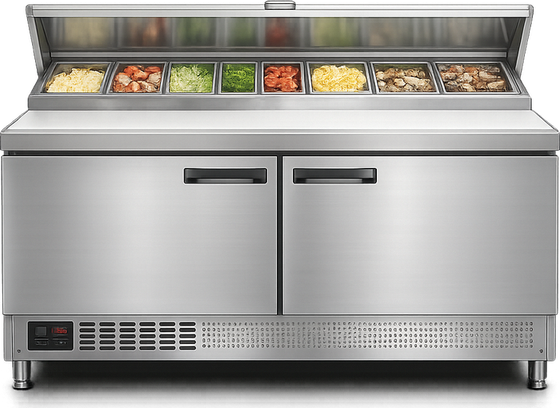
A prep table is the hardest working refrigeration in a kitchen and the easiest to misread. The base cabinet can be perfectly cold while the pans on the rail sit at fifty degrees, and staff will say the unit is fine because the thermometer inside the door agrees. On a hot line, in a trailer, or in a venue kitchen that only runs on weekends, that gap gets wide fast.
Common Prep Table Problems in Liberty Hill Kitchens
Top pans drifting above forty one degrees
This is the complaint that matters, because it is the one an inspector writes down. The rail is cooled by a curtain of cold air across the top of the wells, and anything that disturbs that curtain, overfilled pans, missing dividers, a lid left open, or a fan that has slowed, leaves the product warm while the cabinet below reads perfectly. Product temperature is measured in the pan, not at the door thermometer.
A cold base cabinet and a warm rail
When the base holds and the top does not, the problem is almost always airflow rather than refrigeration. A blocked return at the back of the well, a failed rail fan, or ice narrowing the air path will do it. Adding refrigerant to a system that is working correctly will not help, which is why the split between base and rail gets established before gauges go on.
Ice building on the evaporator behind the rail
Prep tables run with lids open all service, pulling humid kitchen air across a cold coil. If defrost is not keeping up, or a gasket is letting in even more humidity, the coil ices and airflow collapses over the course of a shift. The unit then recovers overnight, which is exactly why the complaint only appears during service.
A condenser breathing hot air from under the line
Most prep tables draw condenser air from the front or side at floor level, right where fryers and ovens dump heat. Add grease and dust from the line and the condenser cannot shed heat at all. In August that alone can account for the entire temperature problem, and it is the cheapest one on this page to fix.
Water pooling inside the base cabinet
Condensate is supposed to leave through a drain line into an evaporator pan or a floor drain. When that line blocks with debris, water backs up into the cabinet, soaks product boxes and eventually reaches the insulation. It is also an inspection finding, so it is worth clearing properly rather than mopping.
Lids and gaskets that no longer seal
Prep table lids take abuse all day and the gaskets around the wells and the base doors harden, tear and pull loose. A door that does not seal runs the compressor constantly and still loses temperature, and on the rail a poor seal is a direct path for warm humid air onto the coil. Gaskets are inexpensive, and on a prep table they are consumables.
A unit running nonstop and never cycling off
Continuous running is either a load problem or a system problem. A dirty condenser, a door or lid that will not close, warm product loaded during service, or a genuine refrigerant or control fault. Pressures and the condenser get checked together, because the same symptom covers a very cheap repair and a very expensive one.
A trailer or venue unit that cannot hold on the day
In a trailer the prep table lives in the hottest, tightest spot available, often with the condenser facing a wall and a generator feeding it marginal voltage. In a venue kitchen it sits idle all week and is then loaded with warm product two hours before service. Power, airflow and how far in advance product goes in all get checked before the sealed system is touched.
Prep Tables We Service in Liberty Hill
Sandwich and salad prep tables, pizza prep tables with raised rails, mega top and high capacity units, under counter refrigerated bases, and prep refrigeration in trailers and mobile kitchens. Common brands include True, Turbo Air, Beverage Air, Continental, Delfield, Traulsen, Randell and Atosa.
We are EPA Section 608 Universal certified and insured, with certificates of insurance available when a venue or building requires one.
What Prep Table Repair Costs in Liberty Hill
The commercial diagnostic is one hundred and forty nine dollars and it is credited toward the repair once you approve the work. Fans, gaskets, lids, controls, drain line clearing and a proper condenser cleaning are all routine. Sealed system work or a compressor on a prep table is a larger decision and we will compare it honestly against a replacement unit.
If you have an inspection coming or a product temperature issue right now, say so when you call so we can prioritize correctly.
Neighborhoods We Cover in Liberty Hill
Downtown Liberty Hill and the businesses along 29, Santa Rita Ranch, Orchard Ridge, Rancho Sienna, Butler Farms, Bar W Ranch, Stonewall Ranch, the venues and event barns off 183 and Ronald Reagan, and commercial properties toward Bertram and Leander.
Common Questions About Prep Table Repair in Liberty Hill
The cabinet reads thirty six but the pans are at fifty. Is the unit broken?
Possibly not in the way you think. That split normally means rail airflow is disturbed rather than refrigeration being dead. Overfilled pans, missing dividers, lids left open and a failed rail fan all produce it, and the first three cost nothing to correct.
How should pans be filled so the rail actually holds?
Fill to the line and not above it, keep the dividers in, and close the lid when the line is not actively working the well. The cold air curtain only works if it has somewhere to travel, and an overfilled pan blocks it completely.
How often does the condenser need cleaning?
On a prep table on a hot line, every three months is realistic and monthly is better in a heavy kitchen. It is the highest return maintenance item on this equipment and the one most often skipped until the unit fails in July.
Do you work on prep tables in food trailers?
Yes, regularly. Tell us whether you are on shore power or a generator when you call, because power quality is frequently the reason a trailer unit holds fine at the commissary and fails on site.
Repair or replace?
Fans, controls, gaskets and drains are always worth repairing. A compressor on an older low cost prep table often is not, especially where the cabinet has already taken water damage. You get both numbers before you decide.
Book Prep Table Service in Liberty Hill
Tell us the make, what the base cabinet reads, and what the pans on the rail actually measure, and we can usually narrow it down before we arrive. Call (737) 388-3867 or book online. The one hundred and forty nine dollar commercial diagnostic is credited toward the repair.
Refrigerated Prep Table Repair in Liberty Hill, TX
-

What Brings Us Out to a Prep Table in Liberty Hill
- Top pans drifting above forty one degrees
- Base cabinet cold while the rail runs warm
- Ice building on the evaporator behind the rail
- Condenser pulling hot air from under the line
- Water pooling inside the base cabinet
- Lids or gaskets no longer sealing the well
- Unit running nonstop and never cycling off
-
Prep Tables We Cover
- Sandwich and salad prep tables
- Pizza prep tables with raised rails
- Mega top and high capacity units
- Under counter refrigerated bases
- Trailer and mobile kitchen prep units
- Gaskets, lids, controls and condenser service

Prep Table Brands We Service in Liberty Hill
If your brand is not listed, contact us — we likely service it.
Why Homeowners & Businesses Choose TakiDA
-
 Quality WorkWe deliver professional appliance repair with attention to detail, proper diagnostics, and long-lasting results you can rely on.
-
 OEM / High-Quality PartsWe use OEM or high-quality replacement parts to ensure correct operation, reliability, and extended appliance lifespan.
-
 Same-Day / Next-Day ServiceFast response with same-day or next-day service to reduce downtime and get your appliances back in working order quickly.
-
 Clear PricingUpfront estimates with transparent pricing. No hidden fees, no surprises — you know the cost before work begins.
-
 EPA Certified & InsuredEPA Section 608 Universal certified and fully insured for residential and commercial repair, giving you peace of mind and protection.
-
 Warranty on Labor & PartsAll repairs are backed by a warranty on labor and installed parts for added confidence and long-term reliability.
