
Commercial Steam Table Repair in Lakeway, TX
Steam tables around Lakeway earn their living at events. Club banquets, wedding buffets, holiday service, catered functions at venues that cook a handful of times a month and then feed two hundred people at once. That usage pattern creates a particular problem: the equipment is idle long enough to develop faults and then needed at full capacity with no margin for error. Add water hard enough to crust a wet well element in a season and you have the two things we get called about. We repair wet and dry hot wells, electric and gas steam tables, holding cabinets and carving stations.
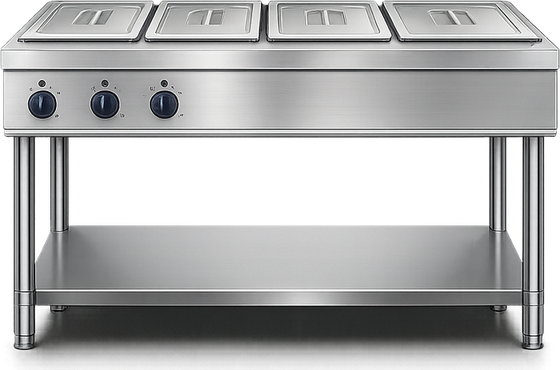
Common steam table problems we fix in Lakeway
Wells not reaching holding temperature
Hot holding has a number it must meet, and a steam table that cannot reach it is a food safety failure rather than an inconvenience. The causes are a failing element, scale insulating the element in a wet well, a thermostat out of calibration, or a control that is cutting power early. We measure actual water and product temperature rather than trusting the dial, because on older tables the dial markings mean very little after years of adjustment.
One well cold while the others work
Each well normally has its own element and its own control, so a single cold well points at that well circuit: the element, its thermostat, or the switch and wiring feeding it. This is useful to know before you call, because it narrows the job and it means the table as a whole is not failing. It is also a cheap repair compared to what operators often assume.
Element burned out or scaled over
In a wet well, the element sits in water, and around Lakeway that water leaves mineral deposits every time the table is used and dried out. Scale insulates the element so it runs hotter to deliver less heat into the water, and eventually it fails. Running a wet well dry does the same thing faster and is the single most common way elements are destroyed. We replace elements and descale the wells, and we will show you what the scale situation actually is.
Water not filling or draining
On plumbed tables the fill valve, the float and the drain valve all fail in ordinary ways, and a drain valve that has sat unused for months will often seize. A well that cannot drain gets left full, which accelerates scaling and creates a sanitation problem. These are inexpensive parts and quick repairs.
Thermostat out of calibration
A steam table thermostat drifts with age, and the usual kitchen response is to turn the dial further around. That works until it does not, and meanwhile nobody knows what the actual holding temperature is. We verify the control against measured temperature and calibrate or replace as needed, which matters because this is exactly the equipment an inspector checks with a probe.
Gas steam table that will not light or holds unevenly
On gas units the pilot, thermocouple and valve fail the way they do on any gas appliance, and in a kitchen off the natural gas main the propane conversion needs to be correct. An underfired burner shows up as wells that never quite get there and recover slowly after fresh pans go in.
Switches, controls and indicator lights
Steam table controls take spills, steam and heat, and the switches are usually the first thing to go. An indicator light that is out is minor; a switch that has failed closed means a well running full power with no control, which overheats product and destroys elements. The second one is worth fixing immediately.
Unit damaged from being moved
Portable steam tables get rolled between a kitchen and a banquet room, loaded into vans, and bumped through doorways. Loose wiring at the terminal block, a cracked well, and casters that have given up are all common on units that travel. On any portable unit we check the electrical connections, because a loose connection under load is a fire risk rather than just a fault.
Dry firing is what kills steam tables
Running a wet well without water in it is the fastest way to destroy an element, and in a busy event service it happens easily: the water boils off during a long banquet and nobody tops it up. Some tables have a low water cutout and many do not. If yours does not, that is worth knowing, and a simple routine of checking water levels between courses saves elements. We replace burned elements, but we would rather tell you how yours are being burned, because the same thing will happen again otherwise.
Event kitchens and equipment that sits
At a Lakeway club or venue the steam table may run four times a month. Between those times it is dry, often stored, sometimes outdoors in a service area. Faults do not reveal themselves until the table is loaded for a real service. A thermostat that drifted, a drain valve that seized, a switch that corroded, all of them are invisible until an event. If you run on that pattern, the practical answer is to fire everything up under something like load a few days ahead, with water in the wells, and see what does not work. We would much rather repair that on a Tuesday than get the call two hours before a wedding.
Hot holding, inspection and what gets checked
A health inspector will probe the product in the pans, not read your control. Hot held food has a minimum temperature and a steam table that holds the water hot but lets a shallow pan at the end of the run fall below it will still be a finding. We measure product temperature in several pans across the table and tell you whether the unit holds evenly or whether one end is weak. That is information you can work around at an event, and it is better to have it beforehand.
Steam table questions from Lakeway operators
One well is cold and the rest are fine
That is almost always that well own element, thermostat or switch. The table as a whole is not failing, and it is usually an inexpensive repair.
Our elements keep burning out
Usually dry firing. If the wells run out of water during a long service the element overheats and fails. Scale makes it worse by insulating the element. We replace the element and tell you which of the two is happening in your kitchen.
Can you check our table before an event?
Yes, and that is the right time to do it. Fire it up with water in the wells a few days ahead and we can fix what does not work when it is not urgent. Steam table faults almost never show themselves on a cold, dry unit.
Do you service gas and propane steam tables?
Yes. Pilot, thermocouple and valve work, plus checking the propane conversion on kitchens off the natural gas main, where a bad conversion causes wells that never quite reach temperature.
What does steam table repair cost in Lakeway?
The commercial diagnostic is $149 and it is credited toward the repair when you approve it. Elements, thermostats and switches are inexpensive. You get a written estimate with parts, labor and tax before any work starts.
Book Steam Table Service in Lakeway
Tell us the brand, whether the table is electric or gas, wet or dry well, and how many wells are affected. We serve clubs, venues, caterers and restaurants in Lakeway, Bee Cave, Lago Vista, Leander, Lakeway and the surrounding Hill Country, with same-day service when the schedule allows.
Commercial Steam Table Repair in Lakeway, TX
-

What we fix
- Wells not reaching holding temperature
- One well cold while the others work
- Element burned out or scaled over
- Thermostat out of calibration
- Water not filling or draining from wet wells
- Scale and mineral crust in the well
- Controls, switches and indicator lights
-
Lakeway specifics
- Hard water scaling wet well elements fast
- Club and venue kitchens used only for events
- Equipment stored dry between banquets
- Outdoor and tented service exposed to wind
- Portable units moved and knocked around
- Health inspection hot holding requirements

Hot Holding Brands We Service in Lakeway
If your brand is not listed, contact us — we likely service it.
Why Homeowners & Businesses Choose TakiDA
-
 Quality WorkWe deliver professional appliance repair with attention to detail, proper diagnostics, and long-lasting results you can rely on.
-
 OEM / High-Quality PartsWe use OEM or high-quality replacement parts to ensure correct operation, reliability, and extended appliance lifespan.
-
 Same-Day / Next-Day ServiceFast response with same-day or next-day service to reduce downtime and get your appliances back in working order quickly.
-
 Clear PricingUpfront estimates with transparent pricing. No hidden fees, no surprises — you know the cost before work begins.
-
 EPA Certified & InsuredEPA Section 608 Universal certified and fully insured for residential and commercial repair, giving you peace of mind and protection.
-
 Warranty on Labor & PartsAll repairs are backed by a warranty on labor and installed parts for added confidence and long-term reliability.
