
Commercial Steam Table Repair in Cedar Park, TX
A line that holds at lunch and fails at dinner, weak wells at one end, a dial that does nothing through half its range, or a drain that drips the well empty. We service steam tables and hot food wells for restaurants, buffets, schools and church kitchens in Cedar Park. The $149 commercial diagnostic is credited toward the repair.
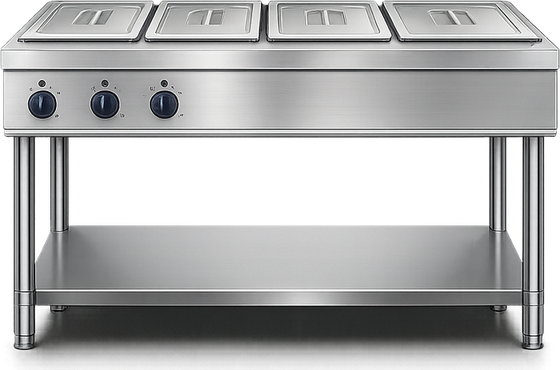
Common Steam Table Problems in Cedar Park Kitchens
The line holds at lunch and fails at dinner
Hot holding equipment is sized for a certain duty, and a table that copes with one service and not the next is usually losing capacity rather than failing outright. The two things we look at first are the water level in wet wells, which falls through a long service and has to be topped up with hot water, and scale on the elements, which insulates them so the well heats more slowly every month. Both are maintenance rather than parts, and both show up exactly this way.
Only the end wells are weak
A pattern across the table is more useful than a single cold well. On an electric table, weakness concentrated at one end often points at the supply rather than the elements — a loose connection in the terminal box heats up, drops voltage and takes the furthest wells with it. On a gas table the same pattern usually means manifold pressure sagging when every well fires at once. Either way it is measured, not guessed.
Steam is escaping into the serving area
Wet wells are meant to steam gently into the pan space, not into the room. Visible steam rolling over the front usually means the pans are not seated properly, adaptor bars are missing, or the water level is too high. Beyond being unpleasant for staff, it is heat and water leaving the well, so the temperature complaint usually arrives a week later.
The thermostat knob does nothing in part of its range
Infinite switches do not regulate temperature; they switch the element on and off in a ratio, and when the contacts wear the useful part of the dial shrinks until the well is effectively on or off. The symptom is a setting that behaves the same from four to ten and then suddenly boils. It is an inexpensive part and an easy test.
A blown fuse or breaker when all the wells are switched on
Steam tables draw hard, and switching an entire bank on at once is the worst case. A breaker that holds with wells brought up one at a time and trips when they all start together usually points at a circuit that was marginal from the day it was installed. We measure the actual draw against the data plate before anyone blames the table.
Rust or pitting inside the wells
Stainless wells pit where water sits with chlorides in it — which is what happens when wells are left wet overnight or cleaned with the wrong product. Once pitting is through, the well leaks and no sealant lasts. Draining and drying wells at the end of service is the single habit that keeps a hot food table alive, and it costs nothing.
The drain valve drips through service
Drain valves on wet wells collect scale and debris, and a valve that no longer seats drips the well empty over a few hours. Staff top it up, the well never stabilises, and nobody connects the two. A dripping drain is also how an element ends up uncovered and destroyed, which turns a cheap repair into a well replacement.
The table pulls food temperature down instead of holding it
If the well is working and the food is still cooling, the problem is usually the pan arrangement: pans too deep for the heat available, product filled above the recommended level, or a well being run dry when the table was built to run wet. Manufacturers specify which operation their wells are designed for, and running the wrong one is the most common reason a perfectly good table cannot hold a line.
Hot Holding Equipment We Service in Cedar Park
Electric and gas steam tables, open-well and sealed-well units, drop-in hot wells built into a counter, bain marie wells, and mobile serving lines.
Brands we service in Cedar Park: Vollrath, APW Wyott, Wells, Duke, Delfield, Hatco, Star, Eagle Group, Advance Tabco, Randell, Nemco, Atosa and Avantco.
What Steam Table Repair Costs in Cedar Park
The commercial diagnostic is $149, credited toward the repair when you approve it. After the diagnosis you get a written estimate covering parts and labor, and nothing is replaced before you approve it. Elements, infinite switches, thermostats, high limits and drain valves are modest parts, and descaling is often what the table actually needs. A pitted or cracked well is the one that is not, and we will say so plainly.
We work around service hours where we can. One well can usually be isolated while the rest of the table keeps running.
Neighborhoods We Cover in Cedar Park
Hot food tables sit in the places that serve volume — the buffet and cafeteria lines off Bell Boulevard, the taquerias and barbecue counters along Whitestone, and the school and church kitchens near Brushy Creek that feed a few hundred people in forty minutes. That last group is where a well going down matters most, and where we try hardest to be same-day. We come from Leander.
Common Questions About Steam Table Repair in Cedar Park
How hot does the food actually have to be?
135°F or above for hot holding, measured in the food. That is the figure an inspector uses, and the table's own dial is not evidence of it — keep a probe thermometer on the line and log it.
Should I run the wells wet or dry?
Whichever the table was built for. Open wells are designed to run dry and need a spillage pan to run wet; sealed wells are designed to run wet and should not be held dry. The drain tells you: a well with its own drain valve is almost always a wet well.
Why do our elements keep failing?
Nearly always because a wet well was run dry, or because the supply voltage does not match the element rating. Both are findable, and until one of them is found a new element will go the same way.
How often should the wells be descaled?
Every few months on Cedar Park water for a table used daily. Longer preheat is the first warning sign, well before anything leaks or fails.
How fast can you get to Cedar Park?
Usually same-day. Call (737) 388-3867 and tell us how many wells are affected — one well down is a scheduled call, a whole table down before a service is not.
Book Steam Table Service in Cedar Park
Tell us whether the table is gas or electric, how many wells are affected, and what the food is actually reading. That decides how fast we come.
Commercial Steam Table Repair in Cedar Park, TX
-

What Brings Us Out to a Steam Table
- Pans dropping below safe holding temperature
- One well lagging behind the rest
- Element dead on a single well
- Dial not holding where it is set
- Wells running dry during service
- Overflowing instead of filling
- Scale coating the bottom of the wells
-
Hot Holding Equipment We Cover
- Electric steam tables
- Gas steam tables
- Drop-in hot wells
- Holding and proofing cabinets
- Soup and food warmers
- Vollrath, APW Wyott, Hatco, Wells
- Duke, Star, Alto-Shaam, Nemco

Hot Holding Brands We Service in Cedar Park
If your brand is not listed, contact us — we likely service it.
Why Homeowners & Businesses Choose TakiDA
-
 Quality WorkWe deliver professional appliance repair with attention to detail, proper diagnostics, and long-lasting results you can rely on.
-
 OEM / High-Quality PartsWe use OEM or high-quality replacement parts to ensure correct operation, reliability, and extended appliance lifespan.
-
 Same-Day / Next-Day ServiceFast response with same-day or next-day service to reduce downtime and get your appliances back in working order quickly.
-
 Clear PricingUpfront estimates with transparent pricing. No hidden fees, no surprises — you know the cost before work begins.
-
 EPA Certified & InsuredEPA Section 608 Universal certified and fully insured for residential and commercial repair, giving you peace of mind and protection.
-
 Warranty on Labor & PartsAll repairs are backed by a warranty on labor and installed parts for added confidence and long-term reliability.
