
Commercial Refrigeration and Walk-In Repair in Round Rock, TX
A walk-in that cannot recover after a delivery, condensate dripping onto product, a compressor short cycling or merchandiser doors fogged over — we service commercial refrigeration across Round Rock, from Old Town and Main Street to La Frontera, the I-35 corridor and the school and hospital kitchens. EPA Section 608 Universal certified and insured. Commercial diagnostic $149, credited toward the repair.
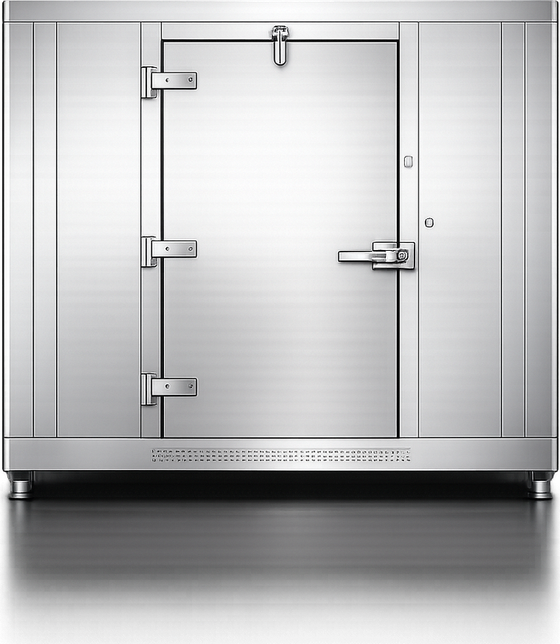
Common Commercial Refrigeration Problems in Round Rock Kitchens
The box holds overnight but cannot recover after a delivery
This is the complaint that most often gets mistaken for a failing system. Refrigeration is sized to hold product that is already cold, not to chill a pallet of it, so a walk-in that sits at temperature all night and climbs for hours after a truck arrives may be doing exactly what it was designed to do. The questions we ask are what the product temperature was coming off the truck, how long the door stood open, and what the system's run time looks like afterwards. If recovery has got worse over the last year with the same deliveries, that is a real capacity loss and we measure for it. If it has always been this way, the answer is a scheduling or a sizing conversation, not a repair.
It loses ground whenever the door is propped during prep
A walk-in door held open during a prep shift pours warm, humid Texas air into the box continuously, and the system has no chance of keeping up. That infiltration also puts moisture straight onto the evaporator, which is where the icing problems start a few weeks later. The fixes are unglamorous and they work: a door closer that actually closes, strip curtains in good condition rather than cracked and curled, and a kick plate so the door is not being held by a crate. We would rather sort those out than keep coming back for the ice.
Condensate dripping from the evaporator onto product
Water landing on boxes below the coil is a health inspection finding and it has a short list of causes. The drain pan may be out of level, so water sits and overflows at one end rather than running to the drain. The drain may be plugged, or on a freezer the drain line heater may have failed so the line is iced. The coil may also be frosting between defrosts, in which case the melt comes faster than the pan can carry it. We check the pan, the level, the drain and the defrost together, because fixing one and not the others just moves the puddle.
The unit cycles on and off every few minutes
Short cycling is the single most damaging thing a compressor can do, because every start draws many times running current and there is no run time to cool the motor or return the oil. Causes split three ways: a control with its differential set far too tight, a low charge letting the suction pressure fall to the cutout and recover, or a condenser so restricted that the high pressure switch is tripping. All three present identically from across the kitchen, and all three are told apart with gauges and a clamp meter in a few minutes.
Glass merchandiser doors fogging over
Those doors have anti sweat heaters in the frames and often in the glass, and their job is to keep the surfaces above the dew point of the room. When a heater circuit fails, or when an energy management controller that cycles them is set wrong or has quit, the doors fog and customers cannot see the product. On a hot humid day the whole run will do it at once. It is an electrical fault rather than a refrigeration one, and it is usually straightforward to put right.
Freezer temperature creeping up after each defrost
A defrost cycle deliberately heats the coil, so the box always gains a little during it and should recover quickly afterwards. When it does not, either the defrost is running longer than it needs to because the termination control has failed and it is timing out instead, or the fan delay is letting the fans start before the coil is cold again and blowing that heat straight into the product. Both are inexpensive controls, and both show up as a slow upward drift over days rather than a sudden failure.
A newly installed system that has never performed to spec
Not every problem is a failure. Remote systems depend on line sizing, proper oil return, correct metering device selection and honest commissioning, and when any of those is wrong the system underperforms from day one and never improves. We take superheat and subcooling, check line temperatures and run times, and give you a written account of what the system is actually doing. That is useful whether the next conversation is with us, with the installer or with a warranty provider.
Several pieces of equipment on one rack going down together
When a cooler, a freezer and a prep table all lose temperature at once, the fault is almost never in three appliances. On a rack system the compressors, the condenser and the controls are shared, and a single failure there affects everything connected to it. The useful diagnostic step is to find out what is common rather than looking at each case separately. We will tell you plainly when a problem is at the rack, including when it needs a contractor who specialises in that system rather than us.
Equipment We Service in Round Rock
We service walk-in coolers and freezers, reach-in and under-counter refrigerators and freezers, glass door merchandisers, refrigerated prep tables, back bar and keg coolers and display cases, from True, Turbo Air, Beverage-Air, Continental, Traulsen, Delfield, Hoshizaki, Arctic Air, Avantco and Atosa, along with the Heatcraft, Bohn, Copeland and Tecumseh components behind them. That covers self contained units and remote condensing systems, electronic and mechanical controls, defrost systems, doors, heaters and drains. Sealed system work is done under EPA Section 608 Universal certification and we are insured for commercial premises.
What Commercial Refrigeration Repair Costs in Round Rock
The commercial diagnostic is $149 and it comes off the repair when you approve it. You get a written price covering parts and labor before anything is replaced. Fan motors, defrost controls and heaters, thermostats, probes, gaskets, hinges, door and drain heaters, anti sweat circuits and contactors are modest parts. Compressors, condensing units and evaporator coil replacements are the expensive end, and on a unit nearing the end of its service life we will put the repair number next to a replacement rather than let you find out afterwards.
For a kitchen the real cost is downtime, so on the first visit we will tell you what can be made to hold through service and what cannot, so you can plan around a shift rather than lose one.
Neighborhoods We Cover in Round Rock
Round Rock has a wider mix of commercial refrigeration than most towns its size. Along the I-35 corridor and around La Frontera and the outlets there are chain kitchens, hotels and convenience stores where the equipment is newer but runs hard and the merchandiser doors take constant use. Around Old Town, Main Street and Mays the kitchens are smaller and older, often in buildings never designed as restaurants, so condensing units end up in back rooms and alleys with very little air around them, which is why head pressure is the first thing we measure there.
We also work the institutional side, which in Round Rock is substantial: school kitchens, hospital and clinic food service, and the large entertainment and hospitality venues on the east side of town, where a walk-in going down on a weekend is a serious matter rather than an inconvenience. Those sites usually keep temperature logs, and a drift visible in the log is far more useful to us than a snapshot reading. Round Rock is an easy run from Leander, and for a kitchen with product at risk we will tell you honestly how quickly we can be there.
Common Questions About Commercial Refrigeration Repair in Round Rock
My walk-in only struggles after deliveries. Is it failing?
Not necessarily. Refrigeration holds cold product rather than chilling warm product. If recovery has got worse over time with the same deliveries, that is a real capacity loss and we measure for it.
Why does my coil keep icing up?
Nearly always moisture getting into the box: a door held open during prep, worn strip curtains, or a door that no longer seals. Defrost faults are the other cause, and they are inexpensive to fix.
Three units lost temperature at the same time. What does that mean?
Almost certainly something they share rather than three failures. On a rack system that is the compressors, condenser or controls, and the first job is finding what is common.
Can you provide a certificate of insurance for our landlord?
Yes. We carry commercial general liability insurance and can have a certificate issued for your building or management company. Sealed system work is done under EPA Section 608 Universal certification.
How quickly can you get to Round Rock?
Often the same day. Call (737) 388-3867, tell us whether product is at risk, and we will give you a straight answer on timing rather than an optimistic one.
Book Commercial Refrigeration Service in Round Rock
Tell us what the equipment is, what it is doing, and whether product is at risk right now. If you keep temperature logs, a drift over several days tells us more than a single reading. Call (737) 388-3867 or book online and we will confirm a time for Round Rock.
Commercial Refrigeration and Walk-In Repair in Round Rock, TX
-

Symptoms We Sort Out
- Cannot recover after a delivery
- Losing temperature when the door is propped
- Condensate dripping onto product
- Cycling on and off every few minutes
- Merchandiser doors fogging over
- Freezer creeping up after defrost
- New system never meeting spec
- Several units on one rack going together
-
Equipment We Service
- Walk-in coolers and freezers
- Reach-in and under-counter units
- Glass door merchandisers
- Refrigerated prep tables
- Back bar and keg coolers
- Remote and rack systems

Commercial Refrigeration Brands We Service in Round Rock
If your brand is not listed, contact us — we likely service it.
Why Homeowners & Businesses Choose TakiDA
-
 Quality WorkWe deliver professional appliance repair with attention to detail, proper diagnostics, and long-lasting results you can rely on.
-
 OEM / High-Quality PartsWe use OEM or high-quality replacement parts to ensure correct operation, reliability, and extended appliance lifespan.
-
 Same-Day / Next-Day ServiceFast response with same-day or next-day service to reduce downtime and get your appliances back in working order quickly.
-
 Clear PricingUpfront estimates with transparent pricing. No hidden fees, no surprises — you know the cost before work begins.
-
 EPA Certified & InsuredEPA Section 608 Universal certified and fully insured for residential and commercial repair, giving you peace of mind and protection.
-
 Warranty on Labor & PartsAll repairs are backed by a warranty on labor and installed parts for added confidence and long-term reliability.
