
Commercial Refrigeration and Walk-In Repair in Leander, TX
When a walk-in drifts warm, the clock is running on your inventory and on your health score at the same time. We repair walk-in coolers and freezers, reach-ins and commercial refrigeration for restaurants, bars, bakeries, convenience stores, gyms and salons across Leander and the surrounding area. The $149 commercial diagnostic goes toward the repair, and you get a firm price before any part is replaced.
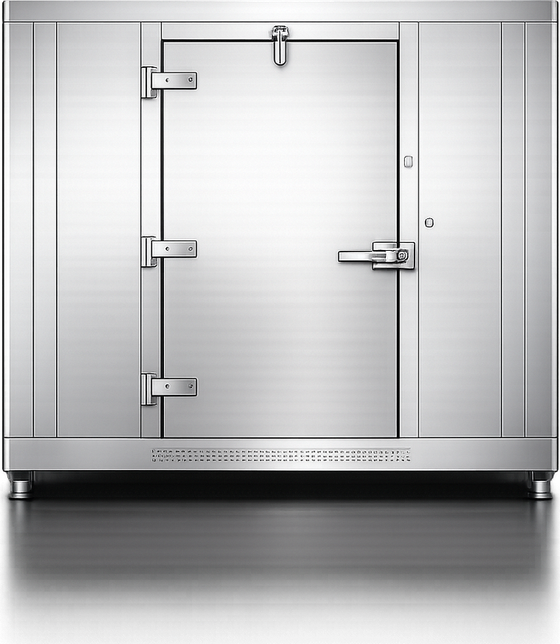
Common Walk-In and Commercial Refrigeration Problems in Leander
Commercial refrigeration is diagnosed with gauges and a thermometer, not with a parts list. The numbers below come from manufacturer service literature and standard commercial refrigeration practice, and they are what we actually measure on site.
The box will not hold temperature
Common causes. A box drifting warm is answered by superheat and subcooling, not by guesswork. On a TXV system a superheat of roughly 6 to 12°F is normal, and high superheat means a starved evaporator — a restricted valve, a low charge, or airflow that is not reaching the coil. Low superheat means liquid is reaching the compressor, which is the expensive failure. Condensing temperature should sit roughly 20 to 30°F above ambient; higher than that is a dirty condenser or blocked airflow, and in a Texas summer that margin disappears fast.
What we do. We record suction and discharge pressure, liquid and suction line temperatures, and calculate superheat and subcooling before touching anything. Those two numbers separate a charge problem from an airflow problem from a valve problem, and they are the difference between a correct repair and an expensive guess on a sealed system.
The evaporator coil is iced over
Common causes. Ice on the coil means defrost is not clearing it, or moisture is getting in faster than defrost can cope with. The service literature gives the checks plainly: the defrost heaters should pull their rated amperage, the termination thermostat should open at around 50°F coil temperature, and the controller should be initiating two to four defrost cycles a day. Beyond the defrost circuit, a door left open, a failed door closer, a torn gasket, or a low evaporating temperature from an undercharge will all ice a coil.
What we do. We clamp the heaters to confirm they draw current, test the termination thermostat, and read the defrost schedule out of the controller. Then we look at why moisture is entering — a cooler that ices up again a week after a defrost repair usually has a door problem, not a defrost problem.
Water on the floor, or ice in the drain pan
Common causes. Walk-in drains run from the evaporator pan out through the wall, and in a freezer that line is heated for a reason. A failed drain line heater freezes the line solid and the pan overflows into the box. A trap installed wrong, a line that has sagged, or a drain blocked with debris does the same thing at cooler temperatures.
What we do. We clear and test the drain path and check the drain heater where one is fitted. A freezer drain that refreezes every few weeks has a heater or a routing problem, and clearing the ice without fixing that just books the next call.
The condensing unit runs constantly
Common causes. Continuous run means the system cannot remove heat as fast as it is arriving. Dirty condenser coils come first, then a condenser fan that has stopped, then a door or gasket problem letting warm air in, then a charge or valve fault. In a kitchen the condenser also loads up with grease, which insulates the coil far more effectively than dust does.
What we do. We clean and inspect the condenser, confirm the fans run, check the door seals and closers, and then take pressures. Condenser cleaning on a restaurant unit in Central Texas is maintenance, not a repair, and a unit that is cleaned on a schedule does not reach this symptom.
The compressor will not start, or starts and trips out
Common causes. A compressor that hums and trips is drawing locked-rotor current: a failed start component, a seized compressor, or low voltage. A compressor that short-cycles on the pressure control is usually reacting to a restriction or a low charge rather than failing itself. High head pressure from a dirty condenser trips units on a hot afternoon and runs fine the next morning, which is why the complaint is often reported as intermittent.
What we do. We measure supply voltage under load, check the start components and the contactor, and take pressures before condemning a compressor. A contactor with pitted contacts and a dirty condenser produce the same complaint as a dying compressor at a fraction of the cost.
Doors, gaskets and closers
Common causes. On a walk-in the door does more work than any other part. A torn gasket, a closer that no longer pulls the door shut, a dragging hinge, or a failed heater wire around a freezer door frame all put humid air into the box continuously. Everything downstream — icing, run time, temperature drift — follows from that.
What we do. We check the gasket seal along its whole length, the closer, the hinges and the frame heater, and we fix the door before chasing the symptoms it causes. It is the cheapest work on a walk-in and the most often deferred.
Temperature alarms and controller faults
Common causes. Walk-in controllers alarm on box temperature, probe failure and defrost faults. A probe that has drifted or come loose from its holder reports a temperature the box is not at, which either hides a real problem or creates a false one. Controllers also hold the defrost schedule, and a schedule changed by somebody chasing an earlier problem is a common finding.
What we do. We verify the controller reading against our own calibrated thermometer in the box, check the probe placement, and read the defrost and alarm settings. A box that reads 38°F on the controller and 46°F on a thermometer has a probe problem and a food safety problem at the same time.
Failing a health inspection on temperature
Common causes. Inspection failures are usually a box that holds temperature overnight and drifts during service, when doors open constantly and warm product goes in. That is a capacity and airflow problem rather than a broken part, and it is often caused by product blocking the evaporator or by a condenser that has not been cleaned in a year.
What we do. We measure under working conditions rather than at eight in the morning with the doors shut, because that is when the problem exists. We document the readings so you have something to show, and we tell you plainly whether the fix is a repair, a cleaning schedule, or a unit that is undersized for what the kitchen is now doing.
Commercial Refrigeration We Service in Leander
We work on walk-in coolers and freezers, reach-in refrigerators and freezers, undercounter and back-bar units, merchandiser and display cases, and the condensing units that serve them — self-contained and remote. All of it includes sealed-system work: the technician is EPA Section 608 Universal certified, which is required to handle refrigerant legally.
Brands we service in Leander: True, Turbo Air, Beverage-Air, Continental, Traulsen, Delfield, Hoshizaki, Migali, Atosa, Arctic Air, Master-Bilt, Nor-Lake, Bohn, Heatcraft, Copeland, Russell and Kolpak.
What Commercial Refrigeration Repair Costs in Leander
Diagnostics are $149 for a commercial call, and that amount is credited toward the repair when you approve it. After the diagnosis you get a written estimate covering parts and labor, and nothing is replaced before you approve it. The final figure depends on what failed — a defrost heater, a termination thermostat, a fan motor, a contactor, an expansion valve, or the sealed system itself — and on how the unit is installed, since a remote condensing unit on a roof is different work from a self-contained reach-in.
Completed repairs carry a 3-month labor warranty from TakiDA LLC and a 1-year parts warranty against manufacturer defects.
Neighborhoods We Cover in Leander
We cover Leander as a whole and reach most commercial addresses in the city within about twenty minutes, including the kitchens along US-183 and the businesses around Old Town. Nearby Cedar Park, Georgetown, Liberty Hill and Round Rock are also in our service area.
Common Questions About Commercial Refrigeration in Leander
How fast can you get out when a walk-in goes down?
Leander is our home city, so same-day is usually possible if you call in the morning. Tell us when your service hours are when you call — we would rather be there before the rush than during it.
Do you work on the sealed system, or only electrical?
Both. The technician is EPA Section 608 Universal certified, which is required to handle refrigerant legally, so charge, leak and valve work is ours rather than something we hand off.
Can you service the equipment outside business hours?
Where it can be arranged, yes. A walk-in that needs a defrost repair is better done before opening than in the middle of lunch service, and we will schedule around the kitchen where the fault allows it.
What does a commercial call cost?
The commercial diagnostic is $149, and it is credited toward the repair when you approve the work. You get a written estimate covering parts and labor before anything is replaced.
Book Commercial Refrigeration Service in Leander
Tell us what the equipment is, what the box is actually reading, and when the problem started — overnight, during service, or only on hot afternoons. That last detail narrows it more than anything else you can tell us.
Reliable Commercial Refrigeration Repair in Leander, TX
-

Commercial Refrigeration Faults We Handle
- Walk-in not holding temperature
- Evaporator iced over
- Condenser running but not cooling
- Compressor short cycling
- Water on the walk-in floor
- Door not sealing or heater failed
- Alarm or controller fault
-
Equipment We Service
- Walk-in coolers and freezers
- Reach-in refrigerators and freezers
- Refrigerated display cases
- Remote and self-contained racks
- Defrost and controller work
- True, Turbo Air, Traulsen, Beverage-Air
- Delfield, Continental, Master-Bilt, Norlake

Commercial Refrigeration Brands We Repair
If your brand is not listed, contact us — we likely service it.
Why Homeowners & Businesses Choose TakiDA
-
 Quality WorkWe deliver professional appliance repair with attention to detail, proper diagnostics, and long-lasting results you can rely on.
-
 OEM / High-Quality PartsWe use OEM or high-quality replacement parts to ensure correct operation, reliability, and extended appliance lifespan.
-
 Same-Day / Next-Day ServiceFast response with same-day or next-day service to reduce downtime and get your appliances back in working order quickly.
-
 Clear PricingUpfront estimates with transparent pricing. No hidden fees, no surprises — you know the cost before work begins.
-
 EPA Certified & InsuredEPA Section 608 Universal certified and fully insured for residential and commercial repair, giving you peace of mind and protection.
-
 Warranty on Labor & PartsAll repairs are backed by a warranty on labor and installed parts for added confidence and long-term reliability.
