
Commercial Ice Machine Repair in Cedar Park, TX
No ice, not enough ice, bridged ice in the bin, or a machine that locks out and has to be power cycled. We service commercial ice machines for bars, restaurants, convenience stores and school kitchens in Cedar Park. The $149 commercial diagnostic is credited toward the repair, and sealed system work is covered.
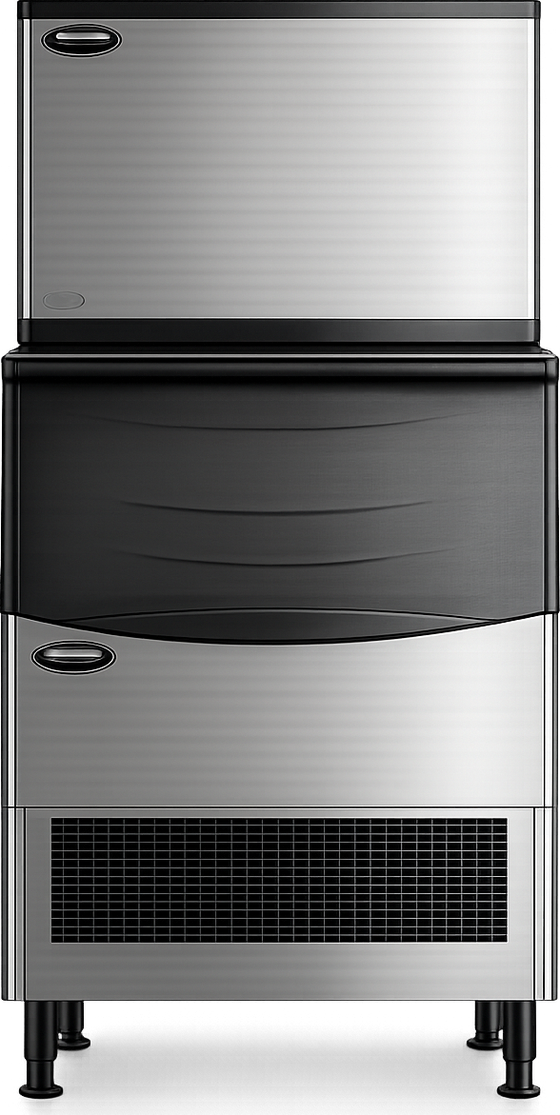
Common Ice Machine Problems in Cedar Park Kitchens
It keeps up all winter and falls behind every summer
Published ice machine capacity is a rated figure measured at a specific air and water temperature, and real output falls a long way below it as both rise. A machine quoted at several hundred pounds a day on a cool test bench produces materially less in a Cedar Park kitchen in August with warm incoming water. So a machine that only fails in summer may be doing everything it was designed to do. The honest work here is measuring the actual cycle time and the room conditions and telling you whether this is a fault, a maintenance problem or a machine that was undersized when it was bought.
Ice is bridging into a solid sheet in the bin
Separate cubes that fuse into a slab usually mean the ice is leaving the evaporator wetter than it should, or the bin is holding ice far longer than it was designed to. A short harvest, a water level that is too high, or a bin thermostat that is not shutting the machine down all produce it. Bridged ice is also a staff problem before it is a service call — once it has fused, breaking it up with anything metal puts damage into the bin liner.
The machine locks out and needs a power cycle to run again
Modern machines do not simply stop; they stop and tell you why. Controls monitor freeze and harvest times, water level and discharge temperature, and when a cycle goes outside the window too many times in a row they go into a safety shutdown and hold a code. Cycling the power clears the code and loses the evidence. We would rather read it first, because the stored fault usually names the circuit and saves an hour of hunting.
Cubes are hollow or uneven across the evaporator
The shape of the ice is diagnostic. Cubes hollow in the middle mean the freeze cycle is ending early. Ice that forms thick at one end of the evaporator and thin at the other means uneven water distribution — a blocked distributor, a scaled-up curtain, or a machine that is not level. Both are cheap to correct and both get expensive if they are allowed to run, because partial ice loads the harvest and the harvest loads the compressor.
Water runs through the machine even when it is off
That is an inlet valve not seating, and in Cedar Park the usual reason is scale rather than a failed solenoid. It wastes water quietly, it keeps the sump full so the next cycle starts wrong, and on a machine with a floor drain nobody notices for months. Shut the supply until it is fixed.
The condenser fan screams on hot afternoons
Air-cooled machines run their condenser fans harder as the room heats up, and a bearing that is on its way out announces itself in August. It is a small part and a short job now, and a dead fan in the middle of a weekend is a machine down plus a head pressure trip. Worth hearing early.
The machine is in a hot back room
Ice machines are specified with a maximum ambient and a required clearance around the cabinet, and a machine wedged into a hot store room with no air path will underproduce permanently and wear out early. This is one of the most common findings we have on a "the machine is weak" call, and no part will fix it. Moving it, venting the room or going to a water-cooled or remote condenser are the real options, and we will lay them out rather than sell you a compressor.
The bin melts ice as fast as the machine makes it
Bins are insulated boxes with a drain, and when the drain blocks the melt water sits in the bottom and eats the ice from underneath. A failed door gasket or a lid left open in a hot room does the same thing more slowly. If your machine is producing to specification and you are still running out, the bin is the first place we look rather than the last.
Machines We Service in Cedar Park
Modular cube machines on bins, undercounter and self-contained units, nugget and flake machines, air-cooled, water-cooled and remote condenser configurations, and ice dispensers behind bars and in cafeterias.
Sealed system work is included — the technician holds EPA Section 608 Universal certification.
Brands we service in Cedar Park: Manitowoc, Scotsman, Hoshizaki, Ice-O-Matic, Follett, True, Atosa and Avantco.
What Commercial Ice Machine Repair Costs in Cedar Park
The commercial diagnostic is $149, credited toward the repair when you approve it. After the diagnosis you get a written estimate covering parts and labor, and nothing is replaced before you approve it. Water valves, float switches, fans, pumps and controls are modest. Evaporators and compressors are not, and on an older machine we will put the repair next to a replacement so the decision is yours.
Deep cleaning and descaling are separate from repair work and often remove the fault entirely. We will tell you when that is what the machine actually needs.
Neighborhoods We Cover in Cedar Park
Ice machines are the piece of equipment that decides whether a bar or a taqueria can trade, and in Cedar Park ours are mostly along Bell Boulevard and Whitestone, in the restaurants around Lakeline, and in school and church kitchens near Brushy Creek. Hard water is the common enemy across all of them. We come down from Leander, so a machine that stops before lunch normally gets looked at the same day.
Common Questions About Ice Machine Repair in Cedar Park
How often does an ice machine need cleaning here?
On Cedar Park water, most machines want a full descale and sanitation every six months and some every three. Manufacturers make this a warranty condition, and scale is behind a large share of the "it stopped making ice" calls we take.
Why does the machine make less ice than the label says?
Because the label is a rating measured at cool air and cool water. Output falls as the room and the incoming water warm up, which is why summer is when machines look undersized. We measure what yours is actually doing before calling it a fault.
Do you work on the sealed system?
Yes. The technician is EPA Section 608 Universal certified, which is a legal requirement for refrigerant work.
Is a water filter worth it?
On this water, yes. A filter costs a fraction of one service call and slows the scale that wears evaporators, valves and pumps. It does not remove the need to clean the machine.
How fast can you get to Cedar Park?
Usually same-day when a machine is down. Call (737) 388-3867 and tell us the make and whether it is making no ice or just not enough — those go down different paths.
Book Ice Machine Service in Cedar Park
Tell us the make, whether it is making no ice or just not enough, and any code on the control. That decides what goes on the van.
Commercial Ice Machine Repair in Cedar Park, TX
-

What Brings Us Out to an Ice Machine
- Bin empty by the middle of service
- Cubes coming out soft or short
- Sheet sticking and never releasing
- Production falling off as the day warms
- Drip forming under the cabinet
- Machine cycling but no water entering
- Scale coating the evaporator
-
Ice Machines We Cover
- Modular cube machines on bins
- Undercounter ice machines
- Flake and nugget machines
- Air and water cooled condensers
- Remote condenser systems
- Hoshizaki, Manitowoc, Scotsman
- Ice-O-Matic, Follett, KoolAire, True

Ice Machine Brands We Service in Cedar Park
If your brand is not listed, contact us — we likely service it.
Why Homeowners & Businesses Choose TakiDA
-
 Quality WorkWe deliver professional appliance repair with attention to detail, proper diagnostics, and long-lasting results you can rely on.
-
 OEM / High-Quality PartsWe use OEM or high-quality replacement parts to ensure correct operation, reliability, and extended appliance lifespan.
-
 Same-Day / Next-Day ServiceFast response with same-day or next-day service to reduce downtime and get your appliances back in working order quickly.
-
 Clear PricingUpfront estimates with transparent pricing. No hidden fees, no surprises — you know the cost before work begins.
-
 EPA Certified & InsuredEPA Section 608 Universal certified and fully insured for residential and commercial repair, giving you peace of mind and protection.
-
 Warranty on Labor & PartsAll repairs are backed by a warranty on labor and installed parts for added confidence and long-term reliability.
