
Commercial Dishwasher Repair in Cedar Park, TX
Racks going through twice, a booster that cannot keep up at peak, scale on the glassware, or a conveyor that stalls. We service commercial dish machines for restaurants, bars, schools and church kitchens in Cedar Park — high-temperature and chemical-sanitising. The $149 commercial diagnostic is credited toward the repair.
Common Dish Machine Problems in Cedar Park Kitchens
Racks take two passes to come out clean
Double-racking is expensive in labour long before anyone calls it a fault. It usually means the wash arms are not delivering what they should: nozzles blocked with scale or debris, an arm that no longer spins freely, or a wash pump that has lost output. The other half of the answer is upstream — scrapping and pre-rinsing practice, and a tank that has not been dumped often enough during a long service. We check the arms turning and the spray pattern before anyone talks about a pump.
The booster heater cannot keep up at peak
Many kitchens pass the test in the morning and fail it at the busiest hour. A booster heater is sized for a certain number of racks per hour from a certain incoming water temperature, and if the incoming supply has dropped — a failing water heater elsewhere in the building, or simply everything running at once — the booster cannot make up the difference. Measuring the incoming temperature alongside the final rinse tells us whether the booster is failing or being asked to do someone else's job.
Detergent and rinse aid are being used far faster than before
Chemical consumption is a good early warning. A dispenser whose squeeze tube has worn pumps erratically, a pick-up tube drawing air, or a fill level sensor misreading will all push consumption up while performance goes down. On a chemical-sanitising machine this matters twice over, because the same dispensing system is what delivers the sanitiser.
The curtains and the hood are soaked and the kitchen steams up
Steam escaping from a door machine or at the ends of a conveyor normally means the curtains are missing, torn or hung wrong, or the vent system over the machine is not pulling. Beyond the discomfort it costs heat out of the tank, so the machine works harder and the rinse struggles. It is a cheap fix that quietly improves two other complaints.
The machine runs a cycle with the door open, or will not start with it closed
Both are the door switch and both matter. A machine that runs with the door open sprays hot water at whoever is standing there. A machine that will not start with the door shut is usually the same switch failing the other way, or the door not reaching it because a hinge or a counterweight has worn. Neither should be bypassed, and we see bypassed ones regularly.
Scale on the tank, the arms and the glassware
In Cedar Park this is the background problem behind half the dish machine calls we take. Scale narrows nozzles, insulates heating elements so the tank and booster lose output, and sits on glassware as film. Deliming is routine maintenance with a defined procedure and the right chemical — not something to improvise with whatever is under the sink. Machines that are delimed on schedule do not generate most of the faults above.
The conveyor stops, stalls or jams
On rack conveyor and flight machines the drive is its own system: motor, gearbox, clutch and the limit switches that tell the control a rack has arrived. A conveyor that stalls under load but runs empty points at the drive or a jam in the curtain path. One that will not move at all is usually a switch or a control. Either way the machine will normally hold a fault code, and we read it before opening panels.
The drain is slow and the tank will not empty between shifts
Dish machines drain into a line that also takes grease, and that line narrows over years. A machine that empties slowly at the end of the night, or that backs up slightly when the dump valve opens, is usually telling you about the drain rather than the pump. We establish which it is before anyone replaces a pump that was never at fault.
Dish Machines We Service in Cedar Park
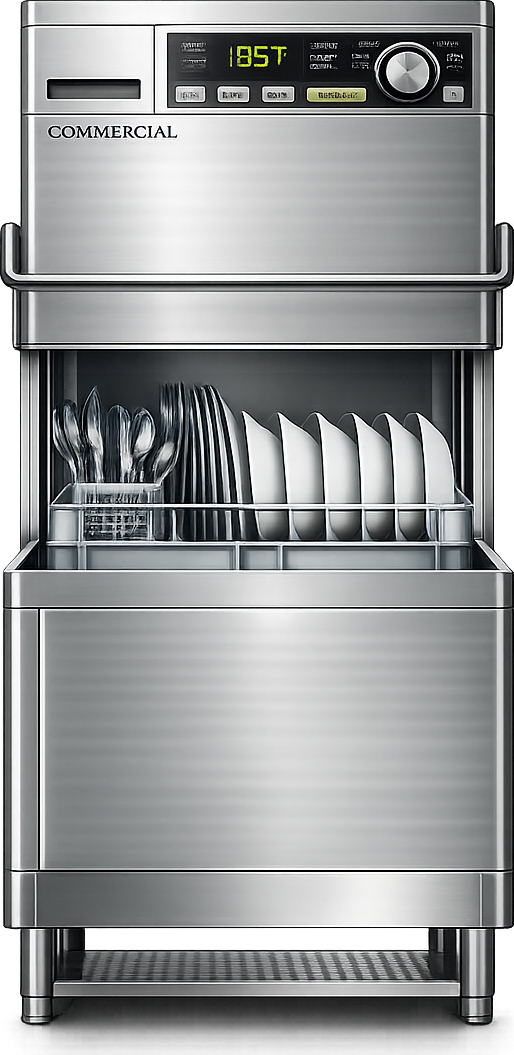
Undercounter machines, single and double rack door machines, rack conveyors and flight-type machines, glass washers, and both high-temperature and chemical-sanitising configurations with booster heaters.
Brands we service in Cedar Park: Hobart, Jackson, CMA, Champion, Ecolab-supplied machines, Moyer Diebel, Insinger and Atosa.
What Commercial Dish Machine Repair Costs in Cedar Park
The commercial diagnostic is $149, credited toward the repair when you approve it. After the diagnosis you get a written estimate covering parts and labor, and nothing is replaced before you approve it. Wash arms, nozzles, door switches, curtains, thermostats, dispensers and drain components are modest. Wash pumps, booster heaters and conveyor drives are not, and we will give you the figure first.
Deliming is separate work from repair, and on this water it frequently removes the fault on its own. We will tell you when that is what the machine needs.
Neighborhoods We Cover in Cedar Park
Dish machines take us into the back of house right across Cedar Park — the restaurants along Bell Boulevard and Whitestone, the cafes and bars off Lakeline, and the cafeterias in schools and churches near Brushy Creek. Hard water is the one thing they all share, and it is the reason most of these machines age faster than their manuals assume. We are twenty minutes away in Leander.
Common Questions About Dish Machine Repair in Cedar Park
What temperature does the machine actually have to hit?
On a high-temperature machine the final rinse is the number inspectors care about, and the data plate on your machine states what it must reach. We verify it with a test thermometer at the rack rather than trusting the panel gauge, because a gauge reading right while the rinse runs cool is exactly how kitchens fail an inspection.
We failed an inspection but the display looked fine. How?
Because the display reports a sensor and the inspector measures the water hitting the dishes. A scaled probe, a failing booster element or a weak rinse at peak demand all produce that gap. It is measurable and it is fixable.
How often should the machine be delimed?
Monthly for most Cedar Park kitchens, and more often for a high-volume machine. It is the maintenance that determines how long the elements, nozzles and probes last.
Do you work on chemical-sanitising machines as well as high-temp?
Yes, including the dispensing side — pumps, tubes and pick-ups — which is where most low-temp sanitising failures actually start.
How fast can you get to Cedar Park?
Usually same-day when a machine is down. Call (737) 388-3867 and tell us the make and whether the problem is cleaning, temperature or the machine not running at all.
Book Dish Machine Service in Cedar Park
Tell us the make, whether it is high-temp or chemical, and whether the problem is cleaning, temperature or the machine not running. That decides what goes on the van.
Commercial Dishwasher Repair in Cedar Park, TX
-

What Brings Us Out to a Warewasher
- Final rinse coming up short of temperature
- Racks coming out with food still on them
- Tub not filling, or not emptying
- Booster not recovering between racks
- Wash arms turning slowly or not at all
- Sanitizer not being drawn through
- Water running out at the door
-
Warewashers We Cover
- Undercounter dishwashers
- Door type and hood machines
- Conveyor and flight machines
- Glasswashers
- High temp and low temp units
- Hobart, Jackson, CMA, Champion
- Meiko, Moyer Diebel, Insinger

Warewashing Brands We Service in Cedar Park
If your brand is not listed, contact us — we likely service it.
Why Homeowners & Businesses Choose TakiDA
-
 Quality WorkWe deliver professional appliance repair with attention to detail, proper diagnostics, and long-lasting results you can rely on.
-
 OEM / High-Quality PartsWe use OEM or high-quality replacement parts to ensure correct operation, reliability, and extended appliance lifespan.
-
 Same-Day / Next-Day ServiceFast response with same-day or next-day service to reduce downtime and get your appliances back in working order quickly.
-
 Clear PricingUpfront estimates with transparent pricing. No hidden fees, no surprises — you know the cost before work begins.
-
 EPA Certified & InsuredEPA Section 608 Universal certified and fully insured for residential and commercial repair, giving you peace of mind and protection.
-
 Warranty on Labor & PartsAll repairs are backed by a warranty on labor and installed parts for added confidence and long-term reliability.
