
Commercial Cooktop and Vent Hood Repair in Round Rock, TX
A hood that is loud and still lets smoke out at the pass, grease dripping onto the line, a charbroiler weak at the back or a griddle with a hollow in it — we service commercial cooking lines and ventilation across Round Rock, from Old Town and Main Street to La Frontera and the I-35 corridor. Insured for commercial premises. Commercial diagnostic $149, credited toward the repair.
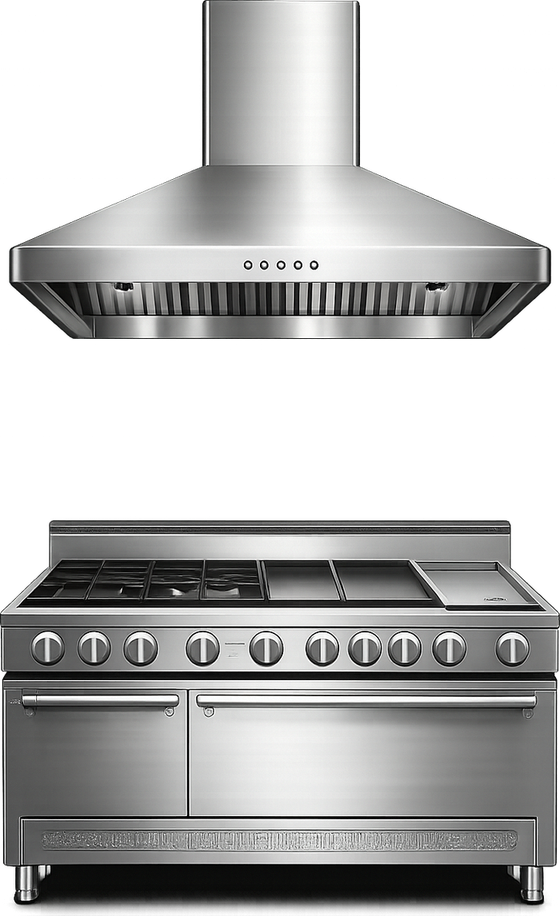
Common Commercial Cooking Line and Hood Problems in Round Rock Kitchens
The hood is loud and the pass is still smoky
Noise is not capture. A hood that is clearly moving air and still letting smoke roll out at the front is usually too small for what sits underneath it, or it does not overhang far enough at the ends. Side panels make a surprising difference here: a hood with open ends loses the plume to cross draft before it can be pulled up, and adding end panels often transforms capture without touching the fan. We look at the hood dimensions against the equipment line and at where the air in the room is coming from before anybody prices a bigger motor.
Grease dripping out of the filter track onto the line
Baffle filters are designed to throw grease out of the airstream and run it down into a trough and a cup, and that only works if they are installed the right way up and the trough is emptied. Filters put in backwards, or sat in a track that is already full, drip exactly where the cook is standing. It is a burn hazard and a food safety one. Emptying and cleaning the trough, replacing filters that have lost their shape and making sure they go back correctly is routine work that prevents a much bigger problem.
A charbroiler that is weak at the back
Long burner rails rely on even gas distribution, and the far end is where that fails first. Blocked ports and orifices at the back, a manifold that is undersized or sagging in pressure once the whole line is firing, and burner sections that have been rotated out of position all produce the same complaint: strong at the front, weak at the back. We check manifold pressure under full load and clean the burners right through rather than only the ones you can see.
A griddle plate with a hollow in the middle
Griddle plates warp when they are shocked: cold water onto a hot plate, scraping while cold, or uneven heating over years. Once a plate has a hollow, grease pools in it and the cooking surface is no longer flat, which affects everything from eggs to smash burgers. Depending on the plate thickness and the depth of the distortion, some can be milled flat by a machine shop and some cannot. We will measure it and tell you honestly which category yours is in rather than selling you thermostats that will not change the shape of the steel.
The salamander drops out part way through service
Salamanders and cheesemelters are small, run very hot and are often mounted tight under a shelf or against a wall, which is exactly what their high limit protects against. A unit that works for twenty minutes and then quits is usually overheating around its own controls rather than failing. Clearance, a blocked air path behind the unit, or a thermocouple and limit at the end of their life are the three things we check, in that order.
Hood lights that keep failing
Lamps in a hood sit in heat and vibration, and standard bulbs do not last there. Repeated failures usually mean the wrong lamp type has been fitted, the socket has corroded or lost tension, or the fixture gasket is gone and grease is reaching the contacts. Replacing the lamp again is a short term answer. Sorting the socket and fitting lamps rated for the location ends it.
Cold air blowing onto the line in winter
Makeup air units replace the air the hood removes, and not all of them temper that air. On a cold morning an untempered unit blows outside air straight onto the cook line, which is miserable to work under and plays havoc with pilot flames and cooking consistency. If yours has a heater section that has stopped working, that is a repair. If it never had one, that is worth knowing too, and we will tell you which it is rather than leaving you to guess.
A fan belt that squeals again a week after replacement
A belt that fails quickly is rarely a bad belt. Upblast fans sit on a roof, and when the motor mount shifts or the pulleys are not in line, the new belt wears on one edge from the first hour. Worn pulley grooves do the same. We check alignment and the condition of both pulleys when we change a belt, because fitting another belt into a misaligned drive just moves the problem a week down the road.
Equipment We Service in Round Rock
We service commercial gas and electric ranges and hot tops, charbroilers, griddles, salamanders and cheesemelters, wok and stock pot ranges, along with Type I and Type II hoods, upblast roof fans, inline fans and makeup air interlocks, from Vulcan, Garland, Imperial, Southbend, Wolf, Star, Montague, Avantco and Atosa on the cooking side and CaptiveAire and similar on the ventilation side. That covers burners and orifices, pilots and ignition, valves, griddle thermostats and bulbs, hood fans, belts, bearings, pulleys, filters, troughs, dampers, lights and control panels. We are insured for commercial premises.
What Commercial Cooking Line and Hood Repair Costs in Round Rock
The commercial diagnostic is $149 and it comes off the repair when you approve it. You get a written price for parts and labor before anything is replaced. Burners, orifices, pilots, valves, griddle thermostats, fan belts, bearings, pulleys, filters, light assemblies and switches are modest parts. Hood fan motors, full control panels and ductwork are the expensive end, and ducting and certified hood cleaning are specialist jobs we will point you to rather than pretend otherwise.
A good share of cooking line calls come down to burner cleaning, filter and trough work or a drive alignment, and those are inexpensive fixes that change how the line runs.
Neighborhoods We Cover in Round Rock
Along the I-35 corridor, around La Frontera and the outlets, and at the larger venues east of town, the kitchens are newer and generally well ventilated, so the work there is mostly mechanical: belts, bearings, pulleys, filters, burners and griddle controls on equipment that runs hard all day. Those sites usually have a hood cleaning contractor already, and we coordinate with them rather than duplicating the work.
Around Old Town, Main Street and Mays the buildings are older and were not built as restaurants. Hoods there were often sized for a different equipment line than the one underneath them today, and makeup air was an afterthought, so a capture complaint is frequently about the room rather than the fan. We will tell you that honestly rather than selling you a motor. We also service cooking lines in school and institutional kitchens across Round Rock. The town is an easy run from Leander, and for a line down in service we will give you a straight answer on timing.
Common Questions About Commercial Cooking Line and Hood Repair in Round Rock
The hood is loud but smoke still escapes. Do I need a bigger fan?
Often not. Overhang, end panels and the duty of the equipment underneath matter as much as airflow, and so does where the replacement air comes from. We check those before pricing a motor.
Do you clean hoods and ducts?
Certified hood and duct cleaning is a specialist trade and we will point you to it. We service the equipment: fans, belts, bearings, pulleys, filters, troughs, dampers, lights and controls.
Can a warped griddle plate be fixed?
Sometimes. Depending on thickness and how deep the hollow is, a machine shop can mill it flat; beyond that it has to be replaced. We measure it and tell you which it is.
Can you service our fire suppression system?
No, and nobody should except a licensed fire protection contractor. We work around it, flag anything that looks wrong, and coordinate with your suppression company when a repair needs the system isolated.
How quickly can you get to Round Rock?
Often the same day. Call (737) 388-3867, tell us what is on the line and what it is doing, and we will give you a straight answer on timing.
Book Commercial Cooking Line Service in Round Rock
Tell us what is on the line, what it is doing, and whether the ventilation side is involved — smoke not capturing, grease dripping, a noisy roof fan or cold air blowing onto the cooks. Call (737) 388-3867 or book online and we will confirm a time for Round Rock.
Commercial Cooktop and Vent Hood Repair in Round Rock, TX
-

Symptoms We Sort Out
- Hood loud but smoke still escaping
- Grease dripping onto the cook line
- Charbroiler weak at the back burners
- Griddle plate with a hollow in it
- Salamander dropping out mid service
- Hood lights failing again and again
- Cold makeup air blowing on the line
- Fan belt squeal back within a week
-
Equipment We Service
- Commercial ranges and hot tops
- Charbroilers and griddles
- Salamanders and cheesemelters
- Type I and Type II hoods
- Upblast roof and inline fans
- Makeup air interlocks and controls

Cookline and Hood Brands We Service in Round Rock
If your brand is not listed, contact us — we likely service it.
Why Homeowners & Businesses Choose TakiDA
-
 Quality WorkWe deliver professional appliance repair with attention to detail, proper diagnostics, and long-lasting results you can rely on.
-
 OEM / High-Quality PartsWe use OEM or high-quality replacement parts to ensure correct operation, reliability, and extended appliance lifespan.
-
 Same-Day / Next-Day ServiceFast response with same-day or next-day service to reduce downtime and get your appliances back in working order quickly.
-
 Clear PricingUpfront estimates with transparent pricing. No hidden fees, no surprises — you know the cost before work begins.
-
 EPA Certified & InsuredEPA Section 608 Universal certified and fully insured for residential and commercial repair, giving you peace of mind and protection.
-
 Warranty on Labor & PartsAll repairs are backed by a warranty on labor and installed parts for added confidence and long-term reliability.
