
Commercial Cooktop and Vent Hood Repair in Lakeway, TX
On a commercial line the cooking equipment and the exhaust above it are one system, and in Lakeway that system has two complications most kitchens in town do not face. Many buildings out here are off the natural gas main and run propane, so every burner has been converted and some of those conversions were never verified. And a lot of these kitchens are newer, tighter buildings where a hood pulling eight or ten thousand CFM has nowhere to get replacement air, which shows up as pilots dropping out and smoke rolling off the line while the fan howls. We repair ranges, griddles, charbroilers and salamanders along with hoods, exhaust fans and makeup air, because the fault is often in the relationship between them.
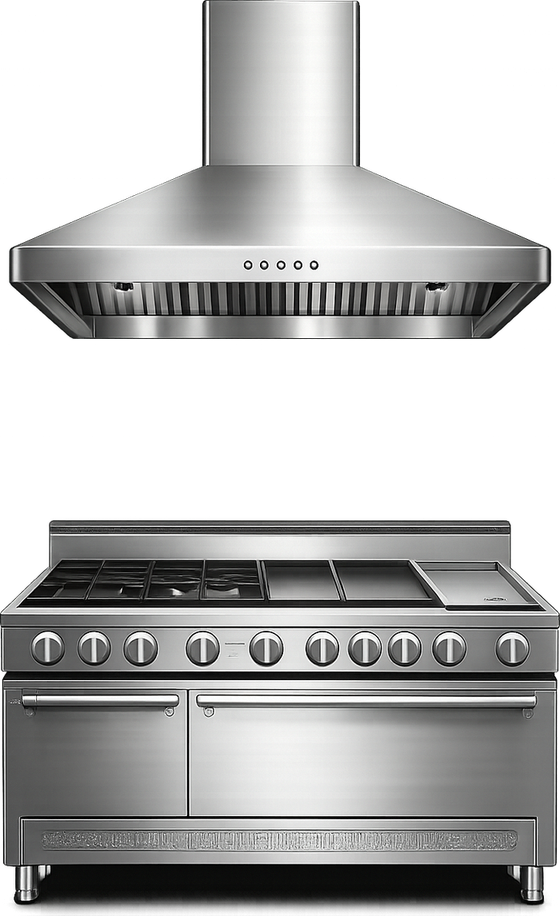
Common commercial cooking and hood problems we fix in Lakeway
Burner will not light or will not stay lit
On a commercial range the chain is the pilot, the thermocouple or flame sensor, the gas valve and the manifold pressure. A burner that lights and drops out points at flame supervision rather than at gas supply. Before replacing a thermocouple we measure its millivolt output under flame, because a weak signal and a failing valve present identically and one of them is a far cheaper part.
Yellow lazy flames, soot on pans
This is the classic signature of a gas appliance running on the wrong orifice or the wrong manifold pressure, and in Lakeway it almost always means a propane conversion that was done partially. Soot is also a carbon monoxide concern in an enclosed kitchen, so it is not a cosmetic issue. We check the orifices and set manifold pressure properly rather than adjusting air shutters to mask it.
Griddle or charbroiler heating unevenly
Uneven heat across a griddle plate is usually burner related: a partially blocked burner, an orifice problem, or a thermostat and probe reading one zone while another drifts. On a charbroiler, uneven output is often blocked burner ports from grease and carbon. We clean and verify burner performance across the plate rather than replacing a thermostat on the strength of one cold corner.
Hood running but smoke rolling off the line
A hood that makes noise and does not capture is either restricted or starved. Restricted means loaded filters, a greased duct, or a fan with a slipping belt and a loaded wheel. Starved means the building cannot supply the air the hood is trying to move. In a newer Lakeway building the second cause is common and no amount of fan work fixes it. We measure capture at the hood edge and check the makeup air path before recommending anything.
Exhaust fan not running or running slow
Rooftop exhaust fans fail at the belt, the bearings, the motor and the starter. A belt that has stretched slips under load, which cuts airflow long before anyone notices a noise. Hill Country summers are hard on rooftop motors, and a fan running hot all July loses bearing life quickly. These are accessible, inexpensive repairs if caught at the belt stage.
Pilots blowing out when the hood is on full
This is the clearest symptom of negative pressure in a kitchen. Turn the hood to full and pilots drop; turn it down and they stay. The hood is pulling more air than the building can replace, and it is pulling it from wherever it can find it, including through burner assemblies. The fix is makeup air, not a thermocouple, and we will tell you that rather than selling parts that will not hold.
Grease in the duct and at the roof fan
Grease accumulation in a long duct run reduces airflow steadily and is a fire risk. We are not a hood cleaning company, but we will tell you honestly when the airflow problem we are looking at is grease rather than equipment, because that is a cleaning job and no fan repair will substitute for it.
Controls, safety interlocks and fire system ties
Commercial hood systems are interlocked with the fire suppression system, and a discharged or improperly reset suppression system will keep gas shut off to the whole line. A kitchen whose range will not light after a suppression event is often not an appliance problem at all. We identify that quickly rather than tearing into a range that is working perfectly.
Propane conversions on a commercial line
Every gas appliance in a kitchen off the main has to be set up for propane: correct orifices for each burner and the regulator set to propane manifold pressure. On a six burner range with an oven and a griddle that is a lot of individual parts, and we routinely find lines where some pieces were converted properly and others were not. The symptoms vary by appliance: a range that soots, a griddle that will not hold temperature at the far end, an oven that takes forever to come up. If your kitchen runs propane and you have a list of small complaints across different pieces of equipment, the conversion is where we start looking, because one bad setup explains several symptoms at once.
Makeup air, and why the hood is only half the story
Exhaust hoods are sized for the cooking line. Makeup air has to be sized for the hood. In older buildings the gap was made up by leakage. In the newer, tighter buildings common around Lakeway it cannot be, so the kitchen goes negative: doors are hard to open, the hood roars without capturing, pilots are unstable, and in the worst case combustion gases get pulled back down a flue. If your kitchen got worse after a renovation, new doors or weatherization, that is the likely cause. We will tell you what we measure, and if the answer is a makeup air unit rather than an appliance repair, we will say so rather than charging you to discover it slowly.
Patio lines and seasonal kitchens
Lakeway has a lot of outdoor and semi-outdoor service, and equipment on a patio line faces conditions no spec sheet assumes: wind across open burners, weather on controls, and in a seasonal operation weeks of idleness between busy stretches. Wind alone will blow out pilots on an exposed line and the usual fix is a windbreak rather than a part. For seasonal kitchens, the pattern we recommend is simple: fire the whole line a few days before the season or a big event and find the faults when there is time to fix them.
Commercial cooking and hood questions from Lakeway operators
Our pilots go out whenever the hood is on high
That is negative pressure in the kitchen. The hood is moving more air than the building can replace and it is pulling it through your burners. The fix is a makeup air path, not thermocouples, and we will show you what we measured.
Our burners soot and the flames are yellow
Almost always a propane conversion issue: wrong orifice or wrong manifold pressure. It is also a combustion safety concern in an enclosed kitchen, so it is worth addressing promptly rather than adjusting around.
The hood is loud but does not capture
Either restricted (loaded filters, greased duct, slipping belt) or starved (no makeup air). We measure at the hood before recommending anything, because those two look identical from the line.
Our range will not light at all after the fire system went off
Check the suppression system reset and the gas shutoff valve. A discharged system keeps gas off to the entire line, and the range itself is usually fine. We can confirm that quickly.
What does commercial cooktop or hood repair cost in Lakeway?
The commercial diagnostic is $149 and it is credited toward the repair when you approve it. Thermocouples, orifices and belts are inexpensive; motors and controls cost more, and a makeup air problem is a building issue we will identify but not quote as an appliance repair. You get a written estimate before work begins.
Book Cookline or Hood Service in Lakeway
Tell us the equipment and brand, whether the kitchen runs natural gas or propane, and whether the problem changes when the hood is on full. We serve restaurants, clubs, bars and event kitchens in Lakeway, Bee Cave, Lago Vista, Leander, Lakeway and the surrounding Hill Country, with same-day service when the schedule allows.
Commercial Cooktop and Vent Hood Repair in Lakeway, TX
-

What we service
- Commercial gas and propane ranges
- Griddles, charbroilers and salamanders
- Induction and electric commercial cooktops
- Exhaust hoods and makeup air systems
- Rooftop exhaust fans and belt drives
- Pilot, thermocouple and gas valve faults
- Burner and orifice conversion work
-
Lakeway specifics
- Propane kitchens off the natural gas main
- Patio and outdoor line exposed to wind
- Rooftop exhaust fans in Hill Country heat
- Makeup air problems in sealed buildings
- Grease loading on long duct runs
- Seasonal kitchens with equipment idle between events

Cookline and Hood Brands We Service in Lakeway
If your brand is not listed, contact us — we likely service it.
Why Homeowners & Businesses Choose TakiDA
-
 Quality WorkWe deliver professional appliance repair with attention to detail, proper diagnostics, and long-lasting results you can rely on.
-
 OEM / High-Quality PartsWe use OEM or high-quality replacement parts to ensure correct operation, reliability, and extended appliance lifespan.
-
 Same-Day / Next-Day ServiceFast response with same-day or next-day service to reduce downtime and get your appliances back in working order quickly.
-
 Clear PricingUpfront estimates with transparent pricing. No hidden fees, no surprises — you know the cost before work begins.
-
 EPA Certified & InsuredEPA Section 608 Universal certified and fully insured for residential and commercial repair, giving you peace of mind and protection.
-
 Warranty on Labor & PartsAll repairs are backed by a warranty on labor and installed parts for added confidence and long-term reliability.
