
Wine Cooler Repair in Round Rock, TX
A cabinet that swings instead of holding temperature, a compressor you can hear through the joinery, warm bottles on the top shelves or a door that no longer closes itself — most of these are a fan, a hinge or a blocked vent rather than a failed cooling system. We repair compressor and thermoelectric wine coolers, freestanding and built-in, across Round Rock from Old Town and Forest Creek to Teravista and Paloma Lake. The diagnostic is $99 and it comes off the repair.
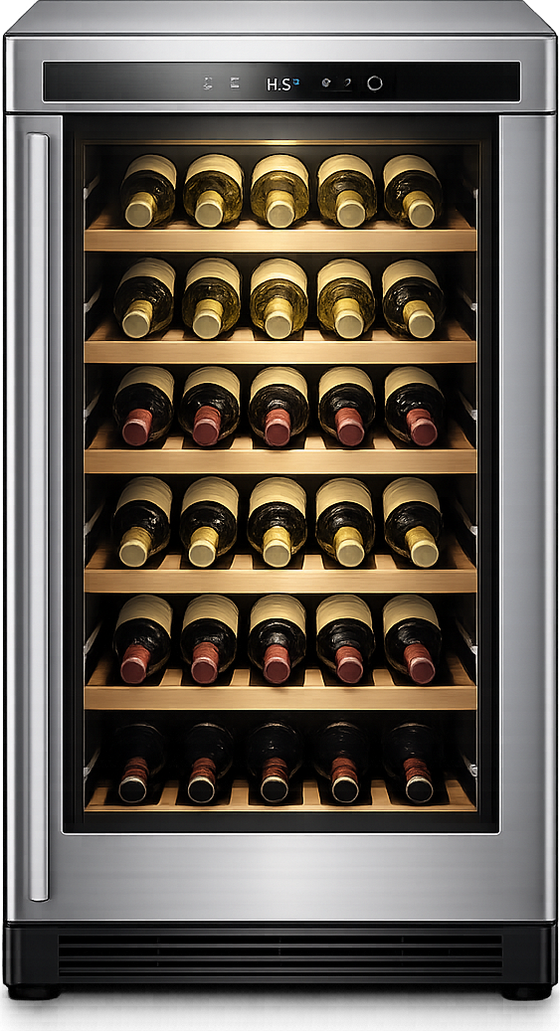
Common Wine Cooler Problems in Round Rock Homes
The temperature swings instead of holding steady
How much swing is acceptable depends entirely on what is controlling the cabinet. A mechanical thermostat works on a bimetal and has a built in differential, so it lets the cabinet drift several degrees either side of the setting before it acts. That is normal behaviour for that design, not a fault, and no repair will tighten it. An electronically controlled unit should hold far closer, and when one of those starts swinging it is usually the thermistor or the control rather than the cooling system. Knowing which type you own is the first thing we establish, because it decides whether there is anything to fix.
You can hear the compressor through the cabinetry
A wine cooler built into an island or a butler's pantry transmits whatever it does into the joinery around it. Compressors sit on rubber isolation mounts, and those harden and compress over the years until the unit is effectively bolted to its own chassis. Add a cabinet opening that is a close fit on the sides, and the whole run of cabinetry becomes a sounding board. This matters for more than comfort: sustained vibration is one of the few things that genuinely affects wine in storage. New mounts and a little clearance usually deal with it.
The display reads correctly but a thermometer inside disagrees
Many wine coolers display the setpoint rather than the measured temperature, and even those that show a reading take it at one point behind the back wall. A bottle sitting in the middle of a loaded cabinet can be several degrees away from that. Before anybody calls it a fault, we put a thermometer in the middle of the cabinet, let it settle for several hours and compare. If the gap is real, then the thermistor and its position are worth looking at.
Bottles at the top are warm and the bottom is fine
In a single zone cooler a gradient from top to bottom is built in rather than broken: cold air falls, so the lowest shelves run coolest, and a few degrees of difference is normal and often useful. A large gradient is a different matter and usually means the circulation fan has stopped, the air path behind the shelves is blocked by bottles pushed too far back, or the evaporator is partly iced. We check the fan and the airflow before concluding anything about the sealed system.
The glass door sweats on the outside
This is condensation from the room, not a leak from the cooler. When indoor humidity is high and the glass is cold, moisture forms on the outside exactly as it does on a cold drink. Some units have a small heater around the frame or in the glass specifically to prevent it, and when that heater fails the sweating appears. Others never had one. Sweating on the inside of the glass is the opposite problem and points at the door seal letting warm air in.
The interior light stays on
Beyond the nuisance, this matters because a light left on is a heat source inside an insulated cabinet, and on older units with incandescent bulbs it is a surprisingly large one. The cause is almost always the door switch, which is a small and inexpensive part. Some coolers also have a display mode that keeps the light on deliberately, so we check that first rather than assuming a fault, because that one costs nothing to fix.
The door no longer swings shut on its own
Most wine cooler doors are self closing through a cam built into the hinge, which lifts the door slightly as it opens so gravity brings it back. When the cam wears, or when a reversible door has been swapped to the other side without resetting the hinge hardware correctly, the door stops closing itself and gets left ajar. That then shows up a week later as a cooling complaint, with ice on the evaporator and a compressor that never stops. Hinges and cams are modest parts.
It cools properly but is much louder through the summer
A cooler in a Round Rock kitchen in August is working far harder than the same unit in February, so it runs longer and you hear it more. That part is physics. What turns it into a problem is restricted airflow at the condenser: dust on the coil, a blocked front grille on a built in unit, or a freestanding unit pushed into a cabinet with no path for the heat to leave. Cleaning the condenser and restoring clearance quietly fixes most summer noise complaints, and it extends the life of the compressor as well.
Wine Coolers We Repair in Round Rock
We work on compressor and thermoelectric units, freestanding and built in, single and dual zone, from EdgeStar, NewAir, Avanti, Danby, Haier, Whynter, Frigidaire, GE, KitchenAid, Vinotemp and the Sub-Zero and Thermador built in columns found in some Round Rock kitchens. That covers undercounter and tall units, glass and solid doors, and the 15 and 24 inch built in widths. On built in units, ventilation and installation are as often the answer as any part, and we will tell you when that is what we are looking at.
What Wine Cooler Repair Costs in Round Rock
The residential diagnostic is $99 and comes off the repair when you approve it. You get a written price for parts and labor before anything is replaced. Fans, thermistors, door switches, seals, hinges and cams, frame heaters, compressor mounts, drains and control boards are reasonable parts. Sealed system work and compressor replacement are the expensive end, and on a small or inexpensive unit they are rarely worth doing. On a built in column the maths usually goes the other way because the cabinetry is built around it. Either way we will put the numbers in front of you.
A real share of wine cooler calls end at a condenser clean, a door switch or a hinge, and those are cheap fixes we are glad to make.
Neighborhoods We Cover in Round Rock
Wine coolers turn up most often in the newer parts of town. Across Teravista, Paloma Lake, Mayfield Ranch, Behrens Ranch and Stone Canyon they are built into kitchen islands, butler's pantries and bar areas, which is where the installation questions come from: front venting that has been blocked, a freestanding unit fitted into a cabinet that cannot clear its heat, and noise travelling through joinery. Those are the complaints we hear most and they are usually fixable without touching the cooling system.
In Forest Creek, Cat Hollow, Chandler Creek, Old Town and Greenlawn we see more freestanding units in kitchens, dining rooms and game rooms, and there the work is closer to thermostats, fans, door seals and hinges on units that have been in service a while. A cooler in a garage or an uninsulated bonus room is its own category, because summer ambient temperatures out there sit well above what most units are rated for, and we will tell you plainly when the location rather than the appliance is the limit. Round Rock is an easy run from Leander and a same day slot is usually open.
Common Questions About Wine Cooler Repair in Round Rock
My temperature drifts a few degrees. Is that a fault?
Not if the unit has a mechanical thermostat, because the swing is designed in. On an electronically controlled cooler it should hold much tighter, and drift there is worth looking at.
Why are the top bottles warmer than the bottom ones?
Cold air falls, so a gradient is normal in a single zone cabinet. A large gradient usually means the circulation fan has stopped or the airflow behind the shelves is blocked.
The glass door is sweating. Is it leaking?
No. Sweating on the outside is room humidity condensing on cold glass, and some units have a frame heater to prevent it. Sweating on the inside points at the door seal instead.
Can I fit a freestanding cooler under a counter?
Only with a way for the heat to escape. Freestanding units reject heat from the back and sides, built in units vent through the front, and getting this wrong is the most common reason a wine cooler dies young.
How soon can you get out to Round Rock?
Usually the same day or the next. Call (737) 388-3867 with the brand, the model and whether it is built in or freestanding, and we will tell you honestly what the day looks like.
Book Wine Cooler Repair in Round Rock
Tell us the brand and model, whether it is built-in or freestanding, and what it is doing — drifting, running non-stop, warm at the top, sweating, or noisy. Where it is installed matters too, so mention it if it sits in an island, a pantry or a garage. Call (737) 388-3867 or book online and we will confirm a time for Round Rock.
Wine Cooler Repair in Round Rock, TX
-

Symptoms We Sort Out
- Temperature swinging instead of holding
- Compressor heard through the cabinetry
- Display and thermometer disagreeing
- Top bottles warm, bottom fine
- Glass door sweating on the outside
- Interior light staying on
- Door no longer closing itself
- Noticeably louder through the summer
-
What We Work On
- Compressor and thermoelectric units
- Freestanding and built-in
- Single and dual zone
- 15 and 24 inch built-in widths
- Undercounter and tall columns
- Door seals, hinges, lights and drains

Wine Cooler Brands We Service in Round Rock
If your brand is not listed, contact us — we likely service it.
We repair all major residential appliance brands across Central Texas, including Whirlpool, GE, Samsung, LG, Maytag, Frigidaire, KitchenAid, Amana, Bosch, Electrolux, Hotpoint, Kenmore, Haier, Fisher & Paykel, Sub-Zero, Wolf, Viking, Thermador, JennAir, Dacor, U-Line, Marvel, Miele, and GE Monogram.
Why Homeowners & Businesses Choose TakiDA
-
 Quality WorkWe deliver professional appliance repair with attention to detail, proper diagnostics, and long-lasting results you can rely on.
-
 OEM / High-Quality PartsWe use OEM or high-quality replacement parts to ensure correct operation, reliability, and extended appliance lifespan.
-
 Same-Day / Next-Day ServiceFast response with same-day or next-day service to reduce downtime and get your appliances back in working order quickly.
-
 Clear PricingUpfront estimates with transparent pricing. No hidden fees, no surprises — you know the cost before work begins.
-
 EPA Certified & InsuredEPA Section 608 Universal certified and fully insured for residential and commercial repair, giving you peace of mind and protection.
-
 Warranty on Labor & PartsAll repairs are backed by a warranty on labor and installed parts for added confidence and long-term reliability.
