
Refrigerated Prep Table Repair in Round Rock, TX
A rail that holds in the morning and gives up by mid-afternoon, lids that no longer sit flat, drawers that will not close or a condenser nobody can reach — we service sandwich, salad and pizza prep tables and chef bases across Round Rock, from Old Town and Main Street to La Frontera and the I-35 corridor. EPA Section 608 Universal certified and insured. Commercial diagnostic $149, credited toward the repair.
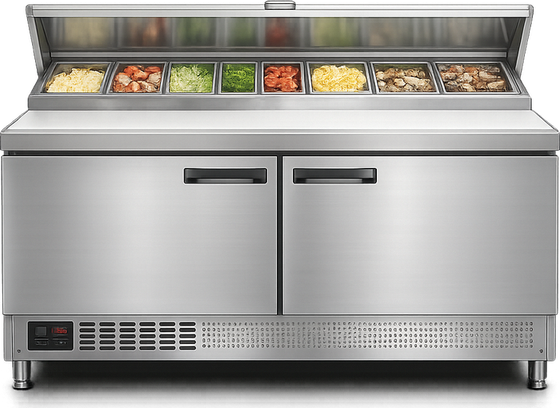
Common Refrigerated Prep Table Problems in Round Rock Kitchens
The lids or night covers no longer sit flat
Prep table lids take a hard life: they get stacked on, dropped, run through a dish machine they were never meant for, and after a while they warp. A lid that does not sit flat leaves a gap along the rail, and the cold air curtain the table relies on simply spills out of it. Owners rarely connect the two, because the lid looks like a cosmetic item. It is not. Replacing warped lids and getting night covers back into use at close is one of the cheapest ways to get a struggling rail holding again.
Sweating on the outside of the cabinet
A little condensation around the rail edge on a humid day is normal and nothing to worry about. Water beading on the front or sides of the cabinet is different, and it usually means the insulation inside the panel has taken on moisture, often through a damaged gasket channel or a leak that was mopped up months ago. Once the insulation is wet it stops insulating, the cabinet runs cold on the outside and the compressor works permanently harder. It is worth identifying early, because wet insulation does not dry out in service.
Drawers stiff, or not closing the last inch
On drawer models the slides collect grease and debris and then bind, and staff stop pushing them fully home. A drawer standing a quarter inch open leaks cold air all shift, and the gasket at the front gets crushed out of shape on top of that. Slides, rollers and drawer gaskets are all inexpensive serviceable parts, and sorting them out usually fixes a temperature complaint that looked like a refrigeration fault.
It holds in the morning and gives up by mid afternoon
A table that is fine at ten and failing at three is almost always being beaten by heat and use rather than by a failed part. By the afternoon the kitchen is at its hottest, the condenser is drawing the warmest air of the day, and the rail has been opened hundreds of times. Where the table sits decides a lot of that, and so does whether the condenser is clean. We measure the ambient at the unit's air intake rather than in the middle of the room, because next to a cook line those are two very different numbers.
Short cycling, and tripping out on overload
A compressor that starts, runs briefly, stops and trips is drawing more than it should. The usual reasons are a condenser so fouled that head pressure never comes down, a start component on its way out, or a charge problem. Every one of those gets worse the hotter the kitchen gets, which is why these calls cluster in summer. Resetting and carrying on costs compressors, so it is worth measuring current and pressures rather than waiting to see if it settles.
A mega top where the back row of pans will not hold
Mega tops put two rows of pans in the rail, and the back row sits furthest from the air discharge. That design is at its limit when the pans are deep, overfilled or the wrong size for the openings, and the back row is where it shows first. Before anything is condemned we check pan sizes against the cut outs, fill levels against the line, and whether the discharge slot is clear. If the table genuinely cannot hold the back row with everything correct, then the fan and the charge are worth looking at.
The condenser filter is missing or solid with grease
Prep tables that live on a cook line draw greasy air through the condenser all day. Many have a filter at the grille, and in most kitchens it has either been thrown away years ago or has not been washed since it was fitted. Without it, the coil fouls in weeks rather than years, and once the coil is blocked everything else on this list gets more likely. Cleaning the coil properly and putting a filter back is the single most useful thing we do on these units.
The table cannot be pulled out to be cleaned
Prep tables are supposed to roll out on casters so the coil and the floor underneath can be cleaned. In practice the casters seize, the unit gets wedged between equipment, or the lines are too short to move it at all. The result is a condenser nobody has touched in years, which brings us back to the start of the list. Replacing seized casters and leaving enough slack for the unit to come out is a small job that makes every future service possible.
Equipment We Service in Round Rock
We service sandwich and salad prep tables, pizza prep tables with raised rails, mega top units, refrigerated chef bases and under-counter prep refrigeration, in door and drawer configurations, from True, Turbo Air, Beverage-Air, Continental, Delfield, Traulsen, Arctic Air, Avantco and Atosa. That covers condensing units and evaporators, fans and defrost, electronic and mechanical controls and probes, drains, gaskets, hinges, drawer slides, lids and casters, as well as the airflow and placement questions behind most rail complaints. Sealed system work is done under EPA Section 608 Universal certification and we are insured for commercial premises.
What Prep Table Repair Costs in Round Rock
The commercial diagnostic is $149 and it comes off the repair when you approve it. You get a written price covering parts and labor before anything is replaced. Fan motors, probes, controls, gaskets, hinges, drawer slides, lids, casters, filters and drain clearing are modest parts. Compressors, condensing units and evaporator coils are the expensive end, and on a table that has spent years beside a cook line we will give you the repair number next to a replacement so you can decide with real figures.
A lot of prep table calls end with a coil clean, a lid or a drawer gasket, and those are cheap fixes that put your rail temperatures back where they need to be.
Neighborhoods We Cover in Round Rock
Along the I-35 corridor, around La Frontera and the outlets, and in the high volume kitchens east of town, prep tables run open all day and the issues are relentless use, cook line heat and condensers that foul fast. Those sites benefit most from a cleaning schedule and a filter that actually gets washed, and we would rather set that up than keep returning for the same temperature complaint.
Around Old Town, Main Street and Mays the kitchens are tighter, and prep tables end up wherever they fit, usually alongside the hottest equipment in the room. That placement is the single biggest reason a rail cannot hold in summer, and it is worth knowing before anyone spends money on refrigeration parts. We also service prep refrigeration in school and institutional kitchens across Round Rock, where holding temperatures are logged and a failing rail has to be dealt with the same day. Round Rock is an easy run from Leander.
Common Questions About Prep Table Repair in Round Rock
Our rail holds in the morning and fails in the afternoon. Why?
Heat and use. The condenser is drawing the warmest air of the day and the rail has been open all shift. We measure ambient at the unit's intake, which next to a cook line is nothing like the room temperature.
Do the lids really matter?
Yes. A warped lid or a missing night cover lets the cold air curtain spill out, and that alone can account for a rail that will not hold. They are cheap to replace.
The cabinet is sweating on the outside. Is that normal?
Around the rail edge on a humid day, yes. On the front or side panels, no: that usually means wet insulation, which does not dry out and makes the unit work permanently harder.
How often should the condenser be cleaned?
On a cook line, far more often than people expect, and with a filter in place. A fouled coil is behind most of the other faults on this page.
How quickly can you get to Round Rock?
Often the same day. Call (737) 388-3867, tell us the make and whether product is at risk, and we will give you a straight answer on timing.
Book Prep Table Service in Round Rock
Tell us the make and model, what the rail and the base are each reading, and roughly what time of day it starts to slip, because that one detail points straight at the cause. If an inspection flagged product temperature, bring the readings. Call (737) 388-3867 or book online and we will confirm a time for Round Rock.
Refrigerated Prep Table Repair in Round Rock, TX
-

Symptoms We Sort Out
- Lids and covers no longer sitting flat
- Sweating on the outside of the cabinet
- Drawers stiff or not closing fully
- Holds in the morning, fails by afternoon
- Short cycling and tripping on overload
- Mega top losing the back row of pans
- Condenser filter missing or blocked
- Unit that cannot be pulled out to clean
-
Equipment We Service
- Sandwich and salad prep tables
- Pizza prep tables and mega tops
- Refrigerated chef bases
- Under-counter prep refrigeration
- Door and drawer configurations
- Controls, probes, drains and gaskets

Prep Table Brands We Service in Round Rock
If your brand is not listed, contact us — we likely service it.
Why Homeowners & Businesses Choose TakiDA
-
 Quality WorkWe deliver professional appliance repair with attention to detail, proper diagnostics, and long-lasting results you can rely on.
-
 OEM / High-Quality PartsWe use OEM or high-quality replacement parts to ensure correct operation, reliability, and extended appliance lifespan.
-
 Same-Day / Next-Day ServiceFast response with same-day or next-day service to reduce downtime and get your appliances back in working order quickly.
-
 Clear PricingUpfront estimates with transparent pricing. No hidden fees, no surprises — you know the cost before work begins.
-
 EPA Certified & InsuredEPA Section 608 Universal certified and fully insured for residential and commercial repair, giving you peace of mind and protection.
-
 Warranty on Labor & PartsAll repairs are backed by a warranty on labor and installed parts for added confidence and long-term reliability.
