
Refrigerated Prep Table Repair in Georgetown, TX
A rail that will not hold while the base stays cold, product failing temperature checks, ice on the coil or water in the base — we service sandwich, salad and pizza prep tables and chef bases across Georgetown, from the Square and Austin Avenue to the I-35 corridor and Wolf Ranch. EPA Section 608 Universal certified and insured. Commercial diagnostic $149, credited toward the repair.
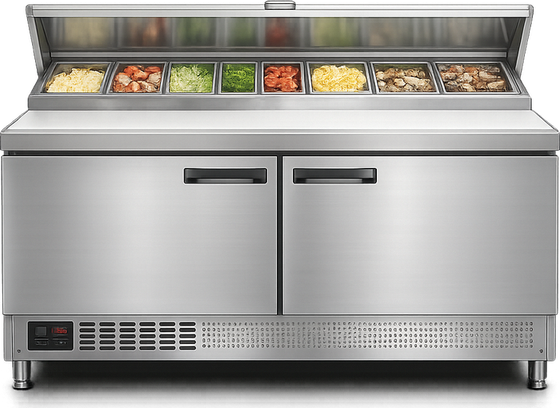
Common Refrigerated Prep Table Problems in Georgetown Kitchens
The rail runs warm while the base underneath holds fine
This is the complaint we get most, and the cause is usually how the table is being used rather than a failed component. The rail is cooled by a curtain of cold air moving along the pan well, and anything that interrupts that curtain defeats it: pans filled above the fill line, a wrong size pan leaving a gap, a cutting board or a stack of lids sitting over the discharge slot, or no night covers. The table was certified to hold product with the pans at or below the line and the covers on. We check the airflow path and the fill practice before condemning the system, because replacing a compressor will not fix a blocked air curtain.
Product in the rail failing temperature checks
Here is the distinction that costs kitchens on an inspection: the controller reads air temperature at the probe, and the inspector reads product temperature in the pan. A table showing thirty six degrees with product at forty six is normal when the top pan is overfilled or has been sitting out of the well. We take product temperatures where the inspector would, at the top and in the middle of the pan, along with air temperature at the discharge and at the return, and that combination tells us whether the problem is the equipment or the line.
The unit struggles because of where it sits
Prep tables are rated for a maximum ambient, often around seventy five degrees, and most of them breathe through a grille at one end. Put that end next to a fryer, a char broiler or an oven, which is exactly where prep tables end up in a tight kitchen, and the condenser is trying to reject heat into air that is already hot. The unit then runs continuously, never pulls the rail down during service, and wears out early. If that is what we find, we will say so plainly, because moving the table or adding ventilation solves more than any part will.
Ice building on the evaporator, or product freezing at one end
Ice on the coil means the system is running colder than it should or the defrost is not clearing it. Most prep tables use an off cycle defrost, which depends on the compressor actually stopping long enough for the coil to clear, so a table that never cycles off never defrosts either. A failed evaporator fan does the same thing from the other direction. Once the coil is iced, airflow stops, the rail goes warm and the base goes warm with it, which is why this often arrives disguised as a cooling failure.
Water in the base or on the floor
Condensate from the coil runs to a drain and then to a pan or a line. On prep tables the drain is short, narrow and in a dirty environment, so it plugs with food debris and the base cabinet fills. The rail pans have their own drain on some models and that plugs too. Neither is expensive to clear, but standing water in the base is a sanitation finding and it rusts the cabinet from the inside, so it is worth dealing with rather than mopping around.
The compressor runs continuously and the table never cycles
Continuous running on a prep table has a short list: the lid or drawer gaskets are no longer sealing, the condenser is fouled or starved of air, the charge is low, or the table is being asked to pull down warm product it was never designed to chill. Prep tables are holding equipment, not chilling equipment, and loading them with warm product straight from prep is one of the most common reasons they appear to fail. We check all of it, and we will tell you which of them we found.
Drawer and door gaskets that have given up
Gaskets on prep tables take more punishment than on any other piece of refrigeration in the kitchen: they get knocked, cleaned with the wrong chemicals, and left open during service. A hardened or torn gasket lets warm moist air in continuously, which costs temperature and builds ice on the coil at the same time. Gaskets, drawer slides, hinges and self closers are all inexpensive and are among the best value repairs on this equipment.
The controller is reading, but nothing matches reality
Electronic controls on prep tables fail quietly: a probe drifts, a connector corrodes in a wet cabinet, or the probe works loose from its clip and ends up reading the air near the door rather than the air it is supposed to. The display then tells a story the food does not agree with. Probes are cheap, the check is quick, and it is always worth doing before anyone starts talking about the sealed system.
Equipment We Service in Georgetown
We service sandwich and salad prep tables, pizza prep tables with raised rails, mega top units, refrigerated chef bases and under-counter prep refrigeration, in door and drawer configurations, from True, Turbo Air, Beverage-Air, Continental, Delfield, Traulsen, Arctic Air, Avantco and Atosa. That covers condensing units and evaporators, fans and defrost, electronic and mechanical controls and probes, drains, gaskets, hinges, drawer slides and lids, as well as the airflow and placement questions that cause most rail complaints. Sealed system work is done under EPA Section 608 Universal certification and we are insured for commercial premises.
What Prep Table Repair Costs in Georgetown
The commercial diagnostic is $149 and it comes off the repair when you approve it. You get a written price covering parts and labor before anything is replaced. Fan motors, probes, controls, gaskets, hinges, drawer slides, lids and drain clearing are modest parts. Compressors, condensing units and evaporator coils are not, and on a prep table that has spent years next to a fryer we will give you the repair number next to a replacement so you can decide with real figures.
A lot of prep table calls end with airflow, a gasket or a drain, and those are cheap fixes that put your rail temperatures back where they need to be.
Neighborhoods We Cover in Georgetown
Downtown around the Square the kitchens are tight, and prep tables end up wherever they fit, which is often alongside the cook line. That placement is the single biggest reason a rail will not hold in summer, and it is worth knowing before anyone spends money on refrigeration parts. We cover the Square, Austin Avenue, Main Street and the blocks around them.
Along the I-35 corridor and Williams Drive we work on higher volume kitchens and sandwich and pizza operations where the rail is open all day and the question is as much about process as equipment: fill lines, covers and how warm the product is when it goes in. Around Wolf Ranch and the Rivery the equipment is newer and better placed, and the faults sit more with controls, probes and defrost. We also service prep refrigeration in schools, churches and senior living kitchens on the Sun City side, where holding temperatures are documented and a failing rail has to be dealt with the same day. Georgetown is a short run from Leander.
Common Questions About Prep Table Repair in Georgetown
The base is cold but the rail is not. Is the system failing?
Usually not. The rail is cooled by an air curtain, and overfilled pans, the wrong pan sizes, items sitting over the discharge slot or missing night covers will all defeat it while the base stays perfectly cold.
My display reads 36 but the inspector measured 46. Which is right?
Both. The display reads air, the inspector reads product. The gap between them is airflow and fill practice, and that is what we measure when we come out.
Can a prep table chill product that is still warm?
No, and this is a common misunderstanding. Prep tables are holding equipment. Product should be brought down to temperature before it goes in the rail, otherwise the table runs continuously and still loses the argument.
Does it matter where the table sits in the kitchen?
A great deal. Most are rated for around seventy five degree ambient and breathe through a grille at one end. Next to a fryer or an oven, that air is far hotter, and performance drops accordingly.
How quickly can you get to Georgetown?
Often the same day. Call (737) 388-3867, tell us the make and whether product is at risk, and we will give you a straight answer on timing.
Book Prep Table Service in Georgetown
Tell us the make and model, what the table is doing, and what the rail and the base are each reading. If an inspection flagged product temperature, say so and bring the readings, because that tells us where to look first. Call (737) 388-3867 or book online and we will confirm a time for Georgetown.
Refrigerated Prep Table Repair in Georgetown, TX
-

Symptoms We Sort Out
- Rail warm while the base holds
- Product failing temperature checks
- Running hot next to the cook line
- Ice building on the evaporator
- Water in the base
- Compressor never cycling off
- Gaskets no longer sealing
- Controller not matching reality
-
Equipment We Service
- Sandwich and salad prep tables
- Pizza prep tables and mega tops
- Refrigerated chef bases
- Under-counter prep refrigeration
- Door and drawer configurations
- Controls, probes, drains and gaskets

Prep Table Brands We Service in Georgetown
If your brand is not listed, contact us — we likely service it.
Why Homeowners & Businesses Choose TakiDA
-
 Quality WorkWe deliver professional appliance repair with attention to detail, proper diagnostics, and long-lasting results you can rely on.
-
 OEM / High-Quality PartsWe use OEM or high-quality replacement parts to ensure correct operation, reliability, and extended appliance lifespan.
-
 Same-Day / Next-Day ServiceFast response with same-day or next-day service to reduce downtime and get your appliances back in working order quickly.
-
 Clear PricingUpfront estimates with transparent pricing. No hidden fees, no surprises — you know the cost before work begins.
-
 EPA Certified & InsuredEPA Section 608 Universal certified and fully insured for residential and commercial repair, giving you peace of mind and protection.
-
 Warranty on Labor & PartsAll repairs are backed by a warranty on labor and installed parts for added confidence and long-term reliability.
