
Refrigerated Prep Table Repair in Bee Cave, TX
Prep rails are the hardest working refrigeration in a kitchen and the ones with the least margin. In the smaller, tightly planned kitchens around Bee Cave they are often pushed right up against the cookline, which asks them to hold food-safe temperature in conditions well outside what they were rated for.
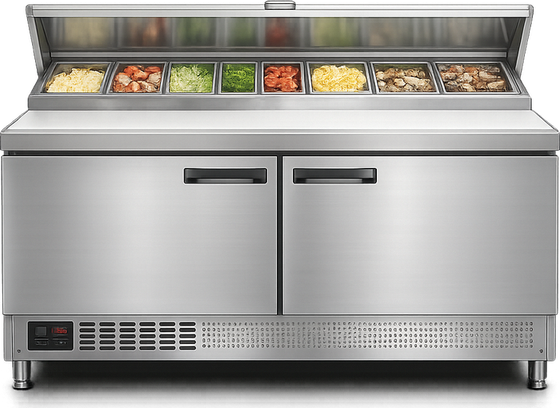
Common Prep Table Problems in Bee Cave Kitchens
Rail pans above safe temperature while the cabinet is fine
The most common call on these. The cabinet below has its own airflow and holds easily; the rail depends on cold air passing along the pans. Pans filled above the line, wrong pan sizes, or a missing divider all break that airflow, and the unit runs without ever reaching the top of the product.
Everything warm, cabinet included
Now it is the system: a condenser packed with grease and dust, a condenser fan that stopped, low charge, or a struggling compressor. The condenser sits low in a hot kitchen, which is why it loads faster on these than on almost anything else.
Icing on the evaporator
Defrost not running, a lid or gasket letting humid kitchen air in continuously, or restricted airflow. On a prep table the ice forms where you cannot see it, and the first symptom is the rail getting warm, which sends people looking at the wrong thing.
Running constantly and never cycling off
Either it cannot reach setpoint or the control is not telling it to stop. Nonstop running in July is often condenser and ambient rather than a failed component, and cleaning plus an airflow correction solves it more often than parts do.
A unit installed too close to the cookline
A prep table beside a fryer or under a heat lamp is being asked to work outside its rating. Sometimes the right repair is adding clearance or moving the unit rather than replacing a component that was never at fault, and we will say so rather than selling parts.
Water pooling inside the cabinet
A blocked drain line or a pan that has shifted. These make more condensate than people expect in a humid kitchen and the drain is small. Water inside also raises humidity, which brings the icing problem back around.
Lids, gaskets, hinges and drawer slides
Prep tables take a beating. A lid that no longer closes flush or a hardened gasket costs temperature every hour of service. These are inexpensive parts and they are the difference between a rail that holds and one that does not.
A controller reading one thing and the product another
The controller reports where its probe sits, usually in the airflow rather than in the food. An inspector measures product. When those disagree, probe location and calibration get checked before anyone decides the unit is broken.
Prep Tables We Service in Bee Cave
Sandwich and salad prep tables, pizza prep and mega-top rails, refrigerated chef bases, worktables and undercounters, cold rails and drop-in wells, with self-contained or remote condensers. Common brands include True, Turbo Air, Beverage-Air, Continental, Delfield, Randell, Traulsen and Atosa.
We are EPA Section 608 Universal certified and insured, and we can issue a certificate of insurance to a property manager or club before work starts.
Who We Work For in Bee Cave
Restaurants, cafes and pizzerias at the Hill Country Galleria and along Bee Cave Road and Highway 71, country club and golf course kitchens, caterers and event venues, school kitchens and churches.
The commercial diagnostic is one hundred forty nine dollars and it is credited toward the repair once the work is approved. A prep rail out of temperature is a food safety problem, so it gets same-day attention when the schedule allows.
Common Questions About Prep Table Repair in Bee Cave
Why is the rail warm when the cabinet is cold?
Airflow across the pans. Overfilled pans, the wrong configuration or a missing lid break the cold air path. It is the first thing to check and costs nothing to correct.
How often does the condenser need cleaning?
Every two to three months in a kitchen, more if the unit sits near a fryer or grill. The condenser on a prep table is low to the floor and pulls in everything.
Does covering the rail overnight help?
Yes. Closing lids or fitting the night cover lets the unit pull the whole rail down and gives the system a rest. A rail left open overnight starts the next day behind.
Should product be left in the rail overnight?
Move it to the cabinet or a reach-in. The rail holds temperature during service; it is not designed to pull warm product down or hold it for long periods.
Is an older prep table worth repairing?
Usually. Fans, controls, gaskets, lids, drains and defrost components are serviceable. A failed compressor on an inexpensive unit is where we give you both numbers rather than pushing a repair.
Book Prep Table Service in Bee Cave
Tell us the brand, what the rail reads against the cabinet, and whether you see ice anywhere, and we can usually tell you how urgent it is before we arrive. Call (737) 388-3867. The one hundred forty nine dollar commercial diagnostic is credited toward the repair.
Refrigerated Prep Table Repair in Bee Cave, TX
-

What We Service
- Sandwich and salad prep tables
- Pizza prep and mega-top rails
- Refrigerated chef bases
- Refrigerated worktables and undercounters
- Cold rails and drop-in wells
- Remote and self-contained units
- Digital and mechanical controls
-
Typical Calls
- Rail pans above safe temperature
- Cabinet cold but rail warm
- Icing on the evaporator
- Short cycling and constant running
- Water pooling inside the cabinet
- Lids, gaskets, hinges and drawer slides

Prep Table Brands We Service in Bee Cave
If your brand is not listed, contact us — we likely service it.
Why Homeowners & Businesses Choose TakiDA
-
 Quality WorkWe deliver professional appliance repair with attention to detail, proper diagnostics, and long-lasting results you can rely on.
-
 OEM / High-Quality PartsWe use OEM or high-quality replacement parts to ensure correct operation, reliability, and extended appliance lifespan.
-
 Same-Day / Next-Day ServiceFast response with same-day or next-day service to reduce downtime and get your appliances back in working order quickly.
-
 Clear PricingUpfront estimates with transparent pricing. No hidden fees, no surprises — you know the cost before work begins.
-
 EPA Certified & InsuredEPA Section 608 Universal certified and fully insured for residential and commercial repair, giving you peace of mind and protection.
-
 Warranty on Labor & PartsAll repairs are backed by a warranty on labor and installed parts for added confidence and long-term reliability.
