
Oven and Range Repair in Georgetown, TX
An oven that bakes cold, takes forty minutes to preheat, broils but will not bake, or locked itself after a self-clean is usually a sensor, an element or a gasket rather than a control board. We repair gas and electric ranges, built-in and double wall ovens across Georgetown, from Sun City to Wolf Ranch. The diagnostic is $99 and it comes off the repair.
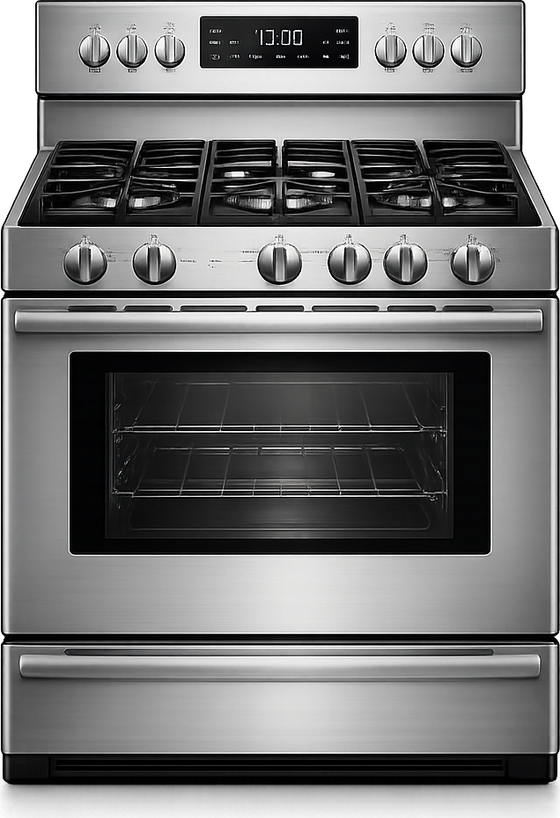
Common Oven and Range Problems in Georgetown Homes
The oven heats, but everything comes out underdone
If baking times have quietly got longer and the oven still seems to work, the usual cause is the oven temperature sensor rather than anything that looks broken. It is a resistance probe in the back wall of the cavity, and it drifts: the control reads what the probe reports, so if the probe reads high the control stops heating early and the cavity sits thirty or forty degrees below the number on the display. It is a measurement to confirm, not a guess — the sensor has a published resistance at room temperature and a known curve as it heats, and a drifted one reads outside both. We check it against the chart and against an independent thermometer in the cavity before replacing anything.
Preheat takes forty minutes
Slow preheat is a heat input problem or a heat loss problem, and they are easy to tell apart. On an electric oven the bake element may be partly open or scaled, drawing less current than it should. On gas, a weak igniter takes a long time to open the safety valve and the burner runs lean. The heat loss side is just as common and gets overlooked: a door gasket that has gone hard, or hinges that have sagged enough that the door no longer pulls tight at the top. You can often feel it with a hand along the door edge during preheat.
Broil works but bake does not
That tells us the control and the power supply are both alive, because broil needs both. There are two candidates left: the bake element itself has gone open, or the relay on the control board that feeds it has failed. The element is the cheaper of the two and the more common, and it can be checked for continuity in a couple of minutes. We will not sell you a control board for this symptom without first showing you that the element is good, because that is the expensive way to get it wrong.
The door locked itself after a self-clean and will not open
Self-clean takes the cavity to around 900 degrees, and the door stays locked until the control sees it cool. When it stays locked afterwards, it is usually the lock motor or the switch that tells the control where the latch is. There is a bigger point here worth saying plainly: self-clean is the hardest thing an oven ever does, and it is what kills bake elements, door locks, thermal fuses and control boards. A fair number of our oven calls arrive the day after a self-clean cycle. Wiping the cavity out by hand is less convenient and much easier on the appliance.
A gas burner where the igniter glows but never lights
This is the most misdiagnosed fault in gas ovens, and it is worth understanding. On a hot surface ignition system the igniter is not just a heat source, it is the current sensing device: gas is held back by a bimetal safety valve that only opens once enough current is flowing through the igniter. As the igniter ages its resistance climbs, so it still glows a convincing orange while drawing too little current to ever open the valve. People look at the glow, conclude the igniter is fine and start replacing valves and boards. The right test is a current reading on the igniter circuit while it tries to light, and a clamp meter gives the answer in under a minute.
Uneven baking, one side always darker
First the dull answers, because they are usually right: rack position, a warped sheet pan, and a convection fan that has stopped turning. After that, a bake element that has sagged or distorted puts more heat on one side, and a door that does not seal evenly lets heat out at one corner. On convection models the fan motor and the baffle behind it are both worth looking at, since a fan that spins but has lost a blade moves far less air than it sounds like it does.
F codes on the display, or a dead display
Write the code down before you clear it, because it narrows the job considerably and it saves you money. Most manufacturers use codes that point at a specific circuit: sensor out of range, lock circuit, communication between the control and the relay board, runaway temperature. A dead display is different and often simpler than it looks — on many ranges it is a cooked connector or a ribbon cable rather than the whole control, and it is worth looking before committing to the most expensive part in the appliance.
The oven shuts itself off part way through cooking
An oven that quits mid bake and comes back later is almost always overheating somewhere it should not. The cavity vents through the back or under the cooktop, and when that path is blocked, the control compartment gets hot enough to open a thermal fuse or to shut the control down. On electric ranges there is a second cause that needs taking seriously: a loose connection at the terminal block or in the cord heats up under load, opens, and resets when it cools. That is a connection that is arcing, and it is worth sorting out quickly rather than living with.
Ovens and Ranges We Repair in Georgetown
We work on free standing and slide in ranges, built in wall ovens, double wall ovens, and range plus microwave combination units, in both gas and electric, from Whirlpool, Maytag, KitchenAid, GE, Frigidaire, Bosch, LG, Samsung, Amana, Kenmore and Electrolux. That includes conventional and convection cavities, and the air fry modes on the newer models, which are a convection fan and a program rather than a separate appliance. On built in wall ovens, getting the unit out of the cabinet safely is part of the job, and we allow time for it rather than rushing it.
What Oven and Range Repair Costs in Georgetown
The residential diagnostic is $99 and comes off the repair when you approve it. You get a written price for parts and labor before anything is replaced. Temperature sensors, bake and broil elements, igniters, safety valves, door gaskets, hinges, door locks, thermal fuses and convection fan motors are all modest parts. Control boards, full door assemblies and glass packs are not. On a range past twelve years that needs a board and a door, we will put the numbers side by side with a replacement and tell you which way we would go.
A real share of oven calls end at a sensor or a gasket, and that is a cheap fix we are glad to deliver rather than looking for something bigger.
Neighborhoods We Cover in Georgetown
In Sun City we see a lot of original builder ranges and built in wall ovens that have been in service fifteen or twenty years, and the pattern there is consistent: temperature sensors drifting, door gaskets gone hard, bake elements that finally let go, and door locks that fail after a self-clean. Those are all inexpensive parts on appliances that are otherwise sound, and they are worth fixing. Double wall ovens in particular get written off too early, because the fault is usually in one cavity and one part. We cover the whole Del Webb side along with Berry Creek, Serenada and Cimarron Hills.
Around Wolf Ranch and Water Oak the appliances are newer and the complaints shift toward controls, convection fans, communication codes and the programs people actually use, like air fry and steam assist. Gas ranges are more common in those kitchens, which brings igniter and safety valve work into it. In the older houses around the Square and along San Gabriel we still find ranges on original wiring and terminal blocks that have run hot for years, and we will tell you when that is what we are looking at instead of only replacing the part that failed. Georgetown is a short run from Leander and a same day slot is usually open.
Common Questions About Oven and Range Repair in Georgetown
My oven bakes cold even though the display is right. What is it?
Nine times out of ten the temperature sensor has drifted. The control is heating to what the sensor reports, not to what the cavity is actually doing. It is a modest part and it is confirmed by measurement rather than by guesswork.
My igniter glows, so the igniter must be good, right?
No, and this is the single most expensive assumption in gas oven repair. The igniter has to draw enough current to open the gas safety valve, and an aged one glows brightly while drawing too little. A current reading tells you in a minute what a glow never will.
Should I use the self-clean cycle?
We would rather you did not, or at most once a year. The cavity reaches around 900 degrees and that is what takes out elements, door locks, thermal fuses and boards. A lot of oven failures arrive the day after a self-clean.
Is a built-in wall oven worth repairing?
Usually more worth it than a range, because replacing one means matching a cutout and often cabinet work. A sensor, an element, a hinge or a lock is a straightforward repair that keeps a cabinet you otherwise have to rebuild around.
How soon can you get to Georgetown?
Usually the same day or the next. Call (737) 388-3867 and we will tell you straight what the day looks like. Have the model number and any error code to hand and it speeds the whole thing up.
Book Oven and Range Repair in Georgetown
Tell us the brand, whether it is gas or electric, and what it is doing — baking cold, slow to preheat, no bake, a locked door, or an F code on the display. The model number and the code save us both time. Call (737) 388-3867 or book online and we will confirm a time for Georgetown.
Oven and Range Repair in Georgetown, TX
-

Symptoms We Sort Out
- Baking cold against the display
- Preheat taking forty minutes
- Broil works, bake does not
- Door locked after self-clean
- Igniter glowing but no flame
- One side always darker
- F code on the display
- Oven switching off mid-bake
-
What We Work On
- Free-standing and slide-in ranges
- Built-in and double wall ovens
- Gas and electric
- Convection and air fry models
- Range and microwave combos
- Door gaskets, hinges and locks

Oven and Range Brands We Service in Georgetown
If your brand is not listed, contact us — we likely service it.
We repair all major residential appliance brands across Central Texas, including Whirlpool, GE, Samsung, LG, Maytag, Frigidaire, KitchenAid, Amana, Bosch, Electrolux, Hotpoint, Kenmore, Haier, Fisher & Paykel, Sub-Zero, Wolf, Viking, Thermador, JennAir, Dacor, U-Line, Marvel, Miele, and GE Monogram.
Why Homeowners & Businesses Choose TakiDA
-
 Quality WorkWe deliver professional appliance repair with attention to detail, proper diagnostics, and long-lasting results you can rely on.
-
 OEM / High-Quality PartsWe use OEM or high-quality replacement parts to ensure correct operation, reliability, and extended appliance lifespan.
-
 Same-Day / Next-Day ServiceFast response with same-day or next-day service to reduce downtime and get your appliances back in working order quickly.
-
 Clear PricingUpfront estimates with transparent pricing. No hidden fees, no surprises — you know the cost before work begins.
-
 EPA Certified & InsuredEPA Section 608 Universal certified and fully insured for residential and commercial repair, giving you peace of mind and protection.
-
 Warranty on Labor & PartsAll repairs are backed by a warranty on labor and installed parts for added confidence and long-term reliability.
