
Ice Maker Repair in Round Rock, TX
No ice at all, cubes coming out small and hollow, a tray frozen into one block or an undercounter unit that makes ice and never drops it — most of these start at the water supply or the filter rather than the ice maker. We repair refrigerator and standalone ice makers across Round Rock, from Old Town and Forest Creek to Teravista and Paloma Lake. The diagnostic is $99 and it comes off the repair.
Common Ice Maker Problems in Round Rock Homes
No ice at all, and the rest of the refrigerator is fine
An ice maker needs three things: water arriving, a cold enough freezer, and a working module. We check them in that order because the first two are cheap. Water comes through a shutoff behind the refrigerator, a line, a filter and an inlet valve, and a filter left in long past its rated volume will starve the ice maker while the drinking water still trickles. Temperature matters more than people expect: most ice makers will not cycle at all if the freezer is not down near zero, so a freezer running a few degrees warm stops ice production entirely while keeping food perfectly frozen.
Cubes coming out small, hollow or half formed
Small cubes mean the mould is not filling completely, and that is a water supply problem rather than a freezing problem. The usual causes are a partly blocked filter, an inlet valve with a restricted screen, a fill tube with ice in it, or water pressure at the house that is below what the valve needs to open fully. Hollow cubes with a soft centre point the same way. The fix is nearly always at the water end, and it is worth checking before anyone replaces an ice maker that is working exactly as the water it is given allows.
Ice that tastes of whatever is in the freezer
Ice absorbs odours, which is why ice that has been sitting in a bin for weeks tastes of the freezer rather than of water. If you empty the bin and the new ice is fine, that was all it was. If the taste comes back quickly, look at the filter and the line, and at how long the water sits in the line between uses. On a unit that has been unused for a while, the first bin should always go in the sink.
The whole tray frozen into one solid block
A mould frozen solid usually means the harvest cycle is not completing. On a refrigerator ice maker the module has a small heater that warms the mould just enough to release the cubes, and when it fails the ejector arm stalls against ice that will not let go. The other version is a fill valve leaking slightly when it is supposed to be closed, so water trickles in continuously and freezes everything together. Those two are told apart quickly and both are modest parts.
Water overflowing in the freezer or running down the back
Overfilling is almost always the inlet valve not closing fully, usually because debris or scale is holding the seat open. Our water contributes to that. The other cause is the fill tube misaligned so water goes past the mould instead of into it, then freezes into a ridge at the back of the compartment. Both leave the same mess and both are inexpensive to put right, but neither one fixes itself.
A standalone undercounter unit that makes ice but never drops it
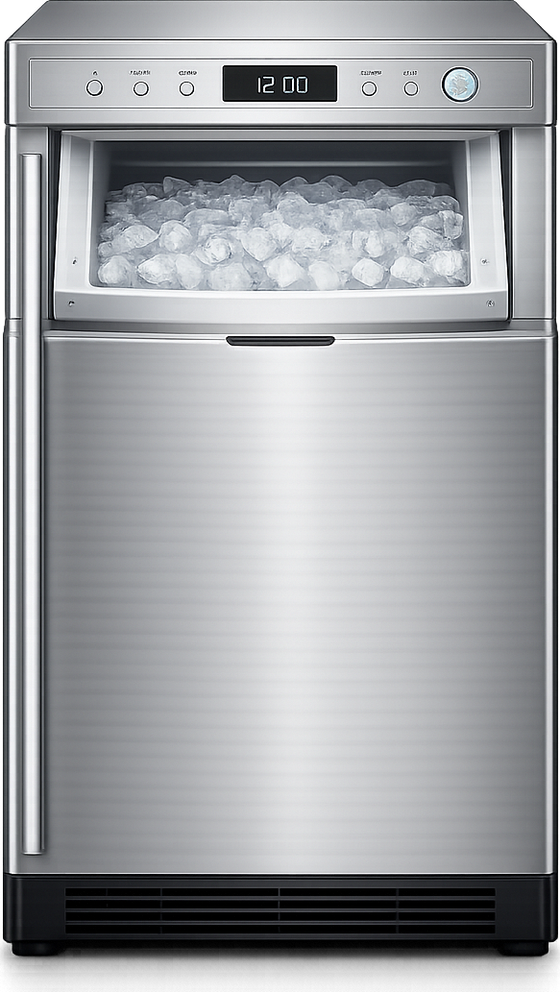
Standalone ice makers work differently from the one in a refrigerator. Clear cube machines build ice on an evaporator plate and then harvest it with hot gas, so a harvest valve, a thermostat or a sensor failing leaves a unit that is clearly working but never puts anything in the bin. Nugget machines use an auger and a gearmotor instead, and there a seized auger or a worn bearing is the usual answer. We identify which type you have before diagnosing anything, because the two share almost nothing.
Water on the floor under an undercounter ice maker
These units have a drain, and whether it is gravity or pumped changes what to look at. Gravity drains plug with sediment and the bin overflows. Pumped units have a small condensate pump that fails quietly. Beyond that, the supply fitting and the inlet valve are the two places we find leaks. Water running under a cabinet damages the floor long before anybody notices, so this one is worth sorting out quickly.
An outdoor or garage unit that cannot keep up in summer
Round Rock has a lot of outdoor kitchens and bar areas, and ice makers in them work in conditions far outside what an indoor unit is designed for. Only units specifically rated for outdoor use should be installed outside, and even those lose a great deal of production as the air temperature climbs. A unit in a closed garage faces the same problem. If a machine is struggling only in July and August, we will tell you whether that is a fault or physics before you spend money on either.
Ice Makers We Repair in Round Rock
We work on refrigerator ice makers across all the mass market brands, and on standalone undercounter machines, including clear cube, nugget and outdoor rated units, from Whirlpool, Maytag, KitchenAid, GE, Frigidaire, LG, Samsung, Bosch, Kenmore, Scotsman, U-Line, Marvel and Avantco. That includes water supply work: shutoffs, lines, filters and inlet valves, as well as dispenser chutes and doors, augers and gearmotors, harvest systems, bins and bin thermostats, drains and condensate pumps.
What Ice Maker Repair Costs in Round Rock
The residential diagnostic is $99 and comes off the repair when you approve it. You get a written price for parts and labor before anything is replaced. Inlet valves, filters, fill tubes, ice maker modules, bin sensors, dispenser doors and flaps, augers, gearmotors and drain work are all modest parts. On a standalone machine, sealed system work is the expensive end, and on a lower cost unit it is usually not worth it. We will tell you that at the diagnostic rather than after the parts are ordered.
A good share of ice maker calls end at the filter, the valve or the freezer temperature, and those are cheap fixes we are glad to make.
Neighborhoods We Cover in Round Rock
In the established subdivisions, Teravista, Forest Creek, Behrens Ranch, Cat Hollow, Chandler Creek and Sendero Springs, most of our ice maker work is in the refrigerator: modules, inlet valves, fill tubes and filters that have been in longer than they should. Backyard kitchens are common in those neighborhoods too, and outdoor ice makers are their own category, with heat, rain and the question of whether the unit was ever rated to live outside.
In Old Town, Greenlawn and the older streets, we see more refrigerators that were plumbed in after the fact, where the supply line, the saddle valve and the shutoff are as likely to be the problem as the appliance. North toward Mayfield Ranch, Paloma Lake and Stone Canyon the homes are newer and come with built in and undercounter machines, so the work shifts to harvest systems, drains and pumps. Round Rock is an easy run from Leander and a same day slot is usually open.
Common Questions About Ice Maker Repair in Round Rock
My water dispenser works but there is no ice. Why?
They are different circuits. Water reaching the dispenser does not prove enough water is reaching the ice maker, and the freezer also has to be cold enough for the ice maker to cycle at all. Both get checked.
Why are my cubes small and hollow?
The mould is not filling fully. That is almost always a filter, a restricted inlet valve, ice in the fill tube or low house water pressure, rather than a failed ice maker.
How often should the water filter be changed?
Go by volume, not by the light, and on our water assume the shorter end of the range. A tired filter starves the ice maker before anybody notices a change in the drinking water.
Can an ice maker live outside or in the garage?
Only if it is rated for it, and even then production drops sharply in the heat. If yours only struggles in summer, that may be the conditions rather than a fault, and we will say so.
How soon can you get out to Round Rock?
Usually the same day or the next. Call (737) 388-3867 and tell us whether it is a refrigerator ice maker or a standalone unit, because the two are completely different machines.
Book Ice Maker Repair in Round Rock
Tell us whether it is the ice maker in your refrigerator or a standalone undercounter machine, the brand, and what it is doing — no ice, small cubes, frozen solid, overflowing, or not dropping into the bin. Call (737) 388-3867 or book online and we will confirm a time for Round Rock.
Ice Maker Repair in Round Rock, TX
-

Symptoms We Sort Out
- No ice at all
- Cubes small, hollow or cloudy
- Ice tasting of the freezer
- Ice frozen into one block
- Water overflowing in the freezer
- Undercounter unit not dropping ice
- Water on the floor under the unit
- Outdoor or garage unit struggling
-
What We Work On
- Built-in refrigerator ice makers
- Undercounter and outdoor ice makers
- Nugget and clear cube units
- Water lines, valves and filters
- Dispenser chutes and augers
- Drains and pumps

Ice Maker Brands We Service in Round Rock
If your brand is not listed, contact us — we likely service it.
We repair all major residential appliance brands across Central Texas, including Whirlpool, GE, Samsung, LG, Maytag, Frigidaire, KitchenAid, Amana, Bosch, Electrolux, Hotpoint, Kenmore, Haier, Fisher & Paykel, Sub-Zero, Wolf, Viking, Thermador, JennAir, Dacor, U-Line, Marvel, Miele, and GE Monogram.
Why Homeowners & Businesses Choose TakiDA
-
 Quality WorkWe deliver professional appliance repair with attention to detail, proper diagnostics, and long-lasting results you can rely on.
-
 OEM / High-Quality PartsWe use OEM or high-quality replacement parts to ensure correct operation, reliability, and extended appliance lifespan.
-
 Same-Day / Next-Day ServiceFast response with same-day or next-day service to reduce downtime and get your appliances back in working order quickly.
-
 Clear PricingUpfront estimates with transparent pricing. No hidden fees, no surprises — you know the cost before work begins.
-
 EPA Certified & InsuredEPA Section 608 Universal certified and fully insured for residential and commercial repair, giving you peace of mind and protection.
-
 Warranty on Labor & PartsAll repairs are backed by a warranty on labor and installed parts for added confidence and long-term reliability.
