
Garbage Disposal Repair in Round Rock, TX
A disposal that has got slow and loud, leaks, jams on anything stringy or backs up only when the dishwasher runs — some of that is a cheap fix and some of it means the unit is finished, and we will tell you which. We repair and replace disposals across Round Rock, from Old Town and Forest Creek to Teravista and Paloma Lake. The diagnostic is $99 and it comes off the repair.
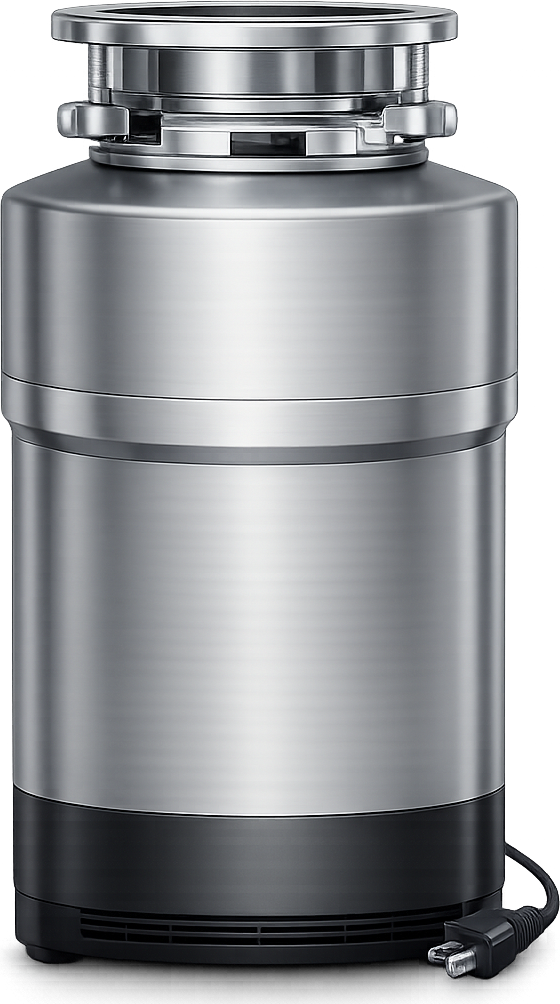
Common Garbage Disposal Problems in Round Rock Homes
It still works, but it is slower and louder than it was
Disposals do not grind with blades, they throw food against a stationary shredder ring with two swivelling impellers. Over the years the ring loses its edges and the impellers wear down, and the unit takes longer to clear the same amount of waste while making more noise doing it. On the one third horsepower units that most builders fit, that point arrives sooner than people expect. There is no sensible way to rebuild a worn grind chamber, so what we do is tell you honestly where yours is and what a better unit would cost, rather than selling you a repair that will not change anything.
A leak coming from the very bottom of the unit
Where the water appears decides whether this is a repair or a replacement, and the bottom is the bad place. Leaks at the top come from the sink flange seal, and leaks at the side come from the dishwasher inlet or the discharge gasket, and both of those are inexpensive to fix. Water dripping from the lowest point of the housing means the seal above the motor has failed and water is inside the motor. Nothing above that seal is serviceable, and a disposal leaking from the bottom is finished. We will say so straight away rather than charging you to open it.
It jams on anything stringy or fibrous
Celery, artichoke leaves, corn husks and potato peelings wrap around the impellers instead of being thrown outward, and a smaller unit with less inertia stalls on them. That is largely a capacity question rather than a fault: a one third horsepower builder unit is working at its limit on that kind of waste, while a three quarter horsepower unit handles it without noticing. We will free the jam and tell you whether what you are putting through it is simply more than the unit was built for.
It runs sometimes and not others
Intermittent operation is an electrical fault somewhere along a short chain, and it is worth finding rather than living with, because the day it fails completely is usually the day the sink is full. The candidates are the wall switch, the receptacle under the sink, the wire connections inside the unit's own junction box, and the thermal overload inside the motor beginning to open early. We check voltage under load rather than with a tester that reads fine on a connection carrying nothing.
The sink only backs up when the dishwasher runs
That timing is a strong clue. The dishwasher discharges into the disposal through an inlet near the top, and it does so quickly and under pressure. If the disposal's outlet is partly restricted, the sink drains acceptably on its own and backs up the moment the dishwasher adds its volume. So the fault is usually the discharge tube or the branch beyond it rather than anything to do with the dishwasher. We check the disposal's outlet first, because the dishwasher usually gets blamed for this.
Black flecks coming up into the sink
Those are almost always pieces of the rubber splash guard, which sits in the throat of the disposal and degrades over the years from heat, detergent and grinding. Once it starts breaking up it keeps shedding, and the pieces come back up when the unit runs. The splash guard is an inexpensive part and replacing it also removes the main place smells live. If the flecks are hard rather than rubbery, that is a different conversation and worth looking at properly.
It vibrates the whole sink and the countertop
Some vibration is normal, a lot is not. The usual cause is the mounting ring working loose, so the unit is no longer held firmly against the sink and everything it does transmits into the counter. The other cause is a worn bearing or a chipped impeller leaving the flywheel out of balance. A stainless sink amplifies both. The mounting is a quick fix; the unbalanced flywheel is not worth repairing on most units, and we will tell you which of the two you have.
It is seized solid and the reset button will not stay in
A reset button that pops straight back out means the motor is drawing fault level current the moment it is energised. If the flywheel also will not move with the hex wrench from underneath, the motor has usually failed rather than jammed. At that point there is nothing to repair: disposals are sealed units and the motor is not a serviceable part. The useful work we do on that visit is confirming it properly, and getting a new unit in and sealed correctly so you do not have a leak next month.
Disposals We Repair and Replace in Round Rock
We work on continuous feed and batch feed units from InSinkErator, Moen, Waste King, Whirlpool, GE, KitchenAid and Kenmore, across the full range from the one third horsepower builder units to one horsepower sound insulated models. That covers jams, reset and electrical faults, flange and gasket leaks, mounting rings, splash guards, dishwasher inlet and discharge work, and replacement when the unit is genuinely worn out. We also clear the drain side while we are under there, because on a disposal call the drain is often the real answer.
What Disposal Repair Costs in Round Rock
The residential diagnostic is $99 and comes off the repair when you approve it. You get a written price for parts and labor before anything is done. Jams, resets, splash guards, flange reseals, mounting rings, gaskets and discharge tubes are all inexpensive. Where we will be straight with you is on the unit itself: a leak from the bottom of the housing, a seized motor or a worn grind chamber are not repairable, and we will quote a replacement rather than a repair that costs nearly the same and lasts a fraction as long.
Plenty of disposal calls end in ten minutes with a hex wrench and a reset button, and we would rather do that and charge you for the visit than talk you into a new unit.
Neighborhoods We Cover in Round Rock
In the big subdivisions, Teravista, Forest Creek, Behrens Ranch, Paloma Lake, Mayfield Ranch and Sendero Springs, most of the disposals are the small builder units that came with the house, and they are now at the age where the grind chamber is worn and the motor seal is starting to let go. That is where the honest conversation about repair against replacement usually happens, and we are happy to have it with the numbers in front of you.
In Old Town, Greenlawn, Cat Hollow and Chandler Creek the kitchens are older and the drain lines with them, so a disposal complaint there is as often about the branch beyond the unit as about the unit itself. Island sinks are common across the newer parts of town, and those have longer runs with less fall, which is exactly the condition in which disposal waste settles out and builds up. We will tell you when that is what we are looking at rather than clearing it and letting you call again in six months. Round Rock is an easy run from Leander and a same day slot is usually open.
Common Questions About Disposal Repair in Round Rock
Water is dripping from the bottom of the unit. Can it be fixed?
No. A leak at the lowest point means water has passed the seal and is inside the motor. Leaks at the top flange or at the side connections are a different matter and are inexpensive to fix.
Mine jams on vegetable peelings. Is it faulty?
Probably not. Fibrous waste wraps rather than throws, and a small builder unit is at its limit on it. A larger unit handles it. We will tell you which situation you are in.
What are the black bits coming up in my sink?
Usually the rubber splash guard breaking down. It is a cheap part, and replacing it also deals with most disposal smells.
The reset button will not stay in. What now?
That means the motor is drawing fault current as soon as it is powered. Combined with a flywheel that will not turn, it generally means the motor has failed and the unit needs replacing.
How soon can you get out to Round Rock?
Usually the same day or the next, and disposal calls are often short. Call (737) 388-3867 and tell us what it is doing and where the water is coming from, if there is any.
Book Garbage Disposal Repair in Round Rock
Tell us the brand if you can see it and what it is doing — humming, dead, jamming, backing up, or leaking. If there is water, tell us whether it is coming from the top, the side or the bottom, because that alone usually decides repair or replacement. Call (737) 388-3867 or book online and we will confirm a time for Round Rock.
Garbage Disposal Repair in Round Rock, TX
-

Symptoms We Sort Out
- Slower and louder than it used to be
- Leaking from the very bottom
- Jamming on anything fibrous
- Running only some of the time
- Backing up only when the dishwasher runs
- Black flecks coming up in the sink
- Vibrating the whole sink
- Seized solid, reset will not hold
-
What We Work On
- Continuous and batch feed units
- One third to one horsepower
- Sound-insulated models
- Flange, gasket and mounting work
- Dishwasher inlet and discharge
- Replacement when it is worn out

Disposal Brands We Service in Round Rock
If your brand is not listed, contact us — we likely service it.
We repair all major residential appliance brands across Central Texas, including Whirlpool, GE, Samsung, LG, Maytag, Frigidaire, KitchenAid, Amana, Bosch, Electrolux, Hotpoint, Kenmore, Haier, Fisher & Paykel, Sub-Zero, Wolf, Viking, Thermador, JennAir, Dacor, U-Line, Marvel, Miele, and GE Monogram.
Why Homeowners & Businesses Choose TakiDA
-
 Quality WorkWe deliver professional appliance repair with attention to detail, proper diagnostics, and long-lasting results you can rely on.
-
 OEM / High-Quality PartsWe use OEM or high-quality replacement parts to ensure correct operation, reliability, and extended appliance lifespan.
-
 Same-Day / Next-Day ServiceFast response with same-day or next-day service to reduce downtime and get your appliances back in working order quickly.
-
 Clear PricingUpfront estimates with transparent pricing. No hidden fees, no surprises — you know the cost before work begins.
-
 EPA Certified & InsuredEPA Section 608 Universal certified and fully insured for residential and commercial repair, giving you peace of mind and protection.
-
 Warranty on Labor & PartsAll repairs are backed by a warranty on labor and installed parts for added confidence and long-term reliability.
