
Garbage Disposal Repair in Georgetown, TX
A disposal that hums without turning, does nothing at all, leaks only while running or backs the sink up is usually a jam, a reset button or the drain downstream — not a dead unit. We repair and replace disposals across Georgetown, from Sun City to Wolf Ranch, and we sort out the drain side with it. The diagnostic is $99 and it comes off the repair.
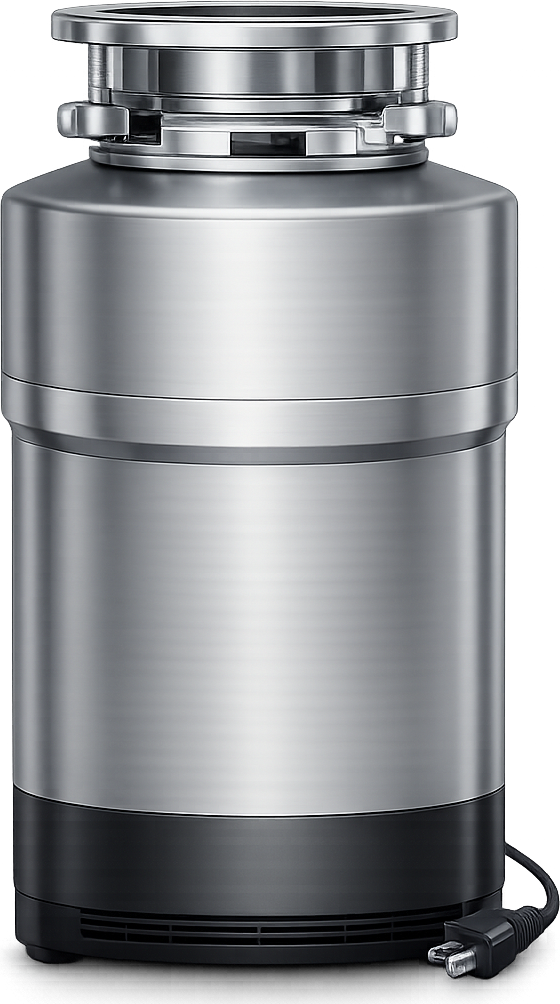
Common Garbage Disposal Problems in Georgetown Homes
It hums but the grinding plate will not turn
A hum means the motor has power and is trying, and something is holding the flywheel. Usually that is a fruit pit, a shell, a bottle cap or a piece of cutlery wedged between a swivel impeller and the shredder ring. On older units in Sun City kitchens it can simply be corrosion: a disposal that sits unused for weeks at a time seizes where the impellers meet the ring. There is a hex socket in the underside of the housing for exactly this, and working it back and forth frees most of them. What matters is not to keep flipping the switch, because every attempt heats the winding, and a motor that has been cooked that way will not come back.
Nothing happens at all when you flip the switch
There is an order to this and it starts cheap. Most disposals have a reset button underneath that pops out on thermal overload, and a surprising number of calls end there. If reset does nothing, the next checks are the receptacle under the sink, which on a lot of Georgetown kitchens shares a circuit with the dishwasher, then the wall switch, then the motor itself. Only after that is it worth talking about a new unit. We check the circuit under load rather than relying on a tester that reads voltage with nothing drawing on it.
It runs properly but the sink backs up
If the motor sounds normal and the water will not go down, the problem is downstream and not in the disposal. The P trap, the branch out to the stack, or the tee where the dishwasher ties in are the three places it sits. The specific thing that catches out slab built houses is slope: a long horizontal run with too little fall lets the fine slurry a disposal produces settle out and build up, and that happens gradually over years rather than all at once. Clearing it is one job, and telling you honestly whether the run itself is the reason is part of the visit.
A leak that only shows up while it is running
Where the water appears tells us what it is before we touch anything. A leak that only appears while the unit runs is usually the dishwasher inlet hose or its clamp, or the gasket at the discharge elbow, because those are the only parts under pressure during the cycle. A drip that is there even when the disposal has not been used points instead to the sink flange seal or the mounting gasket at the top, which means dropping the unit and resealing the flange. Both are repairs rather than replacements, and both get mistaken for a failed disposal.
A rattle, or the sound of metal on metal
A rattle is often nothing: something loose in the chamber, or a mounting ring that has worked loose so the unit is knocking against the cabinet or the drain line. A steady grinding of metal against metal is a different matter. That is the impellers contacting the shredder ring because the lower bearing has worn and the shaft is no longer running true, and there is no sensible repair for it. When we hear that, we will tell you it is the end of the unit rather than charging you to open it up and reach the same conclusion.
The sink still smells after running the disposal
The smell is almost never in the grinding chamber, which gets scoured every time the unit runs. It is in the space just above the grind ring and on the underside of the rubber splash guard, where food collects and nothing ever reaches it. Lifting the guard out and cleaning both sides properly deals with most of it. Ice cubes and lemon halves are a pleasant ritual and they do very little, because neither one touches the part that actually smells.
It cuts out after a few seconds, again and again
Repeated cutting out is the thermal overload doing its job, and it means the motor is drawing more current than it should. Either something is partly jamming it, so it is working against a load it was not designed for, or the motor is worn and pulling high current with nothing in the chamber. The way to tell them apart is a current reading with the unit running empty, compared against the figure on the nameplate. A worn motor reads high with an empty chamber, and that is a replacement rather than a repair.
Water coming up into the other basin
In a double bowl sink both basins meet at a tee before the trap, so a blockage past that point sends water up whichever side is easier. If running the disposal pushes water up the clean side, the restriction is downstream of the tee rather than in the unit. The other version of this is a baffle or a basket strainer on the non disposal side that has failed. We find which by running water on each basin separately, which takes a minute and saves replacing a disposal that was never the problem.
Disposals We Repair and Replace in Georgetown
We work on continuous feed and batch feed units from InSinkErator, Moen, Waste King, Whirlpool, GE, KitchenAid and Kenmore, in the full range of sizes from the half horsepower builder units up to one horsepower, including the sound insulated models. We handle jams, reset and electrical faults, flange and gasket leaks, discharge and dishwasher inlet work, mounting rings, and replacement when the unit is worn out. We will also sort out the drain side while we are there, because on a disposal call the drain is frequently the real answer.
What Disposal Repair Costs in Georgetown
The residential diagnostic is $99 and comes off the repair when you approve it. You get a written price for parts and labor before anything is done. Jams, resets, splash guards, flange reseals, mounting rings, gaskets and discharge tubes are all inexpensive. Where we will be straight with you is on the units themselves: on a half horsepower builder grade disposal, a worn motor or a failed bearing is not worth rebuilding, and we will quote you a replacement instead of a repair that costs nearly the same and lasts a fraction as long.
A lot of disposal calls end in ten minutes with a hex wrench and a reset button, and we would rather do that and charge you for the visit than talk you into a new unit.
Neighborhoods We Cover in Georgetown
Sun City is where most of our disposal work is, and the pattern there is particular. Many of the units are the ones the builder installed, they are fifteen or twenty years old, and a good share of them get used lightly, which is actually harder on a disposal than daily use: the chamber sits damp, the impellers seize to the ring, and the first thing anybody notices is a hum. Those are usually recoverable. We cover the whole Del Webb side along with Berry Creek, Serenada and Cimarron Hills.
Around Wolf Ranch and Water Oak the units are newer and generally larger, and the complaints shift to the drain side, the dishwasher tee and the mounting. In the older blocks near the Square and along San Gabriel we find original cast iron drain lines and runs that were never going to cope with a disposal, and in those cases we will tell you what we are seeing rather than clearing it and letting you call again in six months. East of town toward Weir, plenty of homes are on a septic system, and whether a disposal belongs on one at all is a conversation worth having before you replace it. Georgetown is a short run from Leander and a same day slot is usually open.
Common Questions About Disposal Repair in Georgetown
My disposal just hums. Is it finished?
Usually not. A hum means the motor works and something is jamming the flywheel, and most of those free up with the hex wrench from underneath. The thing that does finish a disposal is repeatedly flipping the switch while it is jammed.
Where is the reset button?
Underneath the unit, usually a small red button in the middle of the base. It pops out on thermal overload. Press it firmly, and if it trips again straight away, something is loading the motor and it needs looking at rather than resetting again.
Is it cheaper to repair or replace?
Depends entirely on what failed. Jams, leaks, flanges, guards and mounting hardware are cheap repairs worth doing on any unit. A worn motor or a failed bearing on a half horsepower builder unit is not, and we will say so.
Do ice cubes and lemons clean a disposal?
Not really. The part that smells is above the grind ring and under the splash guard, and neither ice nor citrus reaches it. Pulling the guard and cleaning it properly does.
How soon can you get out to Georgetown?
Usually the same day or the next, and disposal calls are often short. Call (737) 388-3867 and we will tell you honestly what the day looks like.
Book Garbage Disposal Repair in Georgetown
Tell us the brand if you can see it and what it is doing — humming, dead, leaking, backing up, or making a metal on metal noise. That is usually enough for us to arrive with what the job needs. Call (737) 388-3867 or book online and we will confirm a time for Georgetown.
Garbage Disposal Repair in Georgetown, TX
-

Symptoms We Sort Out
- Humming without turning
- Dead when you flip the switch
- Sink backing up
- Leaking only while running
- Metal on metal grinding
- Smell that will not clear
- Cutting out every few seconds
- Water rising in the other basin
-
What We Work On
- Continuous and batch feed units
- Half to one horsepower
- Sound-insulated models
- Flange and gasket leaks
- Dishwasher inlet and discharge
- Replacement when it is worn out

Disposal Brands We Service in Georgetown
If your brand is not listed, contact us — we likely service it.
We repair all major residential appliance brands across Central Texas, including Whirlpool, GE, Samsung, LG, Maytag, Frigidaire, KitchenAid, Amana, Bosch, Electrolux, Hotpoint, Kenmore, Haier, Fisher & Paykel, Sub-Zero, Wolf, Viking, Thermador, JennAir, Dacor, U-Line, Marvel, Miele, and GE Monogram.
Why Homeowners & Businesses Choose TakiDA
-
 Quality WorkWe deliver professional appliance repair with attention to detail, proper diagnostics, and long-lasting results you can rely on.
-
 OEM / High-Quality PartsWe use OEM or high-quality replacement parts to ensure correct operation, reliability, and extended appliance lifespan.
-
 Same-Day / Next-Day ServiceFast response with same-day or next-day service to reduce downtime and get your appliances back in working order quickly.
-
 Clear PricingUpfront estimates with transparent pricing. No hidden fees, no surprises — you know the cost before work begins.
-
 EPA Certified & InsuredEPA Section 608 Universal certified and fully insured for residential and commercial repair, giving you peace of mind and protection.
-
 Warranty on Labor & PartsAll repairs are backed by a warranty on labor and installed parts for added confidence and long-term reliability.
