
Cooktop and Vent Hood Repair in Round Rock, TX
Weak flames across every burner, clicking on one burner, food burning on the lowest setting or a hood that makes noise without moving air — most of these are an adjustment, an electrode or a blower wheel rather than a new cooktop. We repair gas, electric and induction cooktops and all types of vent hood across Round Rock, from Old Town and Forest Creek to Teravista and Paloma Lake. The diagnostic is $99 and it comes off the repair.
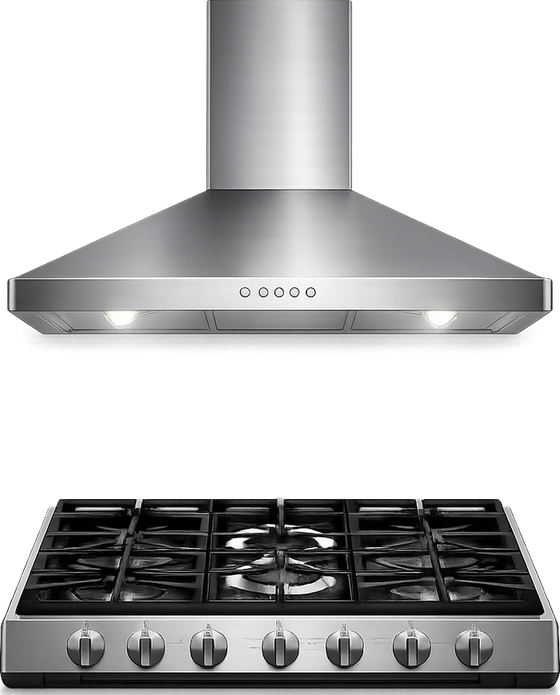
Common Cooktop and Vent Hood Problems in Round Rock Homes
Low, lazy flames on every burner
If all the burners are weak at once, the fault is upstream of the burners. Gas appliances are designed around a manifold pressure, and when it sags the flames go small and soft everywhere. That can be the regulator at the appliance, a kinked or undersized connector behind the cooktop, or the supply itself struggling when something else large fires at the same time. The other cause we find is a conversion done badly: a cooktop moved from one house to another, or switched between natural gas and propane, needs the right orifices and the right regulator setting, and without both it never burns correctly. Manifold pressure is a measurement, and it settles the question in one reading.
Clicking on one burner and nothing on the others
Spark modules fire every electrode together on most cooktops, so clicking confined to a single burner usually means that burner's switch is stuck closed or its electrode is shorting to the burner base. The most common cause is a spill that has worked under the burner cap and dried there. The second is a cracked ceramic insulator on the electrode, which lets the spark go to ground before it ever crosses the gap. Cleaning fixes the first, and the second is one inexpensive part.
Food burns on the lowest setting
On a sealed gas burner the low setting does not come from the knob position alone. Inside the valve there is a bypass passage with an adjustment that sets how small the flame can go, and if that adjustment is wrong, or the passage is partly blocked, your lowest setting is somebody else's medium. It is also what goes wrong after a gas conversion. The adjustment is made with the burner lit and the knob at its lowest position, and it takes minutes. On a radiant electric top, the same complaint comes from the switch not cycling properly.
The glass top is marked or pitted after a spill
We will be honest about this one because it saves you money. Ceramic glass is chemically attacked by sugar at cooking temperature, so a sugar spill that is left to cool etches the surface permanently, and melted plastic or foil bonds to it. That damage is cosmetic and it is not repairable: the glass can only be replaced, and on many models the price makes that a poor trade. What matters going forward is scraping sugar spills off while the surface is still hot. A mark is not a fault, and we are not going to charge you to confirm it.
A recirculating hood that does not seem to do anything
Plenty of Round Rock kitchens have hoods that are not ducted outside at all. A recirculating hood pulls air through a grease filter and a charcoal filter and puts it back into the room, which means it never removes heat or steam, only some of the grease and odour. If yours has stopped doing even that, the charcoal filters are almost certainly original, and they have a service life measured in months. We will also tell you whether ducting it outside is practical in your kitchen, because where it is, it makes a difference no filter can.
An island hood that rattles, hums or vibrates
Island hoods hang from the ceiling and run their duct through the joists, so every bit of blower imbalance travels through the structure. Grease builds unevenly on the blower wheel and throws it out of balance, which starts as a hum and becomes a rattle. The mounting hardware and the duct straps loosen over time and add to it. Cleaning or replacing the blower wheel and sorting out the mounting usually deals with it, and it is worth doing before the bearings go.
An induction cooktop that will not recognise the pan
Induction works by inducing current in the pan itself, so the pan has to be magnetic and it has to cover enough of the coil. A magnet that will not stick to the base means that pan will never work, whatever the cooktop does. Pans smaller than the coil's minimum diameter, or with a warped base that does not sit flat, also fail detection. When the pan is right and the cooktop still refuses it, then the detection circuit or the coil is worth looking at, and we check in that order rather than the other way round.
A downdraft that rises but hardly pulls
Downdrafts are fighting physics: they are trying to pull hot air and steam sideways and down while it wants to go up, so they need serious airflow and a clean duct to work at all. The duct usually runs under the floor or through the slab chase, it is long, and it has had years to collect grease. Add a damper that no longer opens fully and the unit becomes decorative. We check the blower, the damper and as much of the run as we can reach, and we will tell you honestly if the limitation is the design rather than a fault.
Cooktops and Hoods We Repair in Round Rock
We work on gas, radiant electric, coil and induction cooktops in 30 and 36 inch widths from Whirlpool, Maytag, KitchenAid, GE, Frigidaire, Bosch, LG, Samsung, Amana, Kenmore and Electrolux, and on under cabinet, wall chimney, island and downdraft hoods in both ducted and recirculating configurations. That covers igniters and electrodes, spark modules, gas valves and simmer adjustment, orifices and conversions, infinite switches and radiant elements, induction coils and detection, blower motors and wheels, speed switches, dampers, filters and lights.
What Cooktop and Hood Repair Costs in Round Rock
The residential diagnostic is $99 and comes off the repair when you approve it. You get a written price for parts and labor before anything is replaced. Electrodes, igniters, spark modules, burner caps, simmer adjustment, infinite switches, hood blower motors and wheels, speed switches, dampers and filters are all modest. Glass tops, induction generator boards and full downdraft assemblies are the expensive end, and there we will show you the part price next to a new unit and say which way we would go ourselves.
A good share of cooktop calls are a cleaning job, a simmer adjustment or a pressure reading, and we would rather do that and charge you for the visit than sell you a part.
Neighborhoods We Cover in Round Rock
Across Teravista, Forest Creek, Behrens Ranch, Paloma Lake and Mayfield Ranch, gas cooktops with five or six burners and island or chimney hoods are the norm, and the recurring work is electrodes, simmer settings, blower wheels and dampers. Island installations are common in those kitchens, and that is where hood noise complaints come from, because the duct runs through the ceiling structure and carries every vibration with it.
In Old Town, Greenlawn, Cat Hollow and Chandler Creek we see more electric and coil tops, downdrafts dropped into island counters in the nineties and plenty of recirculating hoods that have never had a charcoal filter changed. Those are easy wins. North toward Stone Canyon and Siena the kitchens are newer, with induction appearing more often and the questions shifting to pan detection, ventilation clearance under the cooktop and controls. Round Rock is an easy run from Leander and a same day slot is usually open.
Common Questions About Cooktop and Hood Repair in Round Rock
All my burners are weak. What causes that?
Supply pressure or the regulator, or a gas conversion that was never finished properly. It is one measurement at the manifold rather than a guessing game.
Can a scratched or etched glass top be repaired?
No. Sugar etching and bonded plastic are permanent, and the glass can only be replaced. That is cosmetic, not a fault, and we will say so rather than charging you to find out.
My hood does not vent outside. Is that normal?
It is common. Recirculating hoods filter grease and odour and put the air back in the room, so they never remove heat or steam. If yours seems useless, start with the charcoal filters, which are often the originals.
Why will my induction cooktop not see my pan?
If a magnet does not stick to the base, that pan will never work on induction. Pans that are too small for the coil or have a warped base also fail detection.
How soon can you get out to Round Rock?
Usually the same day or the next. Call (737) 388-3867, tell us whether the cooktop is gas, electric or induction, and what it is doing. If you smell gas, call the gas utility first and us afterwards.
Book Cooktop and Vent Hood Repair in Round Rock
Tell us the brand, whether the cooktop is gas, electric or induction, and what it is doing — weak flames, clicking, no control on low, a marked glass top, or a hood that will not pull. If the hood is recirculating rather than ducted, mention it. Call (737) 388-3867 or book online and we will confirm a time for Round Rock.
Cooktop and Vent Hood Repair in Round Rock, TX
-

Symptoms We Sort Out
- Low, lazy flames on every burner
- Clicking on one burner only
- Food burning on the lowest setting
- Glass top marked or pitted after a spill
- Recirculating hood doing nothing
- Island hood rattling or humming
- Induction not recognising the pan
- Downdraft rising but barely pulling
-
What We Work On
- Gas, radiant and coil cooktops
- Induction cooktops
- Under-cabinet and chimney hoods
- Island and downdraft hoods
- Recirculating and ducted setups
- 30 and 36 inch widths

Cooktop and Hood Brands We Service in Round Rock
If your brand is not listed, contact us — we likely service it.
We repair all major residential appliance brands across Central Texas, including Whirlpool, GE, Samsung, LG, Maytag, Frigidaire, KitchenAid, Amana, Bosch, Electrolux, Hotpoint, Kenmore, Haier, Fisher & Paykel, Sub-Zero, Wolf, Viking, Thermador, JennAir, Dacor, U-Line, Marvel, Miele, and GE Monogram.
Why Homeowners & Businesses Choose TakiDA
-
 Quality WorkWe deliver professional appliance repair with attention to detail, proper diagnostics, and long-lasting results you can rely on.
-
 OEM / High-Quality PartsWe use OEM or high-quality replacement parts to ensure correct operation, reliability, and extended appliance lifespan.
-
 Same-Day / Next-Day ServiceFast response with same-day or next-day service to reduce downtime and get your appliances back in working order quickly.
-
 Clear PricingUpfront estimates with transparent pricing. No hidden fees, no surprises — you know the cost before work begins.
-
 EPA Certified & InsuredEPA Section 608 Universal certified and fully insured for residential and commercial repair, giving you peace of mind and protection.
-
 Warranty on Labor & PartsAll repairs are backed by a warranty on labor and installed parts for added confidence and long-term reliability.
