
Cooktop and Vent Hood Repair in Georgetown, TX
A burner that will not light, igniters that will not stop clicking, an element stuck on high or a hood that makes noise without moving air — most of these are small parts and a clean spark gap rather than a new cooktop. We repair gas, electric and induction cooktops and all types of vent hood across Georgetown, from Sun City to Wolf Ranch. The diagnostic is $99 and it comes off the repair.
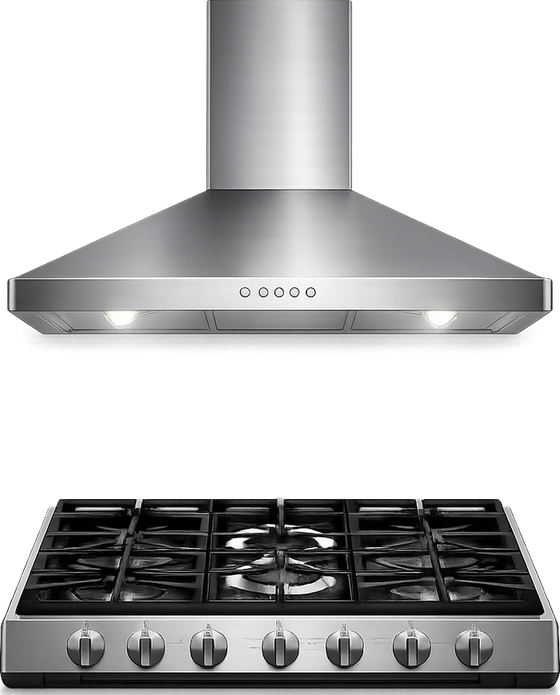
Common Cooktop and Vent Hood Problems in Georgetown Homes
One gas burner will not light while the rest do
When the other burners light normally, the spark module and the gas supply are both fine, so the fault is local to that one burner. Nearly always it is a spill that has worked its way into the spark gap, a burner port blocked by what boiled over last week, or an electrode wire that has chafed where it passes through the cooktop. The repair is cleaning and, if the electrode is damaged, one part. If somebody has told you the ignition module needs replacing because one burner will not light, get a second opinion, because a dead module does not light the other four.
The igniters click and will not stop
A spark module keeps firing until it sees a flame. If moisture or a sugary spill is bridging an electrode to the burner base, the spark is going to ground instead of across the gap, the module never gets its confirmation, and on most cooktops it fires every electrode while it tries. That is why all the burners click when only one is wet. Drying the area out and cleaning the electrode and cap properly fixes most of these. The ones that do not come back are the ones where the electrode insulator has cracked, and that is a single modest part.
A radiant element that glows but will not hold a setting
On a glass top, the knob does not control power electronically. It drives an infinite switch, a mechanical device that cycles the element on and off using a bimetal strip to set the ratio. When that switch fails it either sticks full on, so everything scorches on medium, or it stops cycling at all. The element itself is a separate part and usually innocent. We check continuity and cycling at the switch rather than replacing the element because the burner is behaving oddly.
The glass top is cracked
We will be straightforward with you about this one. A cracked glass cooktop is not repairable, and replacement glass on many models costs enough that the sensible comparison is against a new cooktop rather than against a repair. It also should not be used in the meantime: there is a live element directly beneath the crack, liquid will find it, and glass that is already stressed can let go the rest of the way. We will price the glass so you can see the numbers, and we will tell you honestly which way we would go.
An induction top that shuts down part way through cooking
Induction cooktops throttle themselves when the electronics underneath get hot, and the most common reason they get hot in Georgetown kitchens is installation rather than failure. The unit needs clearance and airflow under it, and when a cooktop goes over a drawer cabinet or a tight enclosure with no ventilation path, the cooling fan has nothing to draw on. The result is normal cooking for ten or fifteen minutes and then a shutdown with a code. Before anyone sells you a generator board, the fan, the filter path and the coil temperature sensors need checking, and so does the cabinet it is sitting in.
The hood fan runs but it is not pulling anything
Hold a sheet of paper to the filter. If the hood will not hold it, you have an airflow problem rather than a motor problem. The usual suspects are grease filters that have gone solid, a damper flap that has stuck shut, a crushed duct section, or a roof or wall cap with a bird nest in it. There is one more that catches out the bigger hoods going into newer Georgetown builds: a house that is sealed tight cannot give a high output hood the air it is asking for. Above roughly 400 cubic feet per minute the code expects a makeup air provision, and without one the hood pulls against a closed house and moves very little no matter how loud it is.
The hood light works but the fan does not
Those are two different circuits, which is useful: if the light works, power is reaching the hood and the problem is on the blower side. That means the speed switch, the motor capacitor on the models that use one, or the blower motor itself. On many hoods the motor is a separate module that comes out from below, and it is a reasonable part. What tells us which it is, is a voltage reading at the motor with the switch in each position, and that takes a few minutes.
A gas smell at the cooktop
Do not wait on this and do not diagnose it yourself. Shut the gas off at the appliance valve if you can reach it safely, open windows, leave the switches and the exhaust fan alone, and get everyone out. If the smell is strong, call 911 and the gas utility from outside the house. Once the utility has made the line safe, we handle the appliance end: valve seats, orifice fittings, burner connections and the manifold. A faint smell only at the moment of lighting is usually a slow igniting burner rather than a leak, but it is still worth a look rather than a guess.
Cooktops and Hoods We Repair in Georgetown
We work on gas, radiant electric, coil and induction cooktops from Whirlpool, Maytag, KitchenAid, GE, Frigidaire, Bosch, LG, Samsung, Amana, Kenmore and Electrolux, in 30 and 36 inch widths. On the hood side we do under cabinet, wall chimney, island and downdraft units, including the retractable downdrafts that went into a lot of Sun City island kitchens and are now at the age where the lift mechanism and the blower both want attention. We also handle the ductwork question, because on a hood complaint the duct is usually part of the answer rather than a separate job.
What Cooktop and Hood Repair Costs in Georgetown
The residential diagnostic is $99 and comes off the repair when you approve it. You get a written price for parts and labor before anything is replaced. Igniters, electrodes, spark modules, infinite switches, burner caps, hood blower motors, speed switches, filters and dampers are modest parts. Glass tops, induction generator boards and full downdraft assemblies are not, and in those cases we will put the numbers next to the price of a new unit and say which way we would go ourselves.
A fair number of cooktop calls come down to cleaning a spark gap or a burner port, and we would rather do that, charge for the visit and be done than find a part to sell you.
Neighborhoods We Cover in Georgetown
Sun City is where most of our cooktop and hood work is. The homes are single story, many of them still have the cooktop and the island downdraft the builder installed, and after fifteen or twenty years it is the igniters, the electrodes, the infinite switches and the downdraft lift motors that go. Those are good repairs on equipment that was built solidly. Downdrafts in particular get written off too quickly: the usual fault is the lift or the blower, not the whole assembly. We work the entire Del Webb side, along with Berry Creek, Serenada and Cimarron Hills.
On the Wolf Ranch and Water Oak side the kitchens are newer and bigger, which changes the problem. Five and six burner gas cooktops, 36 inch chimney hoods and high output blowers in houses that are built tight, so ventilation complaints there are often about makeup air and duct routing rather than a failed part. Around the Square and along San Gabriel the older houses bring their own thing: hoods that vent into a soffit and go nowhere, and cooktops dropped into counters that were cut for something else. Georgetown is a short run from Leander, and a same day slot is usually open.
Common Questions About Cooktop and Hood Repair in Georgetown
All my burners click at once. Is the module bad?
Usually not. A spark module fires every electrode while it waits to see a flame, so one wet or dirty burner makes the whole cooktop click. Dry the area, clean the cap and the electrode, and it normally stops. If it does not, it is generally one cracked electrode rather than the module.
Can a cracked glass cooktop be repaired?
No. It can only be replaced, and on a lot of models the glass costs enough that a new cooktop is the better buy. We will give you the glass price so you can compare rather than guessing.
My downdraft will not rise any more. Is that the end of it?
Usually not. The fault is normally the lift motor, the drive belt or the switch, all of which are serviceable, and the blower underneath is usually fine. Downdrafts get replaced far more often than they need to be.
Why is my new hood so loud and so useless?
Because it is probably trying to pull more air than the house will give it. A high output hood in a tightly built home needs a makeup air path, and without one it works against a closed house. That is a ventilation question rather than a repair, and we will tell you what it would take rather than replacing a motor that is fine.
How soon can you get out to Georgetown?
Usually the same day or the next. Call (737) 388-3867 and we will tell you honestly what the day looks like. If you smell gas, call the gas utility first and us afterwards.
Book Cooktop and Vent Hood Repair in Georgetown
Tell us the brand, whether the cooktop is gas, electric or induction, and what it is doing — one burner out, clicking that will not stop, no heat control, a cracked top, or a hood that will not pull. That is usually enough for us to bring the likely parts on the first visit. Call (737) 388-3867 or book online and we will confirm a time for Georgetown.
Cooktop and Vent Hood Repair in Georgetown, TX
-

Symptoms We Sort Out
- One burner not lighting
- Igniters clicking non-stop
- Element stuck on high
- Cracked glass top
- Induction shutting down mid-cook
- Hood running without pulling air
- Hood light on, fan dead
- Downdraft that will not rise
-
What We Work On
- Gas, radiant and coil cooktops
- Induction cooktops
- Under-cabinet and chimney hoods
- Island and downdraft hoods
- 30 and 36 inch widths
- Duct and damper work

Cooktop and Hood Brands We Service in Georgetown
If your brand is not listed, contact us — we likely service it.
We repair all major residential appliance brands across Central Texas, including Whirlpool, GE, Samsung, LG, Maytag, Frigidaire, KitchenAid, Amana, Bosch, Electrolux, Hotpoint, Kenmore, Haier, Fisher & Paykel, Sub-Zero, Wolf, Viking, Thermador, JennAir, Dacor, U-Line, Marvel, Miele, and GE Monogram.
Why Homeowners & Businesses Choose TakiDA
-
 Quality WorkWe deliver professional appliance repair with attention to detail, proper diagnostics, and long-lasting results you can rely on.
-
 OEM / High-Quality PartsWe use OEM or high-quality replacement parts to ensure correct operation, reliability, and extended appliance lifespan.
-
 Same-Day / Next-Day ServiceFast response with same-day or next-day service to reduce downtime and get your appliances back in working order quickly.
-
 Clear PricingUpfront estimates with transparent pricing. No hidden fees, no surprises — you know the cost before work begins.
-
 EPA Certified & InsuredEPA Section 608 Universal certified and fully insured for residential and commercial repair, giving you peace of mind and protection.
-
 Warranty on Labor & PartsAll repairs are backed by a warranty on labor and installed parts for added confidence and long-term reliability.
