
Cooktop and Vent Hood Repair in West Lake Hills, TX
Most kitchens here pair a high-end gas or induction cooktop with a ducted island or chimney hood, and the two get judged together. A hood that has lost its pull makes a perfectly good cooktop feel like the problem, so we look at both before deciding what needs work.
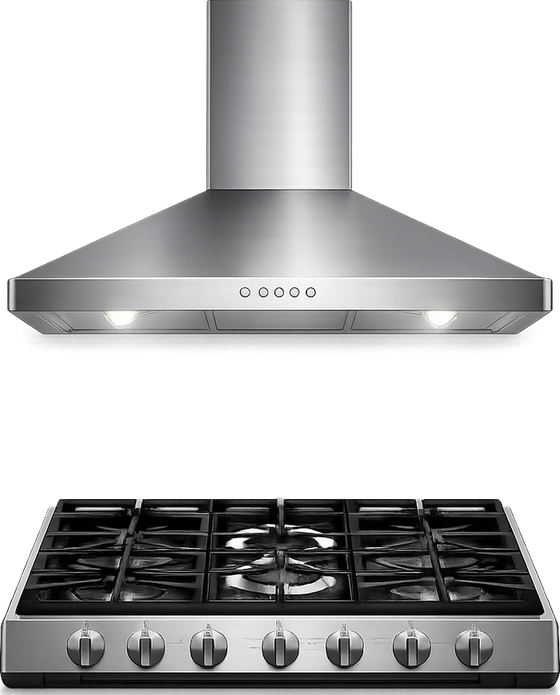
What Usually Goes Wrong
Clicking with no flame
The spark is arriving, so ignition is not the issue. What is missing is fuel or a clean path for it. A burner cap sitting slightly off its seat, ports clogged with boil-over, moisture in the igniter after a clean, or a valve that is not opening. Clean the ports and seat the cap properly and a good share of these calls answer themselves.
A burner that lights and then goes out when you let go
That is the flame safety circuit. The thermocouple or flame sensor has to feel the flame and hold the valve open; when it has aged or sooted over, the output falls below the threshold and the gas shuts off seconds later. It is a cheap part and a quick measurement.
An element stuck on full or completely dead
Radiant elements fail open, and the switches that feed them weld closed. An element stuck on high is the one to take seriously, because it will not respond to the knob at all and should be isolated at the breaker until someone looks at it.
A touch panel doing its own thing
Glass controls read capacitance, so water, grease or a wipe with a wet cloth can set them off. If the panel misbehaves when the surface is dry too, the membrane or the board underneath has taken moisture or heat damage.
An induction zone that errors and quits
Induction tops protect themselves. The cooling fan under the glass, blocked ventilation in the cabinet below, or a zone that has overheated will all cause a shutdown. Pans matter too: a warped base or non-magnetic cookware produces a code that looks like a fault but is not one.
The hood is loud and pulling nothing
Noise comes from the motor, extraction comes from the duct. Loaded filters, a damper flap stuck shut, a crushed flexible duct run, or a roof or wall cap blocked by a nest. The motor can be turning at full speed while almost nothing leaves the building.
Hood lights or switches gone dead
Sockets corrode, halogen transformers fail, and rocker switches wear out. On a newer hood the whole control is one board and the failure takes the lights and the fan together.
Yellow, sooty or lifting flames
The air to gas ratio is wrong. Blocked ports, an orifice sized for the wrong fuel, or a regulator not holding pressure. Soot on a pan bottom is a sign worth acting on rather than living with, especially on a propane conversion.
A knob that spins loose or a burner that will not simmer
Valve stems wear and the low-flame setting drifts out of adjustment. Most burner valves have a simmer screw that can be set properly, which is a much better answer than living with a low setting that will not hold.
Cooktops and Hoods We Work On
Gas, electric radiant and induction cooktops, downdraft units, rangetops, and ducted or recirculating island, chimney, under-cabinet and insert hoods. Brands we see here include Wolf, Thermador, Miele, Bosch, Gaggenau, Zephyr, Vent-A-Hood, Broan, KitchenAid, GE and Samsung.
What It Costs
The residential diagnostic is $99 and is credited toward the repair once you approve the work. You get a written estimate before parts are ordered. On a hood, we will tell you up front when the problem is ducting rather than the appliance, because that changes who you need.
Where We Work
West Lake Hills, Rollingwood, Westlake Highlands, Barton Creek and the streets off Bee Cave Road and Capital of Texas Highway, plus the rest of our Central Texas service area.
Frequently Asked Questions
Our island hood is loud but moves no air. Is the motor finished?
Usually not. A motor making plenty of noise is still turning. Look at filters, the damper and the duct run first; a blocked cap or a collapsed flexible duct does exactly this and costs far less to put right.
Can a cracked glass cooktop be repaired?
The glass itself has to be replaced, and on many models the cost is close to a new cooktop. We will price it honestly. In the meantime a cracked top should not be used, because liquid reaching the elements is a shock hazard.
Why does my induction zone keep cutting out?
Nearly always heat or cookware. Check that the cabinet below is not blocked and that the pan is flat and magnetic. If it still cuts out, the cooling fan or the power board is the next thing to look at.
Do you work on downdraft systems?
Yes. Downdrafts have a motor, a damper and a lift mechanism, and any of the three can fail. The lift is the most common complaint and it is usually serviceable.
How soon can you be out here?
Same-day slots are often open and next-day is typical. Call and we will tell you what we have.
Ducted or Recirculating
It is worth knowing which type of hood you have, because it changes what can reasonably be expected of it. A ducted hood carries air and grease out of the building. A recirculating one passes air through a charcoal filter and returns it to the room, which removes some odour and essentially no heat or moisture. An island hood over a serious gas cooktop that turns out to be recirculating was never going to clear the kitchen.
On a ducted system the performance depends on the whole run: filters, damper, duct diameter, the number of bends, and the cap at the far end. Flexible ducting that has been crushed behind a cabinet, or a cap blocked by a nest, will defeat the best fan on the market.
Keeping a Cooktop Working
For gas, the maintenance is mostly about keeping burner ports and caps clean and properly seated. Boil-over that dries in the ports is behind a large share of ignition complaints, and a cap sitting slightly off its seat produces an uneven flame that looks like a valve problem. Both take minutes to correct and neither needs a technician.
For induction and radiant tops, the thing that matters is ventilation underneath. These have cooling fans below the glass and a cabinet packed with storage, or a drawer pushed hard against the underside, will cause thermal shutdowns that look exactly like a failing board. Leave the clearance the manufacturer asked for and most of those faults never appear.
Book a Cooktop or Hood Repair
Tell us the brand, whether the cooktop is gas, radiant or induction, and what the hood does while the problem is happening. Call (737) 388-3867 or book online. The $99 diagnostic is credited toward the repair.
Cooktop and Vent Hood Repair in West Lake Hills, TX
-

Cooktop and Hood Symptoms We Sort Out
- Burner clicks and never lights
- Flame yellow and sooting the pans
- One element stays on high regardless
- Glass top cracked around a burner
- Knob turns with no change in heat
- Induction zone beeps and shuts off
- Surface staying hot long after shutdown
-
Cooktops and Hoods We Work On
- Gas and propane cooktops
- Electric coil and radiant cooktops
- Induction cooktops
- Downdraft systems
- Wall-mounted and island hoods
- Whirlpool, GE, Samsung, LG, KitchenAid
- Frigidaire, Maytag, Bosch, Electrolux

Cooktop and Hood Brands We Service in West Lake Hills
If your brand is not listed, contact us — we likely service it.
We repair all major residential appliance brands across Central Texas, including Whirlpool, GE, Samsung, LG, Maytag, Frigidaire, KitchenAid, Amana, Bosch, Electrolux, Hotpoint, Kenmore, Haier, Fisher & Paykel, Sub-Zero, Wolf, Viking, Thermador, JennAir, Dacor, U-Line, Marvel, Miele, and GE Monogram.
Why Homeowners & Businesses Choose TakiDA
-
 Quality WorkWe deliver professional appliance repair with attention to detail, proper diagnostics, and long-lasting results you can rely on.
-
 OEM / High-Quality PartsWe use OEM or high-quality replacement parts to ensure correct operation, reliability, and extended appliance lifespan.
-
 Same-Day / Next-Day ServiceFast response with same-day or next-day service to reduce downtime and get your appliances back in working order quickly.
-
 Clear PricingUpfront estimates with transparent pricing. No hidden fees, no surprises — you know the cost before work begins.
-
 EPA Certified & InsuredEPA Section 608 Universal certified and fully insured for residential and commercial repair, giving you peace of mind and protection.
-
 Warranty on Labor & PartsAll repairs are backed by a warranty on labor and installed parts for added confidence and long-term reliability.
