
Cooktop and Vent Hood Repair in Liberty Hill, TX
Cooktop calls out here come with an extra question that city kitchens do not have: what is feeding it. Plenty of Liberty Hill homes cook on propane from a tank rather than natural gas, and plenty of the newer houses have a large hood over the range in a tightly built envelope. Both change the diagnosis before we even open the appliance.
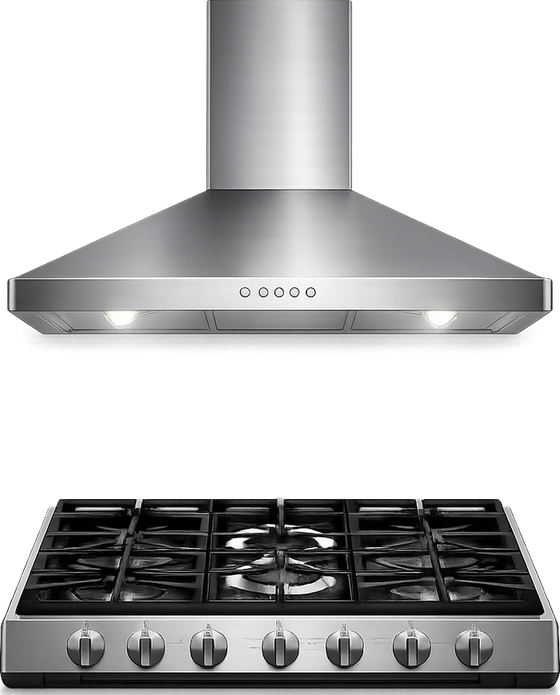
Common Cooktop and Vent Hood Problems in Liberty Hill Homes
A propane burner with a lazy yellow flame
Propane needs smaller orifices than natural gas and a different regulator setting. An appliance that was never properly converted runs with a soft yellow flame, sooty pan bottoms and far less heat than it should have. People live with it for years assuming the cooktop is weak. It is not the cooktop, and checking the orifices and the supply pressure settles it quickly.
A burner that keeps clicking after it lights
The spark module keeps firing because something tells it the burner has not lit. Usually that something is moisture from a boil over, a burner cap sitting crooked, or a switch that got wet during cleaning. If all the burners click together, the module itself moves up the list. The burner keeps working while this happens, which is why it gets ignored until the module fails.
An induction zone that drops out partway through cooking
Induction zones shut down when they stop detecting the pan or when the electronics underneath get too hot. A warped pan base, a pan smaller than the zone expects, or a cooling air intake blocked by a drawer or a liner will all do it. Out here there is a third possibility: a power dip during a storm that left the generator board unhappy, which a proper power down sometimes clears.
A hood running hard and still not clearing the kitchen
In a tightly built new house, a large hood can move more air than the house can replace. With no makeup air path the hood never reaches its rating no matter how healthy the blower is, and in the worst case it pulls on a water heater or furnace flue. That is a pressure problem rather than a broken fan, and it is diagnosed as one.
Hood lights working while the blower stays silent
Lighting and blower are separate circuits, so working lights only tell you the hood has power. A blower that hums without turning points at the motor capacitor or a seized bearing. Complete silence points at the speed control or the switch. Those are different parts at different prices and the test that separates them takes two minutes.
Touch controls on a glass top not responding
The control board sits directly under the glass in a hot, sometimes damp place. The free checks come first: control lock engaged, residue or a wet cloth across the sensors, a tripped leg of the supply. After that it is usually a loose ribbon connector or a board that has taken heat damage, and the board is identified by model rather than by appearance.
A radiant burner stuck on high regardless of the knob
Electric radiant cooktops do not modulate power smoothly. An infinite switch cycles the element on and off and the knob only changes the ratio. When those contacts weld shut, the element never gets the off part of the cycle. Turn the circuit off at the breaker and leave it off until it is repaired, because that one is a genuine hazard.
An outdoor kitchen burner that will not light in winter
A propane grill or outdoor burner that lights fine in September and refuses in January is usually about the tank rather than the appliance. Propane vapor pressure falls with temperature, and a nearly empty tank on a cold morning may not deliver enough to light reliably. Regulators also ice up. We check supply before replacing igniters on outdoor equipment.
Cooktops and Hoods We Repair in Liberty Hill
Natural gas and propane cooktops, electric coil and radiant glass tops, induction cooktops, downdraft and island units, and ducted hoods in under cabinet, wall chimney and island configurations. Common brands include Whirlpool, KitchenAid, GE, Bosch, Samsung, LG, Frigidaire, Thermador, Wolf and Zephyr.
On an LP installation we verify the orifices and the regulator as part of the diagnosis, because an appliance set up for the wrong fuel will never perform no matter which parts we replace.
What Cooktop and Hood Repair Costs in Liberty Hill
The diagnostic is ninety nine dollars for a residential call and it is credited toward the repair once you approve the work. Spark modules, infinite switches, igniters, hood capacitors and orifice conversions are inexpensive. An induction generator board or a glass top for a built in cooktop is not, and you will see the number before anything is replaced.
Duct and makeup air work is quoted on its own, because it is a different kind of job from a part swap and pretending otherwise leads to a hood that is repaired on paper and still does not pull.
Neighborhoods We Cover in Liberty Hill
Santa Rita Ranch, Orchard Ridge, Rancho Sienna, Butler Farms, Bar W Ranch, Stonewall Ranch, Clearwater Ranch, Liberty Parke, downtown Liberty Hill, and acreage properties along 29, 183 and Ronald Reagan Boulevard.
Common Questions About Cooktop and Hood Repair in Liberty Hill
How do I know if my cooktop is set up correctly for propane?
Look at the flame. A correct LP flame is mostly blue with a small lighter tip. Soft yellow flames, soot on pans and weak heat suggest the appliance is still on natural gas orifices. It is a straightforward conversion and it transforms how the cooktop performs.
Our hood is loud but the kitchen still fills with smoke. Why?
Noise is not capture. Loaded filters, a damper that no longer opens, a long duct run, or simply no makeup air path will all leave a noisy hood doing very little. We measure airflow rather than judging by sound.
Can an induction cooktop be damaged by a power flicker?
It can be upset by one, which is more common than actual damage. A full power down at the breaker for several minutes clears a surprising number of these. If the zone still misbehaves afterward, then the board is a genuine suspect.
Do you work on downdraft cooktops in islands?
Yes. Those take longer because the unit has to come up out of the counter to reach the blower, damper and harness, and that is factored into the estimate rather than discovered partway through.
Should the hood be ducted straight up through the roof?
Shorter and straighter is always better, and a roof run is often the shortest path in a single story house. What matters more is that the duct is rigid, properly sized, and that the house has a way to replace the air the hood removes.
Book Cooktop or Hood Repair in Liberty Hill
Tell us the brand, whether it is natural gas, propane, electric or induction, and whether the hood is ducted, and we can usually narrow it down before we arrive. Call (737) 388-3867 or book online. The ninety nine dollar diagnostic is credited toward the repair.
Cooktop and Vent Hood Repair in Liberty Hill, TX
-

Cooktop and Hood Problems We Get Called For
- Propane burner with a lazy yellow flame
- Burner clicking long after it has lit
- Induction zone dropping out mid cook
- Hood running hard and still not clearing the kitchen
- Hood lights on while the blower stays silent
- Touch controls on a glass top not responding
- Burner stuck on high whatever the knob says
-
Cooktops and Hoods We Service
- Natural gas and propane cooktops
- Electric coil and radiant glass cooktops
- Induction cooktops
- Downdraft and island cooktops
- Ducted hoods, under cabinet, chimney and island
- Blower, damper and makeup air diagnostics

Cooktop and Hood Brands We Service in Liberty Hill
If your brand is not listed, contact us — we likely service it.
We repair all major residential appliance brands across Central Texas, including Whirlpool, GE, Samsung, LG, Maytag, Frigidaire, KitchenAid, Amana, Bosch, Electrolux, Hotpoint, Kenmore, Haier, Fisher & Paykel, Sub-Zero, Wolf, Viking, Thermador, JennAir, Dacor, U-Line, Marvel, Miele, and GE Monogram.
Why Homeowners & Businesses Choose TakiDA
-
 Quality WorkWe deliver professional appliance repair with attention to detail, proper diagnostics, and long-lasting results you can rely on.
-
 OEM / High-Quality PartsWe use OEM or high-quality replacement parts to ensure correct operation, reliability, and extended appliance lifespan.
-
 Same-Day / Next-Day ServiceFast response with same-day or next-day service to reduce downtime and get your appliances back in working order quickly.
-
 Clear PricingUpfront estimates with transparent pricing. No hidden fees, no surprises — you know the cost before work begins.
-
 EPA Certified & InsuredEPA Section 608 Universal certified and fully insured for residential and commercial repair, giving you peace of mind and protection.
-
 Warranty on Labor & PartsAll repairs are backed by a warranty on labor and installed parts for added confidence and long-term reliability.
