
Commercial Steam Table Repair in Georgetown, TX
Food that will not hold at safe temperature, a control setting that means nothing, water boiling away by the hour or an element that has burned out — we service steam tables and hot food wells across Georgetown, from the Square and Main Street to the school, church and senior living kitchens on the Sun City side. Insured for commercial premises. Commercial diagnostic $149, credited toward the repair.
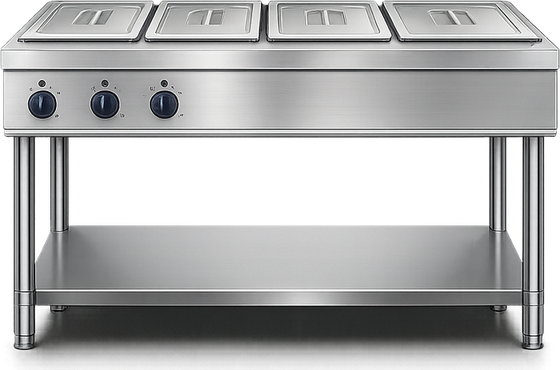
Common Steam Table Problems in Georgetown Kitchens
Food will not hold at safe temperature
Hot holding has a number attached to it, and a steam table that cannot keep product above it is a health inspection problem waiting to happen. The first thing to establish is whether the unit is failing or being asked to do something it was never built for. A steam table holds food that is already hot. It does not reheat, and product that goes into the well below temperature will sit there for hours without ever coming up. Once that is ruled out, we measure well water temperature, element draw and the actual setting on the control, and that tells us where the heat is going missing.
The control setting does not seem to mean anything
Most steam tables are controlled by an infinite switch rather than a thermostat, and this catches people out constantly. An infinite switch does not measure anything. It simply turns the element on and off in a fixed ratio, so setting it to five does not request a temperature, it requests a duty cycle. If the water is boiling away at one setting and barely warm at the next, the switch has lost its calibration or the shaft has worn. On the units that do have a thermostat, the capillary bulb comes loose from its clip and starts reading the cabinet instead of the well. Both are small parts with large effects.
Water boiling away far too quickly
A well that needs topping up every hour is running harder than it should. The usual reasons are a control setting much higher than the job needs, pans that do not seat properly so steam escapes around the edges, or missing adapter bars so there are open gaps in the top. Boiling the wells hard does not hold food any better, it just evaporates water, scales the well and puts the element at risk when the level drops.
An element that has burned out
Most steam table elements sit under the well and are cooled by the water above them. Run a wet well dry and the element has nowhere to send its heat, and it fails, often quickly. Some units are rated for dry operation and many are not, and that distinction is worth knowing for your specific model before anybody runs it empty for a shift. Elements are a serviceable part, but a replacement is worth nothing if the reason the first one died is still in place.
Scale in the wells
Boiling Georgetown water in an open well all day leaves everything that was dissolved in it behind. Scale builds on the well bottom directly over the element, and it insulates: the element gets hotter while the water gets less heat, which costs holding performance and shortens element life at the same time. On units with a low water probe, scale on the probe makes it read wet when the well is empty, which removes the protection that was supposed to stop a dry fire. Descaling is routine maintenance and it is much cheaper than the parts it protects.
One well hot, another barely warm
On tables with individual wells and individual controls, uneven heat usually means one element, one switch or one connection rather than anything systemic. We check element resistance and current draw well by well. On open well tables where one large element serves several pans, uneven results are more often about pan depth, how full the pans are and whether lids are being used, and that is worth knowing before replacing anything.
A drain valve that will not seal
Steam table drain valves collect scale and debris on the seat and then weep continuously into the cabinet below, where the water sits on the wiring and the element terminals. Valves are inexpensive to rebuild or replace, and this is one worth doing promptly because the damage happens somewhere you do not see until something electrical fails.
The unit trips its breaker or its switch gets hot
Steam tables draw heavy current continuously for an entire service, which is hard on switches, terminals and connections. Loose or corroded terminals heat up, and in a wet cabinet corrosion is a given. A switch that is discoloured or a terminal block that smells hot is telling you something before the breaker does. We check connections and current draw against the data plate, because that is where these faults begin.
Equipment We Service in Georgetown
We service electric and gas steam tables and hot food wells, drop in and countertop units, open well and individual well designs, hot holding cabinets and carving stations, from Vollrath, Duke, APW Wyott, Hatco, Wells, Star, Nemco, Avantco and Atosa. That covers elements, infinite switches and thermostats, capillary bulbs and probes, low water protection, drain valves, terminals and wiring, and descaling. We are insured for commercial premises and can provide a certificate of insurance if your landlord or management company needs one.
What Steam Table Repair Costs in Georgetown
The commercial diagnostic is $149 and it comes off the repair when you approve it. You get a written price for parts and labor before anything is replaced. Infinite switches, thermostats, elements, drain valves, terminal blocks and descaling are all modest parts, and they cover the large majority of steam table faults. Full well replacement or a rebuilt wiring harness is the expensive end, and on an older unit we will give you that number next to a replacement rather than letting the cost build up part by part.
Most steam table calls are a switch, an element or scale, and all three are quick fixes that put your hot holding numbers back where they need to be.
Neighborhoods We Cover in Georgetown
Steam tables in Georgetown are concentrated in two places. Downtown around the Square and along Austin Avenue and Main Street, they are in buffet and counter service kitchens where the table is running from open to close, and the recurring faults are switches, scale and connections that have been cooking all day. We cover the Square, Main Street and the surrounding blocks.
The other concentration is institutional: school kitchens, church halls, and senior living and assisted living dining rooms on the Sun City side, where hot holding temperatures are logged and a well that cannot hold has to be sorted out before the next service rather than next week. Those kitchens also tend to have the oldest equipment, which is usually good news, because steam tables are simple and the parts are still made. Along the I-35 corridor and Williams Drive we work on cafeteria and catering operations with the same mix of faults. Georgetown is a short run from Leander.
Common Questions About Steam Table Repair in Georgetown
Why will my steam table not bring food up to temperature?
Because it is not designed to. A steam table holds food that is already hot. Product that goes into the well cool will stay below safe temperature no matter how long it sits, and that is a process issue rather than a fault.
What does the number on the knob actually mean?
On most units, nothing in degrees. It is an infinite switch setting a duty cycle, not a thermostat. If the behaviour between settings has become unpredictable, the switch has usually lost its calibration.
Can I run the wells dry?
Only if your specific model is rated for dry operation, and many are not. Running a wet rated well dry is the most common way steam table elements die.
How often should the wells be descaled?
Regularly, and more often here than the manual probably assumes. Scale over the element costs you holding performance, shortens element life and can disable the low water protection by coating the probe.
How quickly can you get to Georgetown?
Often the same day, and we treat hot holding as urgent because it affects what you can serve. Call (737) 388-3867 with the make and model and what the table is doing.
Book Steam Table Service in Georgetown
Tell us the make and model, whether it is electric or gas, and what it is doing — not holding, one well out, boiling dry, a drain weeping or a breaker tripping. If a temperature log or an inspection flagged it, say so and we will prioritise it. Call (737) 388-3867 or book online and we will confirm a time for Georgetown.
Commercial Steam Table Repair in Georgetown, TX
-

Symptoms We Sort Out
- Food not holding at safe temperature
- Control setting that means nothing
- Water boiling away every hour
- Element burned out
- Scale built up in the wells
- One well hot, another barely warm
- Drain valve weeping into the cabinet
- Breaker tripping or hot switches
-
Equipment We Service
- Electric and gas steam tables
- Drop-in and countertop hot wells
- Open well and individual well designs
- Hot holding cabinets
- Carving stations
- Elements, switches and descaling

Hot Holding Brands We Service in Georgetown
If your brand is not listed, contact us — we likely service it.
Why Homeowners & Businesses Choose TakiDA
-
 Quality WorkWe deliver professional appliance repair with attention to detail, proper diagnostics, and long-lasting results you can rely on.
-
 OEM / High-Quality PartsWe use OEM or high-quality replacement parts to ensure correct operation, reliability, and extended appliance lifespan.
-
 Same-Day / Next-Day ServiceFast response with same-day or next-day service to reduce downtime and get your appliances back in working order quickly.
-
 Clear PricingUpfront estimates with transparent pricing. No hidden fees, no surprises — you know the cost before work begins.
-
 EPA Certified & InsuredEPA Section 608 Universal certified and fully insured for residential and commercial repair, giving you peace of mind and protection.
-
 Warranty on Labor & PartsAll repairs are backed by a warranty on labor and installed parts for added confidence and long-term reliability.
