
Commercial Oven Repair in Cedar Park, TX
Slow preheat, an oven that holds empty and loses it under load, uneven decks, a door that will not seal, or a combi faulting on water. We service commercial ovens for restaurants, bakeries, schools and church kitchens in Cedar Park — convection, deck, conveyor and combi. The $149 commercial diagnostic is credited toward the repair.
Common Commercial Oven Problems in Cedar Park Kitchens
Preheat has got much slower than it used to be
Slow preheat is a capacity complaint, and on a gas deck or convection oven it almost always comes back to combustion rather than controls. Burner ports partly blocked with carbon, a manifold pressure that has drifted, or a flue path restricted with grease all cost heat without stopping the oven working. We take manifold pressure at the tap against the rating plate and look at the flame pattern before anyone discusses a thermostat, because an oven that is short of gas will chase a setpoint forever.
Product on the top rack cooks faster than the bottom
In a convection oven a vertical gradient points at airflow before it points at heat. A fan running the wrong way after a motor change, a damaged fan wheel, or a door that no longer seals and is letting the oven breathe will all do it. In a deck oven the same complaint usually means the deck itself — heat distribution under a stone is slow to recover and uneven loading makes it worse.
The oven holds temperature empty and loses it under load
This is the single most useful symptom a kitchen can report, because it separates the control from the capacity. If an empty oven reaches and holds its setpoint, the thermostat and the sensor are doing their job. Losing it when the racks go in is a recovery problem — gas pressure, burner condition, a blower that is no longer moving what it should, or a door seal letting heat out faster than the oven can replace it.
The door will not close square and heat pours out
Commercial oven doors take hundreds of cycles a day and the hinges, springs and cables wear. A door standing proud at one corner bleeds heat continuously, drives the burner harder, and shows up as uneven baking long before anyone blames the door. Gaskets harden and crack in the same way. Both are stocked parts and both are cheap next to the gas they waste.
A combi oven faulting on water or steam
Combi ovens fail differently from any other oven in the kitchen, and most of their faults are water rather than heat: scale in the steam generator, a blocked drain, a level probe that has furred over, or a water filter that was never changed. Cedar Park water makes all of this arrive sooner. The control usually names the circuit, and we read the stored fault first rather than opening the machine blind.
It trips its high limit after a long bake
High limits open because something is too hot, and on a commercial oven that normally means the cavity vent is restricted or the cooling fan behind the control panel has stopped. Resetting it and carrying on is how an oven ends up with a cooked control board. We find the restriction, confirm the cooling path and then test the limit rather than simply replacing it.
The pilot lights but drops out when the blower starts
That timing is the clue. A pilot that is stable until air moves is a pilot sitting in the wrong place or a flue that is pulling it, not a failing gas valve. On millivolt systems we measure the thermocouple or thermopile output with the blower both off and on, which shows the drop directly. It is a small adjustment or a small part, and it is often misdiagnosed as a control fault.
The thermostat was replaced and the oven still cooks wrong
Then the thermostat was probably not the fault. Commercial ovens are calibrated to a cavity, and where the sensing bulb or probe sits matters as much as what it is. A bulb that has come adrift from its clip, a probe moved during a previous repair, or a cavity with a failing door seal all produce "the thermostat is wrong" twice over. We check the position and the real cavity temperature with an independent probe before fitting anything.
Ovens We Service in Cedar Park
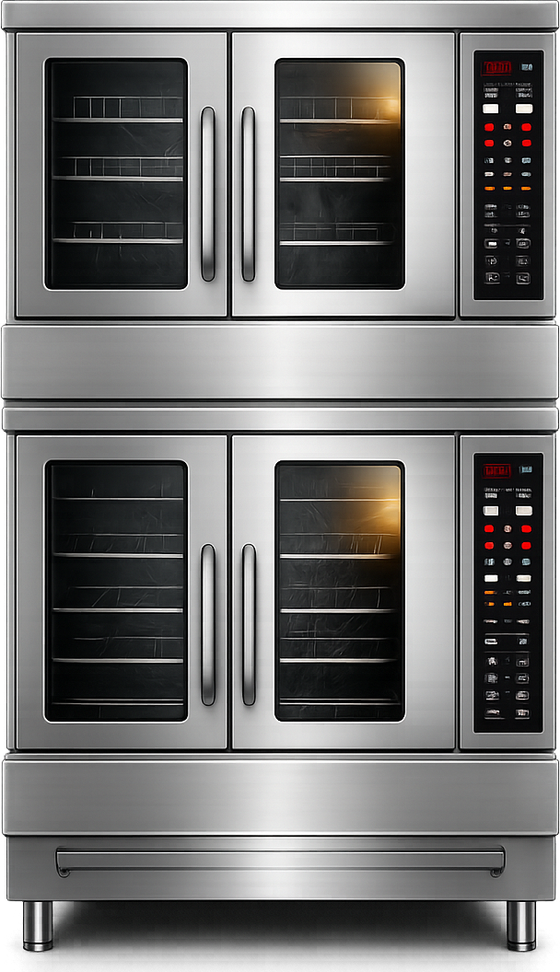
Convection ovens, deck and pizza ovens, combi ovens, conveyor ovens, cook-and-hold cabinets, and the oven bases under heavy-duty ranges. Gas and electric.
Brands we service in Cedar Park: Vulcan, Garland, Blodgett, Southbend, Imperial, Middleby Marshall, Rational, Alto-Shaam, Atosa and Avantco.
What Commercial Oven Repair Costs in Cedar Park
The commercial diagnostic is $149, credited toward the repair when you approve it. After the diagnosis you get a written estimate covering parts and labor, and nothing is replaced before you approve it. Igniters, thermocouples, thermostats, door hardware, gaskets and blower motors are modest. Combi oven boards and steam generators are not, and we will give you the number before you commit.
Gas work finishes with a leak check on anything we opened, and we leave the manifold pressure reading with you in writing.
Neighborhoods We Cover in Cedar Park
Ovens take us right across Cedar Park — pizza and deck ovens along Bell Boulevard, convection ovens in the cafes and bakeries off Whitestone, combi ovens in the newer kitchens near Lakeline, and the big convection stacks in school and church kitchens around Brushy Creek. We come down from Leander and we would rather schedule around your service than interrupt it.
Common Questions About Commercial Oven Repair in Cedar Park
My oven cooks hotter than the dial. Thermostat?
Maybe, and maybe not. We check where the sensing bulb or probe actually sits and measure the cavity with an independent thermometer first. A bulb out of its clip reads the air rather than the cavity and makes a perfectly good thermostat look faulty.
Can you service combi ovens?
Yes, including the water side — descaling, level probes, drains and filtration, which is where most combi faults in Cedar Park start.
How often should a commercial oven be serviced?
Twice a year for a busy kitchen. Gas pressure, burner condition, door seals and calibration drift slowly, and the first sign is usually food rather than an error code.
Do you work on gas and electric?
Both, and dual-fuel ranges with oven bases. Gas work ends with a leak check on anything we opened.
How fast can you get to Cedar Park?
Usually same-day when an oven is down. Call (737) 388-3867 with the make and whether it heats at all — that splits the job before we leave.
Book Commercial Oven Service in Cedar Park
Tell us the make, whether it is gas or electric, and whether the problem is heat, evenness or a fault code. That decides what goes on the van.
Commercial Oven Repair in Cedar Park, TX
-

What Brings Us Out to an Oven
- Product coming out underbaked
- Front of the deck hotter than the back
- Burner cutting out part way through a bake
- Fan silent on a convection cycle
- Heat escaping around the door
- Dial setting and real temperature apart
- Control board throwing a fault
-
Ovens We Cover
- Convection ovens
- Deck and pizza ovens
- Conveyor ovens
- Combi and steam ovens
- Gas and electric models
- Blodgett, Vulcan, Garland, Rational
- Bakers Pride, Southbend, Middleby, TurboChef

Commercial Oven Brands We Service in Cedar Park
If your brand is not listed, contact us — we likely service it.
Why Homeowners & Businesses Choose TakiDA
-
 Quality WorkWe deliver professional appliance repair with attention to detail, proper diagnostics, and long-lasting results you can rely on.
-
 OEM / High-Quality PartsWe use OEM or high-quality replacement parts to ensure correct operation, reliability, and extended appliance lifespan.
-
 Same-Day / Next-Day ServiceFast response with same-day or next-day service to reduce downtime and get your appliances back in working order quickly.
-
 Clear PricingUpfront estimates with transparent pricing. No hidden fees, no surprises — you know the cost before work begins.
-
 EPA Certified & InsuredEPA Section 608 Universal certified and fully insured for residential and commercial repair, giving you peace of mind and protection.
-
 Warranty on Labor & PartsAll repairs are backed by a warranty on labor and installed parts for added confidence and long-term reliability.
