
Commercial Dryer Repair in Leander, TX
A dryer that needs two cycles costs you a machine, not a part. We repair commercial dryers in Leander — tumbling without heat, high limits tripping, sail switch faults, long drying times and bearing noise — gas and electric, vended and on-premise. The $149 commercial diagnostic is credited toward the repair, and you get a firm price before anything is replaced.
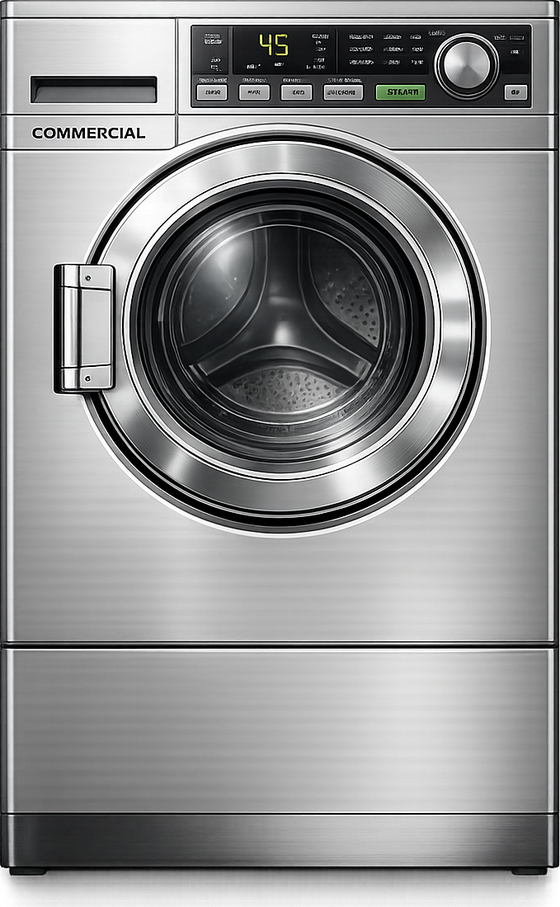
Common Commercial Dryer Problems in Leander
Clothes take two cycles to dry
Nine times out of ten this is airflow, not heat, and there is a number that settles it. Manufacturers specify a maximum static back pressure in the exhaust duct — 0.3 inches water column at the rear outlet is the figure on ADC and Dexter machines, measured with a manometer about two feet from the dryer with it running and empty. Above that the dryer cannot move the air it was designed to move, and the drying time climbs no matter how good the burner is. We measure it rather than guess. Lint in the duct, a stuck exhaust damper, too many elbows and a run longer than the manual allows all show up the same way on the gauge.
The dryer runs but will not heat
On a gas machine the heat circuit is a chain of safeties, and every one of them has to prove itself before the burner lights. Power goes through the door switch, the lint drawer switch, the high limits and finally the airflow switch — the sail switch — which only closes when the blower is actually moving air. If any link is open, you get a dryer that tumbles without heat and no error at all on older controls. We check the chain in order with a meter instead of swapping parts, because a sail switch that will not close is usually telling the truth about the exhaust.
It trips a high limit and shuts the heat off mid-cycle
High limits are disc thermostats, and they do not open for no reason. On ADC machines built after 1998 the burner high limit is a manual-reset disc around 330°F sitting near the burner; others cut out closer to 290°F. Either way, a tripping high limit is the symptom and restricted airflow is almost always the cause. Resetting it and walking away is why the same dryer gets three service calls. The duct, the lint path and the back pressure get checked before we hand the machine back.
Sail switch open or sail switch closed faults
Controls on newer machines report these directly, and they mean opposite things. A sail switch open fault during a heat call means the blower is not generating enough draught — blocked exhaust, slipping belt, failed motor, or a damper that never opened. A sail switch closed fault means it is reading airflow when there should be none, which usually means a stuck switch or a vane bent during a previous cleaning. Both are cheap parts and the fault is rarely the part.
The burner lights, then goes out, then relights
Short-cycling on a gas dryer is either flame sensing or gas pressure. The ignition control gives the valve a fixed window to prove flame, and if the flame signal comes back weak or late it shuts the valve and tries again. We take gas pressure at the valve's own pressure tap on each dryer and compare it with the nameplate, because on a bank of dryers a line that is fine with one running can sag badly with four. That is a building problem, not a dryer problem, and replacing valves will not fix it.
Burning smell, or lint showing up where it should not
Treat this as urgent rather than annoying. Lint is combustible, and a commercial dryer moves a great deal of it; the manuals are blunt that a dryer must be exhausted outdoors for exactly this reason. Lint in the cabinet, around the burner or at the lint chamber means a seal, a filter or a duct joint is letting it escape the airstream. We clean the path, find where it is getting out, and check the high limits that will have been working overtime.
Loud rumbling, squealing, or the drum not turning
Mechanical, and usually cheap if it is caught early. A squeal is normally a roller or an idler bearing. A rumble that changes with the load is the drum support. A motor humming with no drum movement is a seized bearing or a broken belt. The part that costs money is waiting: a failed roller lets the drum sit on the housing and wears a groove that no belt will fix.
The dryer trips its breaker or will not start at all
Start with the obvious: a stack dryer that has tripped is often one of two machines on a circuit that was always marginal. We check the running amperage against the nameplate and whether the motor is pulling hard because of a tight belt or a seizing bearing. A dryer that is dead with power present comes back to the door switch, the lint drawer switch or the control, which is a short list and a quick one.
Machines and Brands We Repair in Leander
We service single-pocket and stack dryers, vended machines in laundromats, on-premise dryers in apartment buildings, gyms, salons and clinics, and tumble dryers in small commercial laundries. Gas and electric, coin, card and OPL controls.
Brands we repair in Leander: Speed Queen, Huebsch, UniMac, American Dryer, Dexter, Maytag Commercial, Whirlpool Commercial, IPSO, Continental Girbau and LG Commercial.
We also clean commercial dryer vents, which on a busy laundry is the single cheapest thing you can do for drying time and for fire risk.
What Commercial Dryer Repair Costs in Leander
The commercial diagnostic is $149, credited toward the repair when you approve it. After the diagnosis you get a written estimate covering parts and labor, and nothing is replaced before you approve it. Most dryer faults are inexpensive parts; what varies is how much of the exhaust system has to be opened up to find the real cause.
If you run a bank of dryers, it is worth doing them together. Back pressure on a shared duct is a system number, not a per-machine one, and measuring one dryer in isolation can be misleading.
Neighborhoods We Cover in Leander
We cover apartment laundry rooms off US-183, Crystal Falls Parkway and Ronald Reagan, gyms and salons along Hero Way, and the laundromats and small commercial laundries around Leander Station. We are based in Leander, so rooftop and roof-duct access on a second trip is not a week away.
Common Questions About Commercial Dryer Repair in Leander
Why does the same dryer keep tripping its high limit?
Because the high limit is doing its job. It opens when the dryer gets too hot, and a commercial dryer gets too hot when it cannot move air. Resetting it without finding the restriction just books you another service call. We measure the back pressure and check the whole exhaust path.
What is a sail switch and why does it stop the heat?
It is an airflow switch that proves the blower is actually moving air before the burner is allowed to light. It exists so a dryer with a blocked vent cannot run its burner into a lint-filled cabinet. If it will not close, the honest answer is usually that the exhaust needs attention, not that the switch needs replacing.
How often should commercial dryer vents be cleaned?
On a busy laundry, far more often than most operators think — drying times creeping up by a few minutes is the early warning. We do this work, and on a bank of machines it usually pays for itself in cycle time within weeks.
Do you work on gas dryers as well as electric?
Yes. Gas work includes the ignition control, flame sensing, the gas valve and manifold pressure taken at the valve's own tap, and it finishes with a leak check on anything we opened.
How fast can you get out to a laundry room in Leander?
Usually same-day or next morning. Call (737) 388-3867 and tell us the make and whether the machine is tumbling without heat or not starting at all — that usually decides what goes on the van.
Book Commercial Dryer Repair in Leander
Tell us the make, whether it is gas or electric, and whether it is tumbling without heat or not starting at all. That is normally enough for us to arrive with the right parts on the van.
Reliable Commercial Dryer Repair in Leander, TX
-

Commercial Dryer Faults We Handle
- Clothes take two cycles to dry
- Runs but will not heat
- High limit tripping mid cycle
- Sail switch fault
- Burner lights then drops out
- Burning smell or lint escaping
- Drum not turning
-
Tumblers We Service
- Single-pocket commercial tumblers
- Stacked commercial dryers
- Vended coin and card dryers
- Apartment laundry room dryers
- Gas and electric machines
- Speed Queen, Huebsch, Unimac, Dexter
- Wascomat, American Dryer, Maytag Commercial

Commercial Dryer Brands We Repair
If your brand is not listed, contact us — we likely service it.
Why Homeowners & Businesses Choose TakiDA
-
 Quality WorkWe deliver professional appliance repair with attention to detail, proper diagnostics, and long-lasting results you can rely on.
-
 OEM / High-Quality PartsWe use OEM or high-quality replacement parts to ensure correct operation, reliability, and extended appliance lifespan.
-
 Same-Day / Next-Day ServiceFast response with same-day or next-day service to reduce downtime and get your appliances back in working order quickly.
-
 Clear PricingUpfront estimates with transparent pricing. No hidden fees, no surprises — you know the cost before work begins.
-
 EPA Certified & InsuredEPA Section 608 Universal certified and fully insured for residential and commercial repair, giving you peace of mind and protection.
-
 Warranty on Labor & PartsAll repairs are backed by a warranty on labor and installed parts for added confidence and long-term reliability.
