
Commercial Dryer Repair in Georgetown, TX
Dry times creeping up, a burner that lights then quits, an ignition lockout or lint building where it should not — we service commercial tumble dryers across Georgetown, from senior living and hotel laundries to salons, gyms and apartment laundry rooms. Duct and makeup air assessment included. Insured for commercial premises. Commercial diagnostic $149, credited toward the repair.
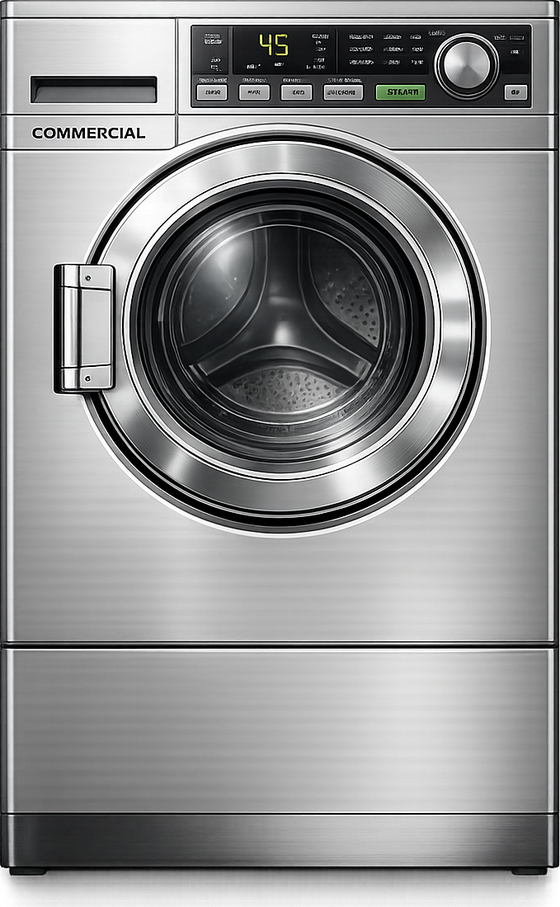
Common Commercial Dryer Problems in Georgetown Laundry Rooms
Dry times have crept up and nobody can say when
Commercial dryers are specified around a static pressure the exhaust system is allowed to put on them, and that figure is small. A duct run that has collected lint over a couple of years, a roof or wall termination with a damper that no longer opens fully, or an extra elbow added when something was moved, will all push the dryer past it. The machine still runs, still heats, and simply takes longer. We measure static pressure at the dryer and compare it against the manufacturer's limit, which turns an argument about the dryer into a number about the duct.
The laundry room has no air to give the dryers
This is the one most people miss. A bank of commercial dryers exhausts a very large volume of air, and that air has to come back into the room from somewhere. If the makeup air provision is undersized, blocked or was never fitted, the room goes negative, the dryers fight for air, and dry times stretch across every machine at once. The clue is that all of them are slow rather than one, and that opening an outside door makes a noticeable difference. That is a ventilation fix, not a dryer repair, and we will tell you so.
No heat, and the ignition locks out
Gas commercial dryers use an ignition module that tries a set number of times and then locks out, which is why a dryer sometimes runs cold until somebody cycles the power. The chain is the module, the igniter, the gas valve coils and the flame sensor, and each failure point behaves differently if you watch the sequence from the burner compartment. Airflow comes into it as well, because the sail switch has to prove airflow before the module will attempt ignition, so a blocked duct shows up as a no heat complaint rather than a slow drying one.
The burner lights, then shuts off on the hi-limit
A dryer that heats for a few minutes and then runs cold for the rest of the cycle is cycling on its high limit. That is a protective device responding to heat building up where air is not moving, so the cause is nearly always restricted airflow: lint in the duct, a plugged lint screen or filter drawer, or a blower wheel that has lost efficiency. Replacing the limit without clearing the restriction gets you a dryer that overheats continuously, and overheated lint is how a laundry fire starts.
Lint building up where it should not be
In a commercial laundry the lint load is far higher than anything domestic, and it accumulates in the lint drawer, the blower housing, the duct and the roof termination. This is a fire risk and an insurance condition before it is a performance problem, and it is the reason commercial duct runs need cleaning on a schedule rather than when somebody notices. We clear what we can reach during service and we will tell you honestly when the run needs a proper clean rather than a tidy up.
The drum will not turn, or turns intermittently
Belts, idler pulleys and drum roller or trunnion bearings are what fail here, and on a stacked unit the drive on one pocket can fail while the other carries on, which makes the fault easy to miss on a quick walk through. A motor that hums and does not start points at the start winding or the capacitor on single phase machines, or a lost leg on three phase. These are measurable in minutes rather than guessed at.
Reversing drums that have stopped reversing
Larger commercial dryers reverse the drum to stop large items roping, and when the reversing function stops, loads come out tangled and dry unevenly while the dryer otherwise seems fine. The usual causes are the reversing contactors, the timer or control that drives them, or on some machines a mechanical linkage. It is worth fixing rather than living with, because a roped load takes far longer to dry and wears the linen.
Controls, coin and card systems
On coin and card operated machines the complaint is often about the payment side rather than the dryer: a jammed mechanism, a card reader that has lost its connection, or a timer board that has stopped crediting. Those are serviceable too. On programmable machines it is worth checking the cycle settings before concluding anything is broken, because somebody changing a program is a surprisingly common cause of the dryer suddenly behaving differently.
Equipment We Service in Georgetown
We service single pocket and stacked commercial tumble dryers in gas and electric, from the 30 pound machines found in apartment and salon laundries to the larger capacities used in hotels and senior living, from Speed Queen, Huebsch, Unimac, Dexter, Continental Girbau, Wascomat, Electrolux Professional, Maytag Commercial and Whirlpool Commercial. That covers ignition modules, igniters, gas valves and flame sensors, high limits and thermostats, sail switches, blowers, belts, idlers, rollers and trunnion bearings, motors, controls and coin and card systems, as well as duct, static pressure and makeup air assessment. We are insured for commercial premises.
What Commercial Dryer Repair Costs in Georgetown
The commercial diagnostic is $149 and it comes off the repair when you approve it. You get a written price for parts and labor before anything is replaced. Igniters, flame sensors, high limits, sail switches, belts, idlers, rollers, thermostats and control components are all modest parts. Gas valves, motors, blower assemblies and bearing work are the expensive end. If several of those are due together on an older machine, we will put the total next to a replacement so you can make the call with real numbers.
A large share of commercial dryer calls are airflow rather than parts, and clearing that gets your dry times and your gas bill back at the same time.
Neighborhoods We Cover in Georgetown
Senior living and assisted living laundries on the Sun City side are a big part of our commercial dryer work. Those rooms run all day, the lint load is heavy, and a dryer down means laundry backing up within a shift. The recurring issues there are duct lint, makeup air and high limits cycling, all of which are fixable and all of which are cheaper to stay ahead of than to chase.
Along the I-35 corridor and Williams Drive we work on hotel laundries, where room turnaround depends on dryer throughput and a slow machine costs more than people realise. Around the Square and Austin Avenue we service salons, barbershops, restaurants and bars running smaller commercial dryers in back rooms that were not designed around a duct run. We also look after apartment laundry rooms and gym and spa laundries around Wolf Ranch and the Rivery. Georgetown is a short run from Leander.
Common Questions About Commercial Dryer Repair in Georgetown
All our dryers got slower at the same time. What causes that?
Usually the room rather than the machines. A bank of dryers needs makeup air, and when that is blocked or undersized the whole room goes negative and every machine slows together.
The dryer heats for a few minutes then goes cold. Why?
It is cycling on the high limit because heat is building where air is not moving. The fix is clearing the airflow restriction, not replacing the limit.
How often should commercial dryer ducts be cleaned?
Far more often than domestic ones, and on a schedule rather than on complaint. Lint in a commercial duct is a fire risk and usually an insurance condition as well.
Our loads come out of the washer soaking. Is that why drying takes so long?
Very likely. If the washer is not reaching full extract speed, the dryers have to remove the difference and your gas bill pays for it. It is worth checking the washers before blaming the dryers.
How quickly can you get to Georgetown?
Often the same day. Call (737) 388-3867 with the make, model and whether it is gas or electric, and we will give you a straight answer on timing.
Book Commercial Dryer Service in Georgetown
Tell us the make and model, whether it is gas or electric, and whether one machine is affected or all of them, because that difference points in two very different directions. Call (737) 388-3867 or book online and we will confirm a time for Georgetown.
Commercial Dryer Repair in Georgetown, TX
-

Symptoms We Sort Out
- Dry times creeping up
- Every machine slow at once
- No heat and an ignition lockout
- Burner cycling on the high limit
- Lint building in the duct
- Drum not turning
- Reversing drum no longer reversing
- Coin, card or control faults
-
Equipment We Service
- Single pocket and stacked dryers
- Gas and electric
- 30 pound to large capacity
- Ignition, burners and gas valves
- Blowers, belts and bearings
- Duct, static pressure and makeup air

Commercial Dryer Brands We Service in Georgetown
If your brand is not listed, contact us — we likely service it.
Why Homeowners & Businesses Choose TakiDA
-
 Quality WorkWe deliver professional appliance repair with attention to detail, proper diagnostics, and long-lasting results you can rely on.
-
 OEM / High-Quality PartsWe use OEM or high-quality replacement parts to ensure correct operation, reliability, and extended appliance lifespan.
-
 Same-Day / Next-Day ServiceFast response with same-day or next-day service to reduce downtime and get your appliances back in working order quickly.
-
 Clear PricingUpfront estimates with transparent pricing. No hidden fees, no surprises — you know the cost before work begins.
-
 EPA Certified & InsuredEPA Section 608 Universal certified and fully insured for residential and commercial repair, giving you peace of mind and protection.
-
 Warranty on Labor & PartsAll repairs are backed by a warranty on labor and installed parts for added confidence and long-term reliability.
