
Commercial Dishwasher Repair in Liberty Hill, TX
A dish machine has to clean and it has to prove it sanitized, and the water around Liberty Hill works against both. Hard water scales boosters and rinse arms, and on a site drawing from a well there is sediment on top of the mineral. Most of the calls we take on these machines start as a results complaint and end at the water.
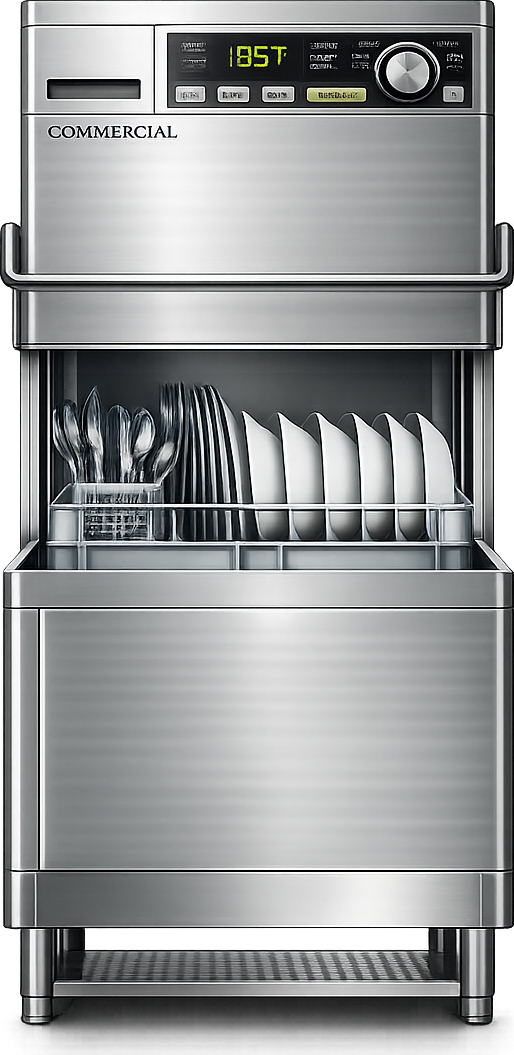
Common Dish Machine Problems in Liberty Hill Kitchens
A final rinse that will not reach sanitizing temperature
On a high temperature machine the rinse has to arrive hot enough to sanitize, and that depends on the booster heater, the incoming water temperature and the rinse flow rate. Scale on the booster element, a rinse line narrowed by mineral, or a building hot water supply that sags during a rush each do it. The gauge on the machine is a starting point, not proof, so we verify the rinse at the rack.
Glassware coming out spotted or filmed
Here this is usually water chemistry rather than a mechanical fault. Mineral left behind as the glass dries shows as spots, and detergent interacting with hard water leaves a film. Rinse aid concentration, final rinse temperature and whether anything is treating the incoming water all get checked before anyone blames the machine.
Scale building through the whole machine
Left alone, the water here puts a mineral layer on heaters, probes, jets and the booster. Efficiency falls, the heaters work harder and eventually fail, and the machine stops hitting rinse temperature. Deliming on a real schedule, and treatment where it is warranted, prevents most of the calls on this list rather than just postponing them.
Wash arms turning weakly or not at all
Blocked jets from food debris and scale, a worn end cap, a pump impeller that has lost efficiency, or a scrap screen left out so the pump keeps ingesting debris. If the arms are not sweeping properly, racks come out visibly dirty no matter how good the water temperature is.
Chemical pumps not drawing detergent or rinse aid
Peristaltic pump tubing hardens and cracks on a schedule, and when it does the machine runs with little or no chemical. Squeeze tubes, pickup tubes and the chemical level get checked together. A dish machine running clean water through a perfect cycle still fails an inspection.
Water left in the tub or spilling to the floor
Drain valves, drain solenoids and blocked drain lines on one side, and on the other an overflow caused by a fill valve that no longer closes. A machine that will not drain also dilutes the next fill, which quietly degrades every rack after it.
A machine cycling but barely cleaning
Short cycle times set by a previous operator, a wash tank heater not maintaining temperature, and scrap screens that are not being emptied account for most of these. It is one of the few problems on this page where the fix is often procedure rather than parts, and we will say so if that is what we find.
A machine in a venue kitchen used once a week
Equipment that sits idle most of the week and then runs flat out for one service is where dried chemical lines, stiff pump tubing and a scaled booster show up at the worst moment. A service before the season, rather than after a failed inspection, is worth considerably more here than a repair call.
Dish Machines We Service in Liberty Hill
Under counter machines and glasswashers, door type and hood machines, conveyor and flight type warewashers, high temperature machines with booster heaters, and chemical sanitizing machines. Common brands include Hobart, Jackson, CMA, Champion, Ecolab, Meiko and Moyer Diebel.
We are insured, and certificates of insurance are available where a venue, building or landlord requires one before work.
What Commercial Dish Machine Repair Costs in Liberty Hill
The commercial diagnostic is one hundred and forty nine dollars and it is credited toward the repair once you approve the work. Fill valves, drain solenoids, thermostats, contactors, chemical pump tubing, wash arms and heating elements are routine. A booster heater or a wash pump is a larger number, and you will see it before anything is ordered.
If an inspection is coming, say so when you call. That changes what we prioritize on the visit.
Neighborhoods We Cover in Liberty Hill
Downtown Liberty Hill and the businesses along 29, Santa Rita Ranch, Orchard Ridge, Rancho Sienna, Butler Farms, Bar W Ranch, Stonewall Ranch, the venues and event barns off 183 and Ronald Reagan, and commercial properties toward Bertram and Leander.
Common Questions About Dish Machine Repair in Liberty Hill
Our rinse gauge reads correctly but the test strips still fail. Why?
The gauge reads what the manifold sees, not what reaches the rack. Low rinse flow, a scaled rinse arm, or a short cycle can leave the rack short while the gauge looks right. Measuring at the rack is the only way to settle it.
How often should the machine be delimed on well water?
Monthly is realistic, and that is before counting sediment. Scale is the root cause behind most heater failures and most temperature complaints we see on these machines, and on a well it accumulates faster than any manual assumes.
Do you work on chemical sanitizing machines as well as high temp?
Yes, both. On chemical machines the dispensing system is as much part of the repair as the pumps and valves, because a machine that is mechanically perfect and not dosing is still not sanitizing.
Can you service a conveyor machine without closing the kitchen?
Usually, if we can schedule outside service. Conveyor and flight machines need the tanks drained and cooled to work on properly, so early morning or late night is normally how those get done.
Should we repair or replace an old dish machine?
Commercial warewashers are built for long service and parts stay available, so repair usually wins. The exception is a machine with a corroded tank or a failed frame, where no amount of component work brings it back. We will tell you plainly which one you have.
Book Dish Machine Service in Liberty Hill
Tell us the make, whether it is high temp or chemical, whether the site is on a well, and what the machine is doing on rinse temperature and on results, and we can usually narrow it down before we arrive. Call (737) 388-3867 or book online. The one hundred and forty nine dollar commercial diagnostic is credited toward the repair.
Commercial Dishwasher Repair in Liberty Hill, TX
-

What Brings Us Out to a Warewasher in Liberty Hill
- Final rinse not reaching sanitizing temperature
- Glassware coming out spotted or filmed
- Scale building through the whole machine
- Wash arms turning weakly or not at all
- Chemical pumps not drawing detergent or rinse aid
- Water left in the tub or spilling to the floor
- Machine cycling but barely cleaning
-
Warewashers We Cover
- Under counter machines and glasswashers
- Door type and hood machines
- Conveyor and flight type warewashers
- High temperature and booster heater systems
- Chemical sanitizing machines
- Scale, drain and chemical dispensing work

Warewashing Brands We Service in Liberty Hill
If your brand is not listed, contact us — we likely service it.
Why Homeowners & Businesses Choose TakiDA
-
 Quality WorkWe deliver professional appliance repair with attention to detail, proper diagnostics, and long-lasting results you can rely on.
-
 OEM / High-Quality PartsWe use OEM or high-quality replacement parts to ensure correct operation, reliability, and extended appliance lifespan.
-
 Same-Day / Next-Day ServiceFast response with same-day or next-day service to reduce downtime and get your appliances back in working order quickly.
-
 Clear PricingUpfront estimates with transparent pricing. No hidden fees, no surprises — you know the cost before work begins.
-
 EPA Certified & InsuredEPA Section 608 Universal certified and fully insured for residential and commercial repair, giving you peace of mind and protection.
-
 Warranty on Labor & PartsAll repairs are backed by a warranty on labor and installed parts for added confidence and long-term reliability.
