
Commercial Cooktop and Vent Hood Repair in Liberty Hill, TX
A cookline and the hood above it are one system, and around Liberty Hill they are often fighting each other for a specific reason: a tight building, a hood sized generously, and gas coming from a propane tank rather than a utility main. All three produce the same complaint, which is equipment that behaves perfectly until the exhaust fan comes on or the whole line fires at once.
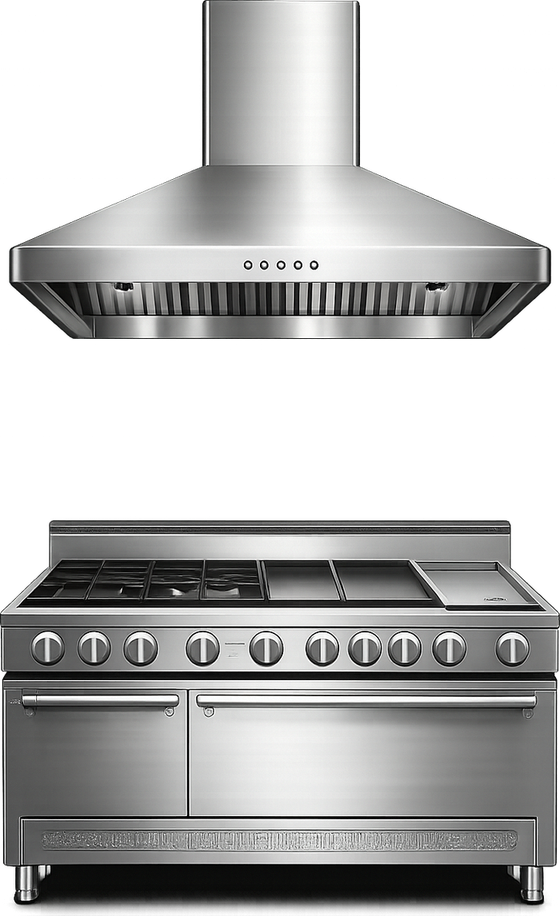
Common Cookline and Hood Problems in Liberty Hill Kitchens
Pilots dropping out whenever the hood runs
This is the classic makeup air problem and it gets misdiagnosed constantly. The exhaust fan removes more air than the room can replace, the kitchen goes negative, and draft across the burner compartment blows out pilots or starves flames. New parts will not fix it. Seeing how the equipment behaves with the fan off and then on takes two minutes and points straight at the real cause.
Burners that will not hold flame under load
When every appliance fires at once, manifold pressure can fall below what the burners need. On top of that, a thermocouple or thermopile that has aged produces less output when hot. Both show up as burners that behave until the kitchen gets busy, and both are measured rather than guessed, because the parts cost very different amounts.
A propane supply that cannot keep up with a full cookline
This one is specific to sites on LP. Tank size, regulator capacity, vaporization rate on a cold morning and the length of the run all limit how much gas the line can actually draw. A cookline that is perfect at ten in the morning and weak at seven in the evening is usually telling you about the tank rather than the appliances. We measure supply pressure under full load first.
A griddle holding different temperatures across the plate
Griddles are meant to be zoned, not uniform, but a zone thirty or forty degrees off its neighbors is a fault. Usually it is a burner port fouled with carbon, a shifted orifice, or a thermostat bulb that has come loose from the underside of the plate. Plate temperature gets checked at several points and compared with what each control is calling for.
A hood pulling poorly with the fan clearly running
A running fan proves only that the motor turns. Loaded grease filters, a slipping belt, a fan wheel caked heavy enough to lose efficiency, or ductwork that has not been cleaned in years all reduce capture without stopping anything. Airflow at the hood gets measured rather than judged by sound.
An exhaust fan that is noisy, vibrating or seized
Rooftop exhaust fans live outdoors in Texas heat and they fail in a predictable order: bearings, then belt, then wheel balance. Vibration that gets worse over weeks almost always means a wheel loaded unevenly with grease or a bearing on the way out. Running it to failure usually takes the motor with it.
Smoke rolling out from under the hood edge
Capture failure comes from too little exhaust, too little makeup air, or equipment positioned too far forward under the hood. In a building with a patio fan or a propped door, pressure elsewhere in the room can be the whole story. We look at the full air path rather than assuming the hood is undersized, because very often it is not.
A trailer cookline that performs differently at every event
Mobile kitchens see this constantly. Propane supply, tank temperature, regulator capacity and hood draft all change from site to site. The same griddle that was perfect at the commissary runs cold at an event with three tanks feeding a full line. Supply pressure under full load is the first measurement on trailer calls, every time.
Equipment We Service in Liberty Hill
Commercial ranges and open burner tops, griddles, charbroilers and salamanders, exhaust hoods and makeup air systems, exhaust fans, belts and dampers, plus natural gas and propane pressure diagnostics on cooklines in restaurants, venues, schools and trailers. Common brands include Vulcan, Garland, Wolf, Imperial, Southbend, Star, Montague and Captive Aire.
We are insured and can supply a certificate of insurance when a building, venue or landlord requires one. Certified hood and duct cleaning is a separate trade and we will tell you when that is what you actually need.
What Commercial Cookline and Hood Repair Costs in Liberty Hill
The commercial diagnostic is one hundred and forty nine dollars and it is credited toward the repair once you approve the work. Thermocouples, pilots, burner valves, griddle thermostats, fan belts, dampers and orifice conversions are routine. Fan motors, bearings and gas valves cost more, and you will see the number before anything is ordered.
Where the honest answer is makeup air, duct work or propane supply rather than a part, we will say so, because replacing components on a kitchen that cannot breathe or cannot draw gas is money spent on the wrong problem.
Neighborhoods We Cover in Liberty Hill
Downtown Liberty Hill and the businesses along 29, Santa Rita Ranch, Orchard Ridge, Rancho Sienna, Butler Farms, Bar W Ranch, Stonewall Ranch, the venues and event barns off 183 and Ronald Reagan, and commercial properties toward Bertram and Leander.
Common Questions About Cookline and Hood Repair in Liberty Hill
Our pilots go out when the hood turns on. Is the hood too big?
More often the makeup air is too small or not working rather than the hood being oversized. The test is simple: see how the equipment behaves with the fan off, then with it on. If the difference is dramatic, it is an air balance problem and no part on the range will fix it.
How do we know if the propane tank is the limiting factor?
By measuring pressure at the manifold with the whole line firing, and by looking at tank size against total input. A tank that frosts over heavily during service is telling you it cannot vaporize fast enough, which is a sizing conversation rather than a repair.
Do you clean hoods?
Certified hood and duct cleaning is a separate trade with its own requirements, so we do not do that work. We do service the mechanical side, fans, belts, bearings, dampers and controls, and we will tell you honestly when what you need is a cleaning rather than a repair.
Why does our griddle cook unevenly?
Some variation across the plate is normal and intended. A zone far off its neighbors is not, and that is usually a fouled burner or a thermostat bulb that has lost contact with the plate. Both are inexpensive to correct.
How often should the exhaust fan be serviced?
Belts and bearings deserve attention twice a year, and more if the fan sits on a hot roof running every service. Catching a bearing early is a small repair. Running it until it seizes usually means a motor and a wheel as well.
Book Cookline or Hood Service in Liberty Hill
Tell us what the equipment is, whether you are on natural gas or propane, and what happens with the exhaust fan off compared with on, and we can usually narrow it down before we arrive. Call (737) 388-3867 or book online. The one hundred and forty nine dollar commercial diagnostic is credited toward the repair.
Commercial Cooktop and Hood Repair in Liberty Hill, TX
-

What Brings Us Out to a Cookline in Liberty Hill
- Pilots dropping out whenever the hood runs
- Burners that will not hold flame under load
- Propane line that cannot keep up with a full cookline
- Griddle holding a different temperature at each zone
- Hood pulling poorly with the fan clearly running
- Exhaust fan noisy, vibrating or seized
- Smoke rolling out from under the hood edge
-
Cookline Equipment We Cover
- Commercial ranges and open burner tops
- Griddles, charbroilers and salamanders
- Exhaust hoods and makeup air systems
- Exhaust fans, belts and dampers
- Natural gas and propane pressure diagnostics
- Trailer and mobile kitchen cooklines

Cookline and Hood Brands We Service in Liberty Hill
If your brand is not listed, contact us — we likely service it.
Why Homeowners & Businesses Choose TakiDA
-
 Quality WorkWe deliver professional appliance repair with attention to detail, proper diagnostics, and long-lasting results you can rely on.
-
 OEM / High-Quality PartsWe use OEM or high-quality replacement parts to ensure correct operation, reliability, and extended appliance lifespan.
-
 Same-Day / Next-Day ServiceFast response with same-day or next-day service to reduce downtime and get your appliances back in working order quickly.
-
 Clear PricingUpfront estimates with transparent pricing. No hidden fees, no surprises — you know the cost before work begins.
-
 EPA Certified & InsuredEPA Section 608 Universal certified and fully insured for residential and commercial repair, giving you peace of mind and protection.
-
 Warranty on Labor & PartsAll repairs are backed by a warranty on labor and installed parts for added confidence and long-term reliability.
