
Washer Repair in Leander, TX
A washer that will not drain or will not spin stops the laundry for the whole house. We repair front-load and top-load washers across Leander — Crystal Falls, Travisso, Bryson and the older streets around Old Town — usually same-day or next-day. The $99 diagnostic goes toward the repair, and you get a firm price before any part is replaced.
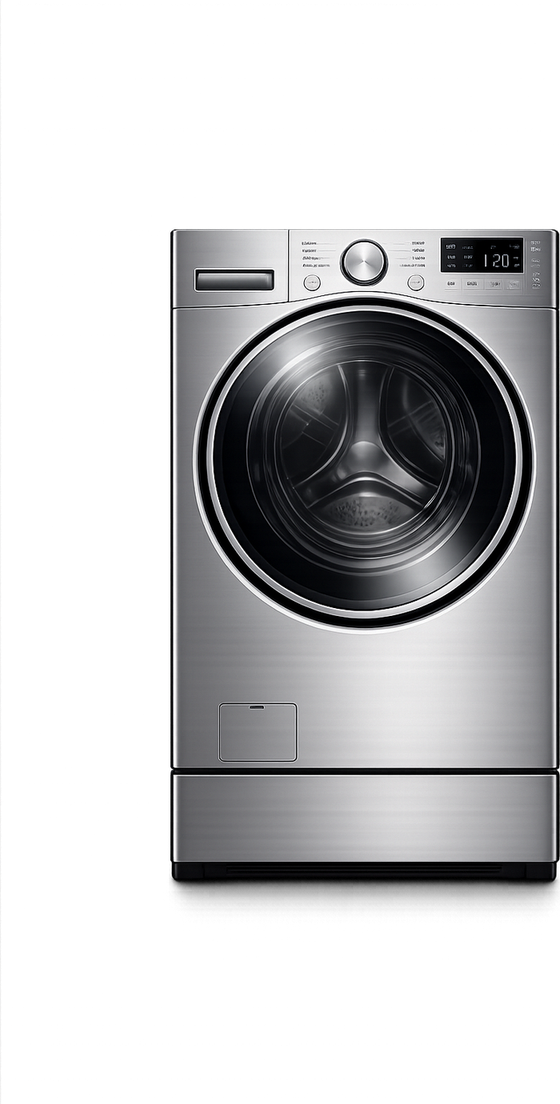
Common Washer Problems in Leander Homes
The diagnosis below follows the manufacturers’ own service documentation for Whirlpool, Maytag, Samsung, LG, GE and Frigidaire — their service diagnostic modes, stored fault codes and component tests — rather than general advice.
The washer will not start, or the door will not lock
Common causes. A front loader admits no water until it has confirmed the door is locked, so a lock fault stops the cycle before it begins. The Whirlpool-platform control tries to lock the door six times and then pauses and stores the fault, which is why the machine appears to sit and do nothing. The usual causes are a garment edge caught in the seal, a cracked door strike, soap residue in the latch, or a failed lock assembly. Samsung and LG report the same condition under their own door codes.
What we do. We check the strike and the latch path first, because a trapped item or a cracked strike is a five-minute finding. If the door closes properly and the fault stays, we test the lock assembly and its harness rather than replacing the control board, which is the expensive misdiagnosis on this symptom.
The washer will not drain
Common causes. Drain faults are the most common washer call and the most commonly misdiagnosed. The order that matters is: the filter or coin trap, the drain hose and standpipe, then the pump itself. The manufacturers say so plainly — a long-drain code is triggered by time, not by a dead pump, so a restricted hose produces exactly the same code as a failed motor. On LG machines a large share of drain codes clear at the pump filter alone.
What we do. We clear and inspect the filter and hose first, then run the manufacturer’s manual test, which switches the drain pump on and off on command so we can hear and measure whether it actually runs. A pump that runs but moves no water is a blockage; a pump that does not run at all is the pump or its circuit.
The washer will not spin, or clothes come out soaking
Common causes. A machine that will not spin either cannot drain, cannot lock, cannot balance, or cannot drive the basket. On Whirlpool-platform top loaders the shifter that moves between agitate and spin is a frequent failure, and the factory manual test steps the shifter through both positions deliberately so the fault shows itself. Excess suds will also stop a spin: the control sees foam as a drain problem and extends or aborts the cycle.
What we do. We confirm the machine drains first, then run the manual test and watch the shifter move into agitate and into spin. We also ask what detergent is being used and how much, because a high-efficiency machine run with ordinary detergent produces suds faults that no part will fix.
The washer will not fill, or fills very slowly
Common causes. Slow fill is almost always supply-side: a shut-off valve not fully open, a screen in the inlet valve blocked with debris, a kinked hose, or genuinely low pressure. The control measures fill by time, so a restricted supply raises a long-fill or low-flow code even though every part is healthy. A failed inlet valve is the remaining cause.
What we do. We check both supply valves and the inlet screens before anything else. Central Texas water leaves scale and sediment, and those little screens catch it, so this is a more common finding here than the code list would suggest.
The washer leaks
Common causes. Where the water appears narrows it fast. Water at the front of a front loader points at the door boot, often torn at the bottom where coins and underwire collect. Water at the back points at hose connections or the inlet valve. Water underneath points at the pump, the tub seal or a cracked outer tub. Overfilling from a failed pressure sensor shows up as a leak at the detergent drawer.
What we do. We run the machine and find where the water actually starts, rather than guessing from a wet floor. A torn boot and a failed tub seal look the same on the floor and cost very different money, so this is worth getting right before anything is ordered.
The washer shakes hard or walks across the floor
Common causes. Violent movement in spin is either load balance, levelling, or worn suspension. On a front loader the shock absorbers and the spring suspension wear out and let the tub swing; on a top loader it is usually the suspension rods. Shipping bolts left in place on a newly delivered machine produce the same symptom and are worth ruling out first.
What we do. We level the machine and check the feet, then test the suspension by hand and look for the wear pattern inside the cabinet. Laundry rooms on a second floor, which is most of the newer Leander builds, show this up sooner than a slab-level garage does.
The washer or the laundry smells
Common causes. Odour in a front loader comes from the boot, the detergent drawer and the drain path, where residue and moisture sit between washes. Too much detergent is the usual root cause, followed by cold-only washing and a door kept closed. A partly blocked drain that never empties fully keeps water standing in the machine.
What we do. We check the boot, the drawer and the drain for residue and standing water, and confirm the machine is draining completely. We will also tell you plainly if the fix is detergent dosing rather than a part, because that is often what it is.
An error code on the display
Common causes. Washer codes name a system and then a fault inside it. On the Whirlpool and Maytag platform the F number is the system and the E number the specific failure, and the control stores the last several faults so a technician can read what happened before you arrived. Samsung and LG use their own letter codes for supply, drain, door and balance. A code names a circuit, not a part: the failure can be the component, the wiring to it, or the board reading it.
What we do. We enter the service diagnostic mode, read the stored faults, and then run the manual test so the suspect part is exercised on command and measured. A drain code confirmed by a pump that will not actuate is a different repair from a drain code with a healthy pump and a blocked hose.
Washer Types and Brands We Repair in Leander
We work on front-load and top-load washers, high-efficiency impeller machines and traditional agitator machines, stacked laundry centres and compact apartment units.
Brands we repair in Leander: Whirlpool, Maytag, GE, Samsung, LG, Frigidaire, KitchenAid, Amana, Bosch, Electrolux, Hotpoint, Kenmore, Haier, Speed Queen, Fisher & Paykel and Miele.
What Washer Repair Costs in Leander
Diagnostics are $99 for a residential call, and that amount is credited toward the repair when you approve it. After the diagnosis you get a written estimate covering parts and labor, and nothing is replaced before you approve it. The final figure depends on which part failed — a drain pump, a door lock, an inlet valve, a shifter, suspension or a control board — and how far the machine has to come apart to reach it.
Completed repairs carry a 3-month labor warranty from TakiDA LLC and a 1-year parts warranty against manufacturer defects.
Neighborhoods We Cover in Leander
We cover Leander as a whole, including Crystal Falls, Travisso, Bryson and Old Town, and we reach most addresses in the city within about twenty minutes. The newer subdivisions mostly have upstairs laundry rooms, where balance and leak problems matter more; the older Old Town houses tend to run garage or utility-room installs. Nearby Cedar Park, Georgetown, Liberty Hill and Round Rock are also in our service area.
Common Questions About Washer Repair in Leander
My washer is eight years old. Is it worth repairing?
Usually yes. The parts that fail at that age — a drain pump, a door lock, a shifter, suspension — are moderate parts on a machine that still has years in it. A failed main bearing or outer tub is the case where replacement often wins, and we will say so plainly rather than selling the repair.
Does Leander water affect washers?
Central Texas water is hard, and the scale it leaves collects in the inlet valve screens and shortens the life of the valve itself. In practice it means slow-fill complaints turn up here more often than the code lists would suggest, and the screens are worth checking before any part is ordered.
Can you work on a second-floor laundry room?
Yes, and most newer Leander homes have one. Second-floor installations show up suspension and balance problems sooner, and they are also the ones where a leak does the most damage, so they are worth looking at early.
How fast can you get to Leander?
Leander is our home city, so same-day is usually possible if you call in the morning, and next-day otherwise.
Book Washer Repair in Leander
Tell us the brand, whether it is front-load or top-load, and what it is doing — no drain, no spin, a leak, a code on the display. That is normally enough for us to arrive with the right parts on the van.
Reliable Washer Repair in Leander, TX
-

Common Washer Problems We Fix
- Washer will not drain
- Door locked at the end of the cycle
- Stops mid cycle or will not spin
- Shaking and walking on spin
- Water on the floor
- Will not fill or fills too slowly
- Error code on the display
-
Washers We Repair
- Front load washers
- Top load agitator washers
- High efficiency impeller washers
- Stacked washer and dryer units
- Whirlpool, GE, Samsung, LG, Maytag
- Frigidaire, KitchenAid, Bosch
- Electrolux, Amana, Kenmore

Washer Brands We Repair
If your brand is not listed, contact us — we likely service it.
We repair all major residential appliance brands across Central Texas, including Whirlpool, GE, Samsung, LG, Maytag, Frigidaire, KitchenAid, Amana, Bosch, Electrolux, Hotpoint, Kenmore, Haier, Fisher & Paykel, Sub-Zero, Wolf, Viking, Thermador, JennAir, Dacor, U-Line, Marvel, Miele, and GE Monogram.
Why Homeowners & Businesses Choose TakiDA
-
 Quality WorkWe deliver professional appliance repair with attention to detail, proper diagnostics, and long-lasting results you can rely on.
-
 OEM / High-Quality PartsWe use OEM or high-quality replacement parts to ensure correct operation, reliability, and extended appliance lifespan.
-
 Same-Day / Next-Day ServiceFast response with same-day or next-day service to reduce downtime and get your appliances back in working order quickly.
-
 Clear PricingUpfront estimates with transparent pricing. No hidden fees, no surprises — you know the cost before work begins.
-
 EPA Certified & InsuredEPA Section 608 Universal certified and fully insured for residential and commercial repair, giving you peace of mind and protection.
-
 Warranty on Labor & PartsAll repairs are backed by a warranty on labor and installed parts for added confidence and long-term reliability.
