
Commercial Fryer Repair in Liberty Hill, TX
Most fryer calls around Liberty Hill come down to one of two things: a burner side that has never been set up correctly for the fuel it is on, or heat transfer that has quietly degraded over a year of frying. Trailers and venues add a third, which is gas supply that changes from site to site.
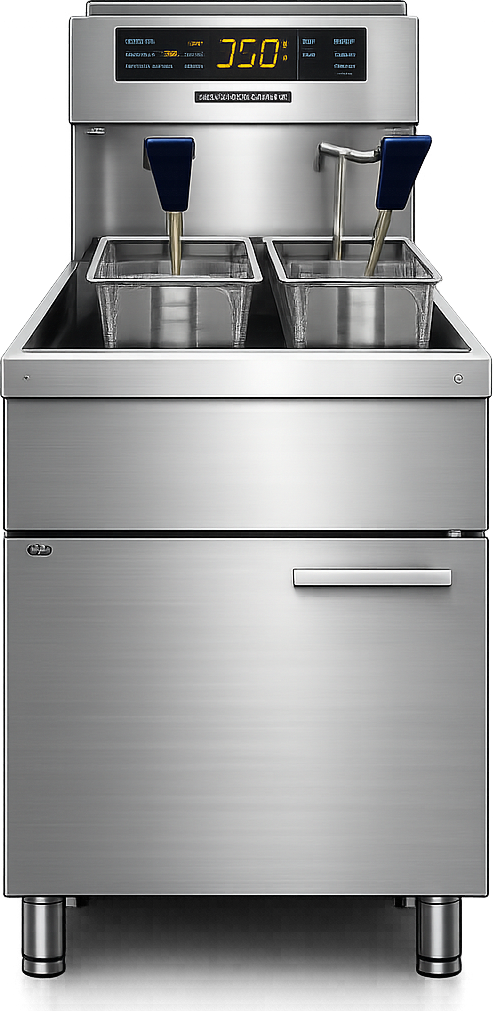
Common Fryer Problems in Liberty Hill Kitchens
Oil that never reaches the set temperature
On a gas fryer this is usually the thermostat, the thermopile or the gas valve rather than the burners themselves. A thermopile that has aged produces less millivoltage, and below the valve holding threshold the valve closes even though the pilot looks perfectly healthy. It is measured, not judged by eye, because a strong looking pilot and a finished thermopile look identical.
Recovery too slow to keep up with a rush
The fryer heats back up between drops too slowly, so the second and third baskets cook in oil well below target. Causes split between heat input and heat transfer: carbon on the heat exchanger tubes, a partly blocked flue, gas supply that sags when every appliance fires, or too many baskets for the vat size. All four get checked, because only one of them is a part.
A propane fryer that works at one site and not another
This is the one that catches mobile operators and venues out. Propane delivery depends on tank size, tank temperature and regulator capacity, and a fryer that performed perfectly at the commissary can run cold at an event with three tanks feeding a full line. We measure supply pressure under full load on these calls before touching a single component.
A pilot or igniter that will not stay lit
A standing pilot that drops out points at the thermocouple or thermopile, a dirty pilot orifice, or draft across the burner compartment. On electronic ignition it is the module, the flame sensor or the ground path. In a trailer with an exhaust fan pulling hard on a small space, draft alone can be the whole answer.
The high limit tripping in the middle of service
The high limit is a safety device and it does not trip for fun. Either the oil genuinely got too hot, which points at the thermostat or valve failing to modulate, or the limit itself has drifted and now opens early. Resetting it repeatedly without finding out which is how kitchens end up with an oil fire rather than an inconvenience.
A built in filtration pump that has stopped
Filtration pumps fail from exactly what they are built to handle. The motor overheats and trips, the pump seizes on debris, the filter pad is loaded, or the drain valve is partly blocked with sediment. When filtration goes down, oil life drops immediately, and that cost adds up faster than the repair does.
A thermostat reading nothing like the actual oil
The probe sits in hot oil all day and it drifts. When the dial says three fifty and the oil is at three twenty five, the food comes out wrong and the staff compensate by cranking it, which puts the fryer closer to its high limit. The oil temperature gets measured independently and compared with what the control believes.
Burners lighting unevenly across the vat
Uneven burner flame means uneven oil temperature, which shows on the plate long before it shows on the thermostat. Usually it is carbon and grease in the burner ports or a shifted orifice, occasionally gas pressure. Manifold pressure gets checked against what the data plate requires rather than set by how the flame looks.
Fryers We Service in Liberty Hill
Natural gas and propane tube fired fryers, open pot fryers, electric fryers, high recovery and high production units, fryers with built in filtration, and fryers in trailers and mobile kitchens. Common brands include Frymaster, Pitco, Henny Penny, Vulcan, Imperial, Dean, Ultrafryer and Globe.
We are insured, and certificates of insurance are available when a venue, landlord or commissary requires one before work on site.
What Commercial Fryer Repair Costs in Liberty Hill
The commercial diagnostic is one hundred and forty nine dollars and it is credited toward the repair once you approve the work. Thermostats, thermopiles, thermocouples, high limits, igniters, filter pumps and drain valves are routine. A gas valve or a full burner assembly costs more, and you will see the number before anything is ordered.
Tell us your service times when you call. On fryers the question is almost always whether it can be running before the next rush.
Neighborhoods We Cover in Liberty Hill
Downtown Liberty Hill and the businesses along 29, Santa Rita Ranch, Orchard Ridge, Rancho Sienna, Butler Farms, Bar W Ranch, Stonewall Ranch, the venues and event barns off 183 and Ronald Reagan, and commercial properties toward Bertram and Leander.
Common Questions About Fryer Repair in Liberty Hill
The pilot is lit but the burners will not fire. What is that?
Most often a thermopile that no longer produces enough output to hold the gas valve open. The pilot can look strong and the thermopile can still be finished. It is a small inexpensive part and a quick measurement confirms it.
Our fryer runs cold at events. Is the fryer the problem?
Usually not. On propane, supply is the first suspect: tank size, how many tanks are feeding the line, regulator capacity, and tank temperature on a cold morning. We measure pressure under load, and more often than not the equipment is fine.
How often should the heat exchanger tubes be cleaned?
At least twice a year in a busy kitchen, more if you fry heavily breaded product. Carbon on the tubes is the most common reason a healthy fryer cannot recover fast enough, and cleaning costs less than any part on the machine.
Is it worth repairing an older fryer?
Usually yes. Fryers are mechanically simple and the parts that fail are inexpensive. The exception is a vat that has started to weep at a seam, which is a replacement conversation rather than a repair, and we will tell you straight if that is what we find.
Do you handle filtration systems as well as the fryer?
Yes. Built in filtration pumps, drain valves and the plumbing between them are part of the same job, and a fryer heating perfectly with dead filtration is still costing you money every day.
Book Fryer Service in Liberty Hill
Tell us the make, whether it is electric, natural gas or propane, and what the fryer does when you call for heat, and we can usually narrow it down before we arrive. Call (737) 388-3867 or book online. The one hundred and forty nine dollar commercial diagnostic is credited toward the repair.
Commercial Fryer Repair in Liberty Hill, TX
-

What Brings Us Out to a Fryer in Liberty Hill
- Oil temperature never reaching the set point
- Recovery too slow to keep up with a rush
- Propane fryer that works at one site and not another
- Pilot or igniter that will not stay lit
- High limit tripping in the middle of service
- Built in filtration pump that has stopped
- Thermostat reading nothing like the oil
-
Fryers We Cover
- Natural gas and propane tube fired fryers
- Open pot fryers
- Electric fryers
- High recovery and high production units
- Fryers with built in filtration
- Trailer and mobile kitchen fryers

Fryer Brands We Service in Liberty Hill
If your brand is not listed, contact us — we likely service it.
Why Homeowners & Businesses Choose TakiDA
-
 Quality WorkWe deliver professional appliance repair with attention to detail, proper diagnostics, and long-lasting results you can rely on.
-
 OEM / High-Quality PartsWe use OEM or high-quality replacement parts to ensure correct operation, reliability, and extended appliance lifespan.
-
 Same-Day / Next-Day ServiceFast response with same-day or next-day service to reduce downtime and get your appliances back in working order quickly.
-
 Clear PricingUpfront estimates with transparent pricing. No hidden fees, no surprises — you know the cost before work begins.
-
 EPA Certified & InsuredEPA Section 608 Universal certified and fully insured for residential and commercial repair, giving you peace of mind and protection.
-
 Warranty on Labor & PartsAll repairs are backed by a warranty on labor and installed parts for added confidence and long-term reliability.
